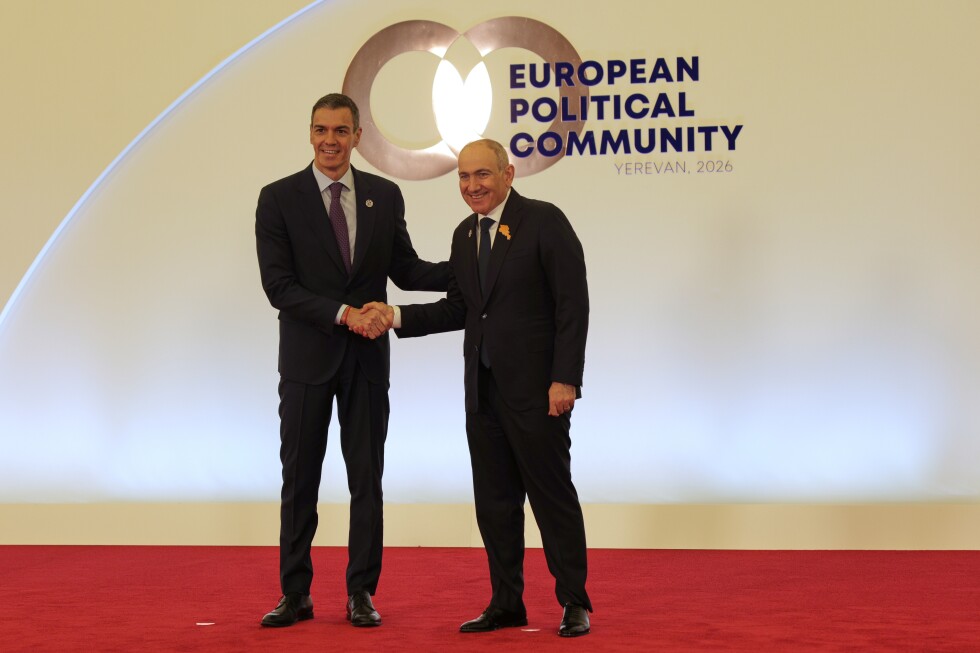
On Tuesday, the Armenian capital of Yerevan played host to an unprecedented event: the first-ever bilateral summit between the South Caucasus nation and the European Union. This milestone comes on the heels of the eighth gathering of the European Political Community (EPC), which brought dozens of senior European leaders to Yerevan just one day earlier, where discussions centered on pressing European security challenges and escalating tensions linked to the Israel-Iran conflict.
The back-to-back high-profile meetings put a public spotlight on Armenia’s deliberate diplomatic reorientation toward the West, a shift that has accelerated after bitter tensions with its long-standing strategic partner Russia. Relations between Moscow and Yerevan collapsed into open friction in 2023, when neighboring Azerbaijan reclaimed full control over the disputed Karabakh region, ending 30 years of separatist rule by ethnic Armenian forces.
In the wake of Azerbaijan’s military operation, Armenian leaders publicly accused Russian peacekeepers—stationed in Karabakh for decades to enforce a ceasefire—of failing to intervene to stop the advance. With Moscow already bogged down in its full-scale invasion of Ukraine, Russian officials rejected the accusations, arguing their peacekeeping contingent never received a mandate to engage in active combat. For regional analysts, the Karabakh conflict laid bare Russia’s waning reliability as a security guarantor for Armenia.
“This conflict was a belated demonstration that Russia is dangerously unreliable as a partner,” explained Richard Giragosian, director of the Yerevan-based Regional Studies Center, in an interview with the Associated Press.
Since the 2023 Karabakh offensive, Prime Minister Nikol Pashinyan’s government has moved aggressively to deepen institutional and economic ties with the EU, a strategic shift that Brussels has enthusiastically embraced. Speaking at Monday’s EPC gathering, European Council President Antonio Costa praised Pashinyan for “the courageous political decisions he has taken to bring Armenia closer to the European Union,” adding that “the direction of travel is unmistakable.” Costa stressed that strengthening Armenian democracy and countering external interference and disinformation remained a top priority for the bloc.
European Commission President Ursula von der Leyen also highlighted Armenia’s growing strategic importance to European trade and connectivity, noting that Yerevan plays a key role in European supply chains “specifically on the connectivity to the South Caucasus and Central Asia.”
Over the past 18 months, Armenia has taken a series of concrete steps to align with Western institutions, moving far beyond rhetorical commitments. In 2023, Yerevan joined the International Criminal Court (ICC), a decision that drew sharp condemnation from Moscow, which labeled the move an “unfriendly step.” The ICC has an active arrest warrant outstanding for Russian President Vladimir Putin, accusing him of personal responsibility for the mass abduction of Ukrainian children during the ongoing war. In 2024, Armenia froze its participation in the Russia-led Collective Security Treaty Organization (CSTO), a Moscow-led military bloc designed for collective defense in the post-Soviet space. Earlier this year, the Armenian parliament passed a formal resolution enshrining the country’s official ambition to acquire full EU membership.
Unlike the post-Soviet space, where the United States has often led Western engagement, Giragosian noted that it is the EU, not Washington, that has moved to fill the geopolitical vacuum left by Russia’s declining influence in Yerevan. “EU engagement is much more prudent and much more productive than the U.S. becoming involved, simply because European engagement is less provocative to Russia over the longer term,” he explained.
Even as it pursues closer ties with Brussels, Armenia has been careful to avoid a complete break with Moscow, for the moment retaining its membership in the Russia-led Eurasian Economic Union (EEU), a single market bloc that also includes Belarus, Kazakhstan and Kyrgyzstan. Putin has publicly warned Yerevan that it cannot maintain membership in both blocs long-term, pointing out that Armenia currently receives heavily subsidized Russian natural gas priced far below European market rates. Pashinyan has acknowledged the eventual incompatibility of dual membership but has argued that Yerevan can continue to combine EEU membership with deepening cooperation with the EU for the foreseeable future.
While Tuesday’s summit is not expected to immediately grant Armenia official EU candidate status, Giragosian framed the gathering as a deliberate step to deepen the already established EU-Armenia partnership, which has been governed by the Comprehensive and Enhanced Partnership Agreement that came fully into force in 2021. He added that the event’s greatest significance is symbolic: it sends a clear message to Moscow of Yerevan’s new geopolitical direction.
Despite the symbolic weight of the summit, concrete deliverables are still expected, including new EU financing for domestic Armenian reforms and additional military assistance through the European Peace Facility, the bloc’s primary fund for supporting Ukraine’s defense. The EU has already operated a long-standing monitoring mission along Armenia’s border with Azerbaijan, and a new mission targeting hybrid threats was recently approved by Brussels.
For Pashinyan, who has held office since 2018 and faces critical parliamentary elections in June, the high-profile international gathering also delivers clear domestic political benefits, boosting his profile as a reliable leader for pro-Western voters. Giragosian noted that Pashinyan’s government is widely expected to retain power, as the fragmented Armenian opposition has failed to put forward a credible alternative policy platform.
Giragosian also pushed back against common framing of Armenia’s foreign policy as a simple “pivot” from Russia to the West, arguing that Yerevan is pursuing a far more nuanced strategy. “Armenia is also pivoting beyond the black and white zero-sum game paradigm,” he said, pointing to Yerevan’s expanding diplomatic and economic ties to major Asian powers including Japan, South Korea and China. “This is not about replacing Russia with the West. This is much more innovative, much more sophisticated.”
The summit takes place against a backdrop of heightened tensions between Brussels and Baku, as Azerbaijan has pushed back against recent European criticism of its treatment of ethnic Armenians. Last week, Azerbaijan’s foreign ministry summoned the EU ambassador to Baku to protest a recent European Parliament resolution that demanded the release of all Armenian prisoners of war and criticized human rights conditions for remaining ethnic Armenians in Karabakh. In response, Azerbaijani lawmakers voted to suspend all formal cooperation with the European Parliament.
Addressing the EPC via video link, Azerbaijani President Ilham Aliyev accused European parliamentary bodies of “double standards” after the Parliamentary Assembly of the Council of Europe (PACE) imposed sanctions on Azerbaijan’s official delegation to the body.
In Yerevan, small-scale protests unfolded outside the EPC summit venue, which was surrounded by heavy security. Demonstrators carried photographs of Armenian prisoners still being held in Azerbaijan, criticizing European leaders for prioritizing diplomatic relations over pressing for the detainees’ release. Aram Sargsyan, leader of Armenia’s Democratic Party and a prominent opposition figure, told local media that European officials were using the summit to signal support for Pashinyan ahead of the June election while “forgetting about the Armenians in prison in Azerbaijan.”