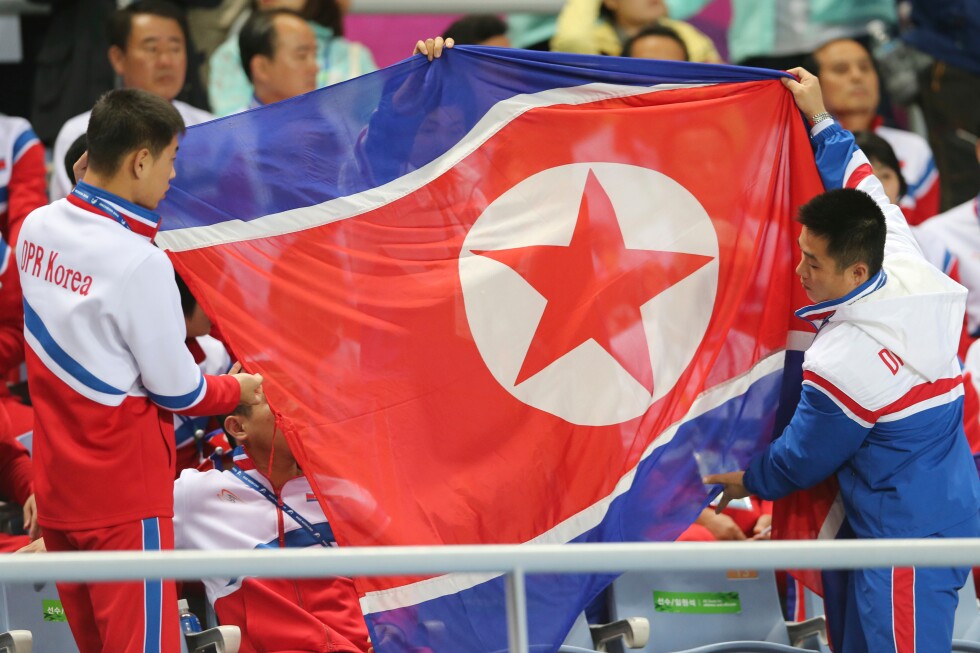
Six years after the last official visit by North Korean athletes to South Korean soil, a historic moment of cross-border sports exchange is set to take place later this month, offering a rare flash of engagement between two nations technically divided by a decades-long armed conflict.
North Korea’s Pyongyang-based Naegohyang Women’s Football Club has qualified for the semifinal round of the Asian Football Confederation (AFC) Women’s Champions League, which will be hosted in the South Korean city of Suwon, located roughly 30 kilometers south of Seoul. The match is scheduled for May 20, where Naegohyang will face a rematch against South Korea’s Suwon FC Women, who they defeated 3-0 during the group stage of the continental tournament in Myanmar last November.
South Korea’s Unification Ministry, the government body responsible for managing inter-Korean relations, confirmed the upcoming visit in an official statement released to reporters on Monday. South Korea’s national governing body for the sport, the Korea Football Association (KFA), added that the AFC has formally communicated that North Korean officials have submitted the required roster of players and support staff traveling to Suwon for the competition. According to the KFA, AFC rules mandate that North Korea will face significant financial penalties from the confederation if the team fails to appear for the scheduled semifinal. The other semifinal fixture will match Australia’s Melbourne City FC against Japan’s Tokyo Verdy Beleza, with the final scheduled to take place just three days after the semifinal round, also in Suwon. Naegohyang earned its spot in the final four after defeating a Vietnamese club in the quarterfinal round held in March this year.
As of Monday, North Korean state media has not yet made any public announcement of the club’s upcoming trip to South Korea.
This upcoming match marks the first time that any North Korean athletic delegation has traveled to South Korea since December 2018, when a North Korean table tennis team crossed the border for a friendly competition. That visit came months after North Korean athletes marched alongside a high-level diplomatic delegation during the opening ceremony of the 2018 Pyeongchang Winter Olympics hosted in South Korea, a high point of diplomatic detente between the two neighbors. The last time North Korean female soccer players competed on South Korean territory was during the 2014 Incheon Asian Games, when the North Korean national women’s team participated in the continental multi-sport event.
Beyond club competition, North Korean women’s soccer has established itself as a global powerhouse in youth international competition in recent years. The country currently holds both the FIFA Under-17 Women’s World Cup and FIFA Under-20 Women’s World Cup titles, defending its status as the top-ranked program in both age groups.
Despite this moment of cross-border sports engagement, broader inter-Korean relations have remained frozen for years, following the collapse of landmark nuclear diplomacy between North Korean leader Kim Jong Un and then-U.S. President Donald Trump in 2019. Talks between Pyongyang, Seoul and Washington broke down after the two sides failed to reach agreement on the easing of sweeping U.S.-led sanctions imposed on North Korea over its illegal nuclear and ballistic missile programs. In recent months, tensions have escalated sharply, as Kim has accelerated development of North Korea’s nuclear and missile arsenals, with multiple tests targeting both U.S. military allies in Asia and the U.S. mainland. Kim has formally labeled South Korea as Pyongyang’s “most hostile adversary,” and has waged an aggressive campaign to block the spread of South Korean popular culture and language within North Korean borders, cracking down on unapproved outside cultural influence.
While inter-Korean sports exchanges were once a key confidence-building measure during periods of warmer relations — with the two sides fielding combined teams and marching together under a single unified flag at multiple Olympic Games — all official cross-border athletic activities have ground to a halt in recent years amid the ongoing diplomatic freeze.