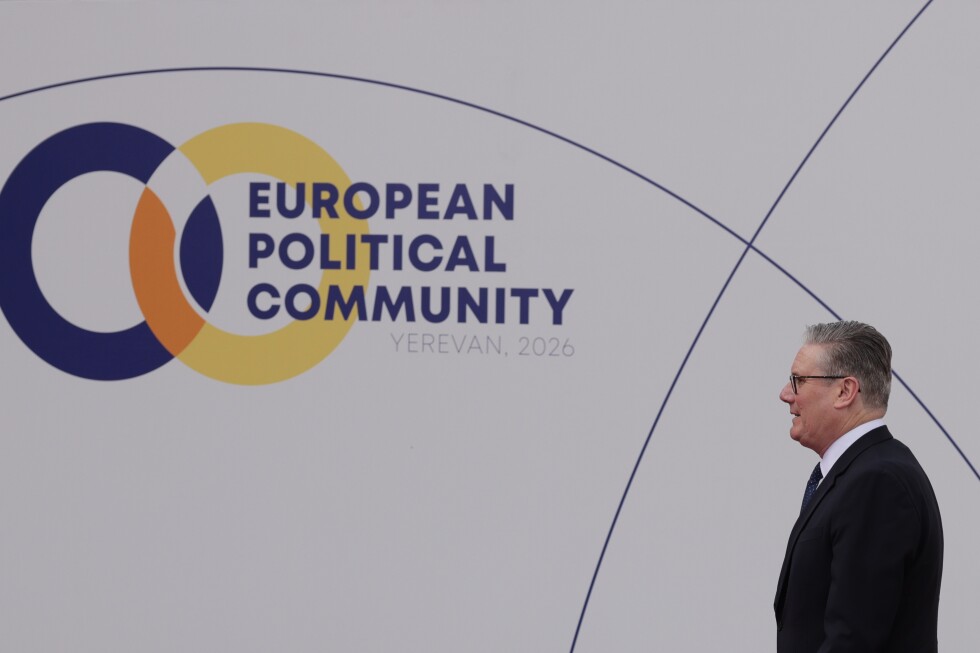
YEREVAN, ARMENIA – During a gathering of European leadership in the Armenian capital this week, top European officials have reacted with surprise to U.S. President Donald Trump’s unexpected announcement that he plans to withdraw far more American troops from Germany than initially disclosed, with many framing the move as a long-delayed wake-up call for Europe to take full ownership of its own regional security.
The Pentagon first made public last week that it would withdraw approximately 5,000 U.S. service members from German military bases. But during a press briefing Saturday, Trump upended that plan by confirming the final drawdown would be far deeper than the 5,000-troop figure, offering no public explanation for the sudden scaling back of the U.S. military presence on European soil. The unanticipated decision caught NATO alliance leadership completely off guard, and comes amid a rapidly escalating public dispute between Trump and German Chancellor Friedrich Merz over the ongoing U.S.-led Israeli war on Iran. A core source of Trump’s frustration has been the widespread reluctance among European NATO allies to commit military support or operational access to the Middle East conflict.
Speaking to reporters on the sidelines of the European summit Monday, Norwegian Prime Minister Jonas Gahr Støre downplayed the immediate stakes of the drawdown, while acknowledging the shifting security dynamic across the transatlantic alliance. “I wouldn’t exaggerate that because I think we are expecting that Europe is taking more charge of its own security,” Støre said. “I do not see those figures as dramatic, but I think they should be handled in a harmonious way inside the framework of NATO.”
European Union foreign policy chief Kaja Kallas noted that discussions about a potential U.S. troop drawdown from Europe have circulated for years, but admitted the sudden timing of Trump’s announcement took the bloc by surprise. “There has been a talk about withdrawal of U.S. troops for a long time from Europe. But of course, the timing of this announcement comes as a surprise,” Kallas said. When asked if the move is intended as a direct rebuke of Merz, who recently stated the U.S. had been humiliated by Iran during ceasefire negotiations, Kallas declined to speculate. “I don’t see into the head of President Trump, so he has to explain it himself,” she added.
NATO leadership has moved quickly to clarify the alliance’s position, with a spokesperson noting over the weekend that officials from the 32-nation bloc are currently working with U.S. counterparts to work out the full details of the revised force posture in Germany. NATO Secretary-General Mark Rutte, who has long positioned himself as a key liaison between Trump and European allies, also sought to soften the impact of the announcement, acknowledging that the White House has been clear about its disappointment over limited European backing for the Iran war.
Multiple major European powers have already rejected U.S. requests for unrestricted access to their national military bases and airspace for operations targeting Iran. Spain has gone the furthest, formally barring U.S. forces from using its Spanish-based infrastructure and airspace for any activities related to the Iran conflict. Even the United Kingdom and France, traditional U.S. security partners, have declined to grant the unrestricted access the White House has requested. Europe has also refused to commit forces to patrol the critical Strait of Hormuz, a chokepoint for nearly 20% of the world’s daily oil trade, until a ceasefire is reached in the war.
Notably, European allies and Canada have been aware since Trump’s return to the White House last year that he intended to draw down U.S. troop levels in Europe; a small contingent of U.S. forces already withdrew from Romania last October. U.S. officials had previously pledged to coordinate all troop movement adjustments with NATO allies to avoid creating a destabilizing security gap across the continent. Rutte, who has openly praised Trump’s leadership within NATO despite the U.S. president’s repeated criticism of most alliance members, said the message from Washington has been received. “I would say the Europeans have heard a message. They are now making sure that all the bilateral basing agreements are being implemented,” Rutte said.
Rutte added that European nations have already moved to pre-position key military assets closer to potential conflict zones in preparation for the next phase of transatlantic security alignment, though he offered no specific details on what assets would be moved or where they would be stationed. Additional reporting for this story was filed from Brussels by AP correspondent Dustin Cook.