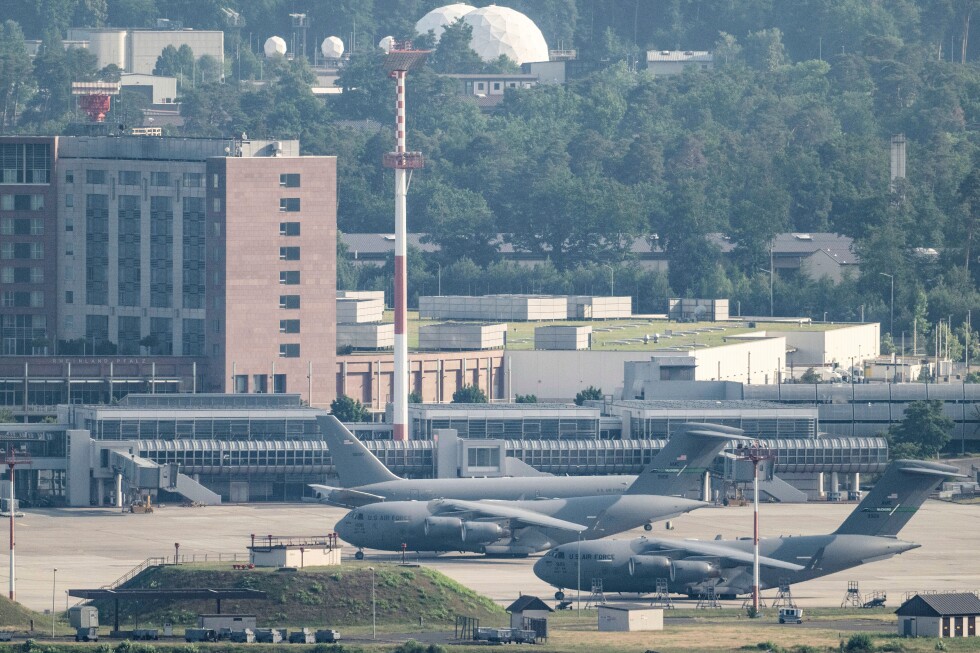
For nearly 80 years, a persistent U.S. military presence across Europe has stood as a cornerstone of transatlantic security, a legacy forged in the aftermath of World War II and hardened during the Cold War’s standoff against Soviet expansion. Today, that long-standing posture faces unprecedented upheaval, after former President Donald Trump’s pledge to slash American troop deployments in Germany has thrust Washington’s commitment to European security into the global spotlight.
Currently, the U.S. maintains between 80,000 and 100,000 active-duty troops across the European continent, with more than 36,000 stationed in Germany alone. On a Friday announcement, the Pentagon confirmed it would withdraw 5,000 troops from the country, but Trump upped the ante a day later, telling reporters he intends to go “a lot further” than that initial drawdown.
Beyond its historical role as a deterrent to adversarial powers, the U.S. military footprint in Europe serves critical global strategic functions. Troops based in the region support operational deployments spanning the Arctic, Africa, and the Middle East, including ongoing tensions with Iran. Germany, in particular, hosts strategically vital infrastructure: it is home to the headquarters of both U.S. European Command (EUCOM) and U.S. Africa Command, Ramstein Air Base — a key logistical hub for the continent — and the Landstuhl Regional Medical Center, which treated thousands of casualties from the Afghanistan and Iraq wars. Germany also hosts a portion of the roughly 100 American nuclear bombs deployed across European NATO bases, according to a March estimate from the Federation of American Scientists.
Per December Pentagon data, other major U.S. troop deployments in Europe include more than 12,000 troops in Italy and 10,000 in the United Kingdom. EUCOM, established in 1947, is one of the Defense Department’s 11 unified combatant commands, with oversight of security operations across roughly 50 countries and territories. Following Russia’s 2022 full-scale invasion of Ukraine, the U.S. increased its overall troop presence in Europe to reinforce deterrence along NATO’s eastern flank, and NATO allies including Germany have anticipated for more than a year that these additional troops would be the first withdrawn under any drawdown plan. To date, the Pentagon has released few details about which units or missions will be affected by the newly announced cuts.
The drawdown plan marks a sharp break from decades of bipartisan U.S. consensus on transatlantic security. Trump has long criticized European NATO allies for failing to carry enough of the defense burden, and the announcement comes amid escalating tensions with German Chancellor Friedrich Merz, who claimed last week that the U.S. had been “humiliated” by Iran and accused the White House of lacking a clear strategy for the Middle East.
Top Republican leaders of both congressional armed services committees have already pushed back against the plan, warning that a premature withdrawal would send the wrong signal to Russian President Vladimir Putin amid his ongoing war in Ukraine. Sen. Roger Wicker of Mississippi and Rep. Mike Rogers of Alabama argued instead that troops should be repositioned to bases in Eastern Europe, rather than removed entirely from the continent. The pair also noted that NATO allies have made major infrastructure investments to host U.S. forces, and confirmed that following Friday’s announcement, the Pentagon had canceled the planned deployment of a U.S. Army long-range missile fires battalion to Germany.
The Trump administration’s January National Defense Strategy lays out the administration’s broader vision for transatlantic security, asserting that European nations must take greater ownership of their own defense. “While we are and will remain engaged in Europe, we must — and will — prioritize defending the U.S. Homeland and deterring China,” the document states. It adds that Europe’s collective economic power remains globally significant, noting that Germany’s economy alone “dwarfs that of Russia,” and that “our NATO allies are substantially more powerful than Russia — it is not even close.” The strategy highlights Trump’s leadership in pushing NATO allies to commit to raising total defense spending to 5% of GDP, a target embraced by the alliance in recent years.
For its part, Germany has taken significant steps in recent years to modernize its long-underfunded military, the Bundeswehr, in the wake of Russia’s 2022 Ukraine invasion. That year, Berlin established a €100 billion ($117 billion) special fund to upgrade the military, most of which has already been allocated to new weapons and equipment procurement. Late last year, Merz’s government unveiled plans to expand active-duty military personnel from roughly 180,000 to 260,000, a level not seen since Germany ended conscription in 2001, when the force numbered 300,000 including conscripts. Berlin also plans to grow its reserve force to roughly 200,000, more than double its current size.
Following the Pentagon’s announcement, German Defense Minister Boris Pistorius told German news agency dpa that he acknowledged Europe must take greater responsibility for its own security, adding that the Bundeswehr is already growing, accelerating equipment procurement, and upgrading military infrastructure to meet new security demands.
As discussions over the drawdown move forward, the decision will have far-reaching implications for transatlantic alliance cohesion, deterrence against Russian aggression, and U.S. global power projection capabilities for years to come.