NAIROBI, Kenya — On a mild Wednesday last month in Kisumu, a lakeside western Kenyan city, Senator Godfrey Osotsi stepped out of a barbershop and stopped for a routine coffee break. What came next was anything but ordinary: a mob of hooded young men launched an unprovoked, brutal assault, beating the senator with punches and kicks, stealing his phones and personal valuables before melting into the busy surrounding streets.
Surveillance camera footage of the attack spread across Kenyan social media and traditional news outlets within hours, sparking national outrage that forced parliament to summon the country’s top security leaders for urgent questioning. For Osotsi, the attack was no random robbery — he alleges it was politically motivated, saying his attackers explicitly questioned why he refused to back President William Ruto’s 2027 re-election campaign. For millions of Kenyans, the high-profile assault was not an isolated shocking incident, but confirmation of a growing, deeply feared trend: the country is once again sliding toward the cycles of deadly political violence that have scarred its modern democratic history.
Kenya’s pattern of political parties patronizing criminal youth gangs stretches back to the early 1990s, when multiparty democracy was reintroduced after decades of one-party rule. Politicians across the ideological spectrum have long hired unemployed young people as tools of electoral intimidation, a practice that escalated into the catastrophic nationwide post-election violence of 2007, when clashes linked to these groups killed an estimated 1,500 people and displaced hundreds of thousands.
Fifteen months out from the next mandatory general election, scheduled for August 2027 at the latest, political tensions are already rising faster than many observers expected. The assassination of veteran opposition leader Raila Odinga in October 2024 triggered a major political realignment, splitting Odinga’s long-dominant Orange Democratic Movement (ODM) into two feuding camps split over whether to back Ruto’s re-election. Most notably, former Deputy President Rigathi Gachagua, who was impeached and removed from office in 2024, is running for president against Ruto bearing a deep public grudge, opening a damaging rift within the ruling Kenya Kwanza coalition.
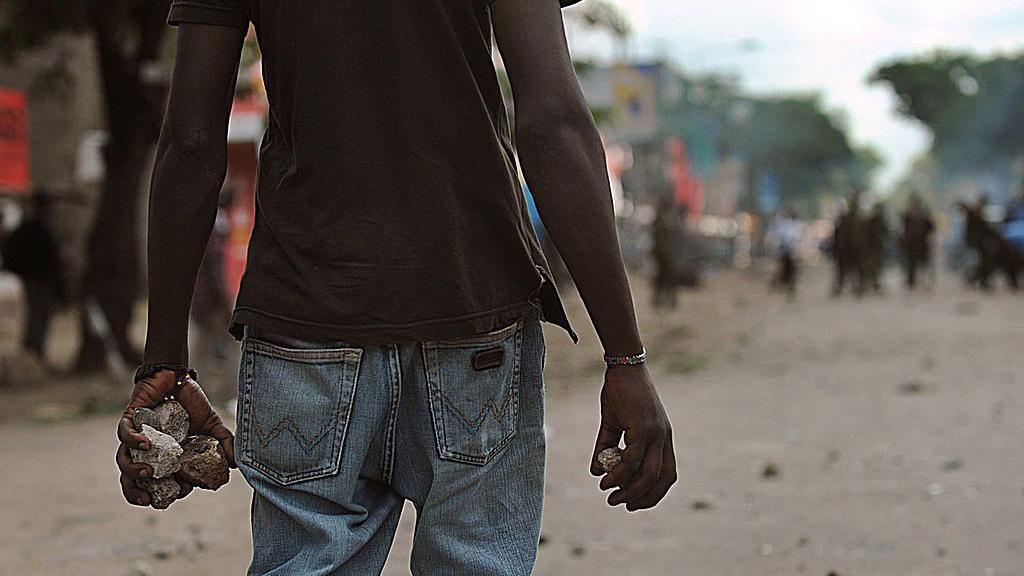
Against this fragmented political landscape, attacks by hired youth gangs — widely known locally as “goons” — have grown more open and brazen. Testifying before a parliamentary committee this month, Interior Cabinet Secretary Kipchumba Murkomen acknowledged that the government is struggling to rein in the groups, which have evolved from disorganized street gangs into what he described as “sophisticated and decentralized networks.” Murkomen, appearing alongside other top security officials, confirmed that more than 104 active criminal gangs operate across the country, the vast majority of which are backed and funded by sitting politicians.
“These gangs are owned by political leaders who play a central role in mobilizing them. The situation is chaotic, and an irresponsible leader is a direct threat to national security,” Murkomen told lawmakers, declining to name specific politicians linked to the groups. Authorities have launched a widespread crackdown, arresting at least 300 suspected gang members, seizing illegal weapons and seizing communications devices during raids — but no politicians have been taken into custody so far. Successive Kenyan administrations have repeatedly banned these groups ahead of elections, but the problem has persisted: gangs simply rebrand, mutate their structures, and reemerge under new names ahead of each electoral cycle. A senior anonymous security source told the BBC that the groups have now become permanent, formally structured organizations rather than temporary election-era mobilizations.
Gachagua, the former deputy president and 2027 presidential challenger, has been a repeated target of this violence. Since his impeachment, he has faced more than two dozen targeted attacks by armed gangs at campaign events and church appearances, with Gachagua and his allies blaming state-sponsored criminal networks for trying to derail his presidential bid before the official campaign begins. Opposition leaders and civil society groups have long accused Kenya’s police force of either colluding with politically linked gangs or intentionally turning a blind eye to their attacks, many of which unfold in plain sight of uniformed officers. In February, a 28-year-old supporter of the anti-Ruto ODM faction was shot and killed during clashes between police and rally attendees, leading the faction to condemn what it called “state-sponsored acts of violence by police and hired goons.”
Government spokesperson Isaac Mwaura rejected all claims of state sponsorship of gang violence, saying “the use of criminal gangs to intimidate or silence individuals undermines our democracy and will not be tolerated. Anyone found financing, supporting, or engaging in such acts will be held fully accountable under the law.”
Attacks are not limited to opposition figures, either. In February, a senatorial candidate aligned with the ruling Kenya Kwanza alliance was forcibly dragged out of a church service and attacked by a mob in Kakamega, another western Kenyan city. During November 2024 by-elections in western and central Kenya, voting was marred by widespread violence: polling agents were assaulted, armed gang factions clashed during vote counting, and police fired tear gas to disperse crowds of voters.
Security analysts warn that the growing frequency of these attacks is pushing Kenya toward a crisis it has barely survived once before. “These incidents paint a troubling picture of a country where political rivalry increasingly spills into organised street violence executed by hired gangs operating with precision and impunity,” said Robert Chege, a Nairobi-based security analyst. Taken individually, single attacks can sometimes be dismissed as isolated crime, but collectively they point to a nation edging back toward the violence that traumatized the country in 2007.
Makau Mutua, a prominent legal scholar and advisor to President Ruto, wrote that the normalization of political gang violence has become a systemic problem, noting “the worrying problem in Kenya is that this is now a near norm carried out by all major political parties. It is, to wit, a Kenyan culture, an epidemic.” A 2024 report from Kenya’s state-funded National Crime Research Centre backed this assessment, finding that hundreds of criminal gangs are active nationwide, with more than 120 directly linked to politicians. Unlike the temporary election formations of the 1990s and 2000s, the report found that these groups are now deeply entrenched, permanent institutions within their local communities.
Inspector General of Police Douglas Kanja told parliament that security forces have made progress identifying the political leaders funding and directing the gangs, promising that “this issue of goons and guns is going to stop soon. We have clearly investigated. We have seen where they come from, who funds, who does what, who is the grassroots organiser and so forth.” Responding to longstanding allegations of police complicity and inaction, Interior Minister Murkomen acknowledged that “operational challenges” including corruption and repeated information leaks have hampered enforcement, saying the government takes all allegations of officer misconduct seriously.
Critics argue that the government’s response has been heavy on rhetoric but weak on enforcement, pointing to the lack of any arrests of politically connected gang backers despite hundreds of detentions of low-level youth. Chege described Kenya’s current security crisis as self-inflicted, sustained by decades of political patronage networks and state systems “that thrive on violence and inequality.” He added, “The question is no longer who the goons are, but who sends them, funds them and protects them? The real architects of Kenya’s rising wave of organised violence remain in the shadows.”
As Kenya counts down to next year’s general election, ordinary citizens and civil society groups are calling for urgent action to rein in political violence before tensions escalate even further, hoping authorities can hold the powerful architects of this violence accountable before the country repeats the mistakes of its past.