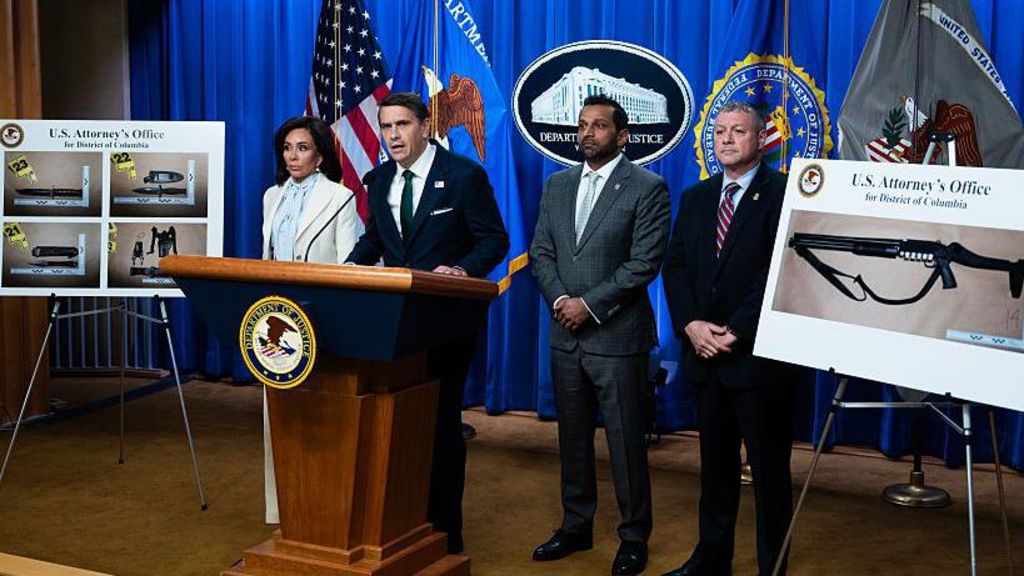
It has been nearly seven days since a suspect was accused of attempting to assassinate former President and current U.S. President Donald Trump at the White House Correspondents’ Association dinner, and critical information surrounding the shooting incident at the Washington Hilton remains unresolved amid an ongoing investigation. As authorities continue to piece together the events of that Saturday night, official statements from prosecutors have shifted dramatically around one central question: did the accused gunman actually shoot the U.S. Secret Service officer that multiple senior officials, including the president, say was hit during the attack.
President Trump and other top administration officials have publicly stated that as the attacker charged the hotel’s security checkpoint, a Secret Service officer was struck by gunfire, and survived the incident only because he was wearing a bulletproof ballistic vest. Trump initially told reporters that the agent was shot “from very close distance with a very powerful gun.” But court documents submitted by federal government attorneys have not explicitly made the claim that the suspect fired the shot that hit the officer on the night of the high-profile gala.
Authorities have confirmed that the responding Secret Service officer fired five shots at the suspect as he advanced through the checkpoint, but none of those rounds struck the suspect, identified by the Department of Justice as 31-year-old Cole Tomas Allen. The incident, which unfolded steps away from the event attended by dozens of top government officials and journalists, was captured by closed-circuit security cameras that recorded the moment of gunfire.
Mark Lesko, a former U.S. Attorney for the Eastern District of New York, explained the tension facing investigators in this high-stakes case in an interview with the BBC. “There’s this insatiable public interest in the case, pressure to get information out to the public,” Lesko said. “But on the other hand, you want to conduct a thorough investigation, which could take weeks in a case like this.” He noted that conflicting public statements from law enforcement are understandable in the chaotic early hours of a high-profile investigation, but warned that early inaccuracies could give defense attorneys room to undermine the prosecution’s case down the line.
The BBC reached out to the Department of Justice for additional comment on the shifting narratives, while the Secret Service and the U.S. Attorney’s Office for the District of Columbia declined to provide any further clarification.
Within hours of the incident, the Department of Justice released an affidavit naming Allen as the suspect and bringing initial charges that included discharge of a firearm. Authorities confirmed Allen, who remains in federal custody, was armed with three weapons: a semi-automatic handgun, a pump-action shotgun, and three knives when he was detained at the scene.
The day after the attack, Acting U.S. Attorney General Todd Blanche told CBS News that the suspect had shot the Secret Service agent, saying “That’s what we understand as of now.” But just 24 hours later, at a public press conference, Blanche walked back that claim. When pressed again by a reporter to confirm who shot the officer, Blanche said, “We wanna get that right, so we’re still looking at that.” He confirmed investigators have recorded that five total shots were fired during the incident, and that “the suspect fired out of a shotgun, and we know that happened.” He added that full ballistics testing is still ongoing and has not been finalized.
The same day as Blanche’s revised press statement, the government released its full criminal complaint against Allen. The document states that the accused “approached and ran through the magnetometer holding a long gun.” It adds that “As he did so, US Secret Service personnel assigned to the checkpoint heard a loud gunshot. US Secret Service Officer V.G. was shot once in the chest; Officer V.G. was wearing a ballistic vest at the time.” Despite that accounting of the officer’s injury, prosecutors do not explicitly name Allen as the person who fired the shot that hit him.
“That is interesting and noteworthy because what it shows is the government does not yet have conclusive proof that the suspect did shoot the agent,” Lesko explained of the omission. He also pointed out that prosecutors have not yet added a charge of assaulting a federal officer to Allen’s case, though Blanche has confirmed additional charges could be filed as the investigation progresses. Even a Wednesday detention hearing filing submitted by the government made no reference to the officer being shot, only stating that a Secret Service officer had “observed the defendant fire the shotgun in the direction of the stairs leading down to the ballroom” without confirming that any of Allen’s shots hit a person.
This omission did not go unnoticed by Allen’s defense team. In a court filing arguing for Allen’s release from custody, defense attorneys wrote, “Moreover, the government, after essentially asserting that Mr. Allen shot a Secret Service Officer in the criminal complaint, has apparently retreated from the theory by not mentioning the alleged officer at all in its memorandum.” Allen’s legal team did not respond to the BBC’s request for additional comment.
Four days after the attack, Jeanine Pirro, the former Fox News host who now serves as U.S. Attorney for the District of Columbia, released new security camera footage of the incident on the social platform X. The video shows the man identified by authorities as Allen running through the hotel’s security checkpoint, and at one point he appears to raise his shotgun, though it is impossible to confirm from the footage whether he fired. The clip also clearly shows the responding Secret Service officer raising his weapon, with multiple visible muzzle flashes confirming he fired his gun. Pirro wrote in her post that “There is no evidence the shooting was the result of friendly fire,” but stopped short of claiming the video proved Allen fired the shot that hit the officer.
The same day that footage was released, Secret Service Director Sean Curran told Fox News that “All the evidence that I’ve seen, the suspect shot our officer point-blank range with a shotgun.”
Forensic reviews of ballistics and other physical evidence often take weeks, and in some cases months, to complete, and authorities are expected to release additional details as the investigation moves forward. Legal experts note that regardless of who fired the shot that hit the officer, prosecutors already have enough charges to secure a lengthy prison sentence if Allen is convicted. “They have enough charges here to put Allen away for a very long time” if a jury finds him guilty, Lesko said.