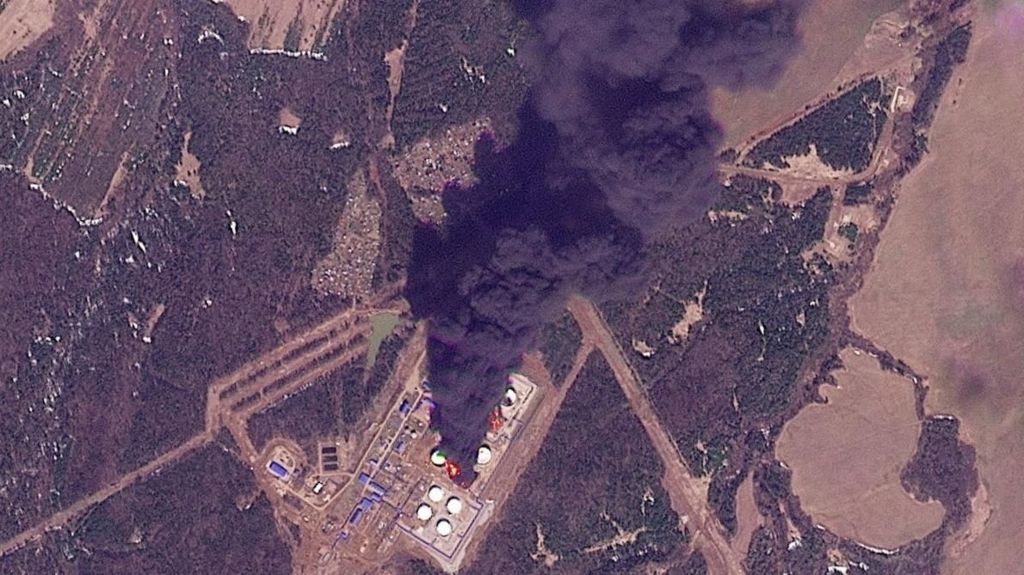
In a significant escalation of cross-border strikes amid the ongoing four-year full-scale invasion of Ukraine, Ukrainian drones have targeted a major Lukoil oil pumping and refining complex near Perm, a city in central Russia more than 1,500 kilometers from the active front line, triggering a massive smoke plume that was captured in dramatic social media footage.
Ukraine’s Security Service (SBU) confirmed it carried out the attack on the facility, one of Russia’s largest oil refining hubs. Visuals shared across online platforms showed towering columns of black smoke and visible flames billowing from the site, and an initial chemical emergency alert was issued for multiple districts of Perm. Local city officials later walked back the alert, framing it as a routine safety test, a move aligned with a broader pattern of Russian authorities downplaying the impact of Ukrainian strikes on domestic infrastructure.
This Perm strike is the second attack on critical Russian energy infrastructure in the same region within a single week. Earlier this week, the SBU announced it had disabled a key strategic hub for Russia’s national oil pipeline network, also located in Perm. Further north along the Black Sea coast, multiple strikes on oil facilities in Tuapse earlier this month caused extensive oil contamination, with local residents sharing images on Telegram of oil slicks spreading across coastal waters, black petroleum puddles on local roads, and wild animals coated in sticky oil residue.
The increasing frequency of deep-penetration drone attacks on Russian territory has become an unavoidable source of concern for the Kremlin, even as official statements continue to minimize their strategic impact. This mounting security threat has already forced tangible policy changes: on Wednesday, the Kremlin announced it would scale back its annual May 9 Victory Day military parade, the iconic holiday marking the defeat of Nazi Germany in World War II, explicitly citing “terrorist threats” originating from Ukraine.
Later that same day, Russian President Vladimir Putin held a 90-minute phone call with former U.S. President Donald Trump, during which Putin put forward a proposal for a one-day ceasefire to coincide with the Victory Day holiday. Yuri Ushakov, Putin’s senior diplomatic advisor, confirmed that Trump had expressed active support for the initiative, noting that the holiday represents a shared victory over Nazi Germany between the two countries.
Ukrainian President Volodymyr Zelensky responded cautiously to the offer, saying Kyiv would seek additional clarification from U.S. officials on the details of the proposal. “We will clarify what exactly this is about — a few hours of security for a parade in Moscow, or something more,” Zelensky said, adding that Ukraine remains committed to its original proposal for a long-term ceasefire and a lasting, sovereign peace.
This proposed temporary truce follows a long pattern of limited, short-lived ceasefires that have been implemented since the full-scale invasion began in 2022. Most of these prior truces have been tied to major holidays, restricted solely to energy infrastructure, or limited to the Black Sea grain initiative. Ukraine has repeatedly pushed for a comprehensive permanent peace agreement, while Russia has refused to enter into such talks unless Kyiv agrees to cede control of occupied sovereign Ukrainian territories to Moscow.
During the call, Ushakov said Trump asked Putin to share his assessment of frontline conditions in Ukraine. Putin claimed to the former U.S. president that Russian forces maintain the strategic initiative and are continuing to push back Ukrainian positions. This characterization directly contradicts independent assessments from military analysts and recent on-the-ground developments.
Over the past several months, Ukrainian forces have retaken portions of occupied Russian territory, capitalizing on technological advances in long-range strike capabilities and slowed Russian recruitment efforts that have stretched Moscow’s frontline forces thin. The U.S.-based Institute for the Study of War (ISW) noted in a recent analysis that Kyiv’s military operations are inflicting mounting casualties and operational costs on Russian troops. The ISW added that the Kremlin is likely overstating its progress to frame the conflict as nearing a Russian victory, in an effort to mitigate growing international and domestic pressure over the mounting costs of the war.
The background of this latest strike is rooted in Russia’s ongoing regular aerial bombardment of Ukrainian civilian areas. Just on Wednesday night, a new Russian airstrike on Ukrainian population centers killed at least three civilians and injured 79 more, including one child, continuing a pattern of attacks that has killed thousands of Ukrainian civilians and displaced millions more since the full-scale invasion began.