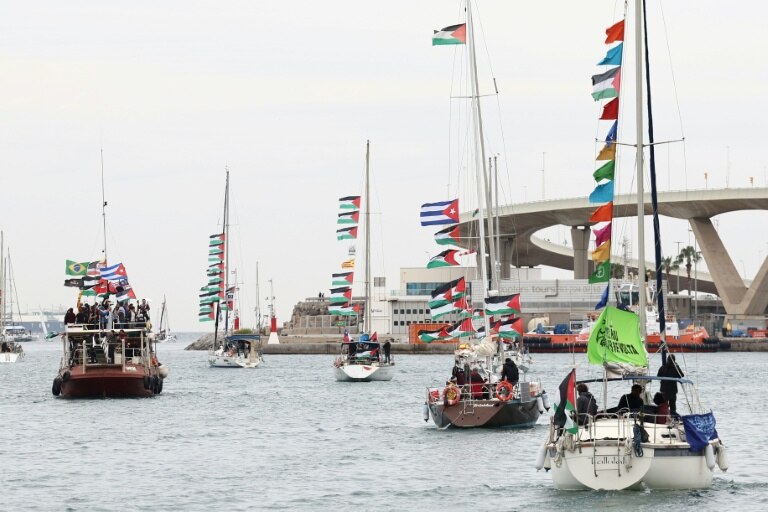
A major diplomatic and humanitarian controversy has erupted after Israeli military forces intercepted a flotilla of pro-Palestinian aid vessels heading to the blockaded Gaza Strip in international waters off the Greek island of Crete, with organizers and Israeli officials clashing sharply on the scope and legality of the operation.
Organizers with the Global Sumud Flotilla, a coalition of 48 national delegations that launched the voyage from ports in France, Spain and Italy over recent weeks, announced Thursday that Israeli commandos had stormed at least 22 of the coalition’s 58 vessels in an operation that took place hundreds of kilometers from Israeli shores — a distance organizers described as unprecedented. In a graphic account of the raid, the group detailed that Israeli military speedboats approached the unarmed aid vessels, pointing laser weapons and semi-automatic assault weapons at activists, ordering crew members to crawl to the fronts of their boats with their hands and knees on the deck. The operation also included jamming of the flotilla’s communications systems, prompting activists to issue an emergency SOS distress call.
Per the coalition’s accounts, a total of 211 activists have been taken into Israeli custody, an outcome organizers frame as an arbitrary kidnapping in violation of international law. Among the detainees are Paris Communist municipal councillor Raphaelle Primet and 10 other French citizens, with crew members representing all 48 participating national delegations believed to be held. Helene Coron, a spokesperson for Global Sumud France, confirmed the details of the interception during an online news conference, noting that the operation occurred far closer to Crete than to Israeli territorial waters. Yasmine Scola, an activist still aboard one of the remaining flotilla vessels anchored near Crete, echoed the organizers’ claim that the detained activists had been kidnapped by Israeli forces.
Israeli officials have offered a conflicting account of the operation. The Israeli foreign ministry put the number of detainees at 175, and derisively labeled the initiative a “condom flotilla” — a reference to prophylactics found in a previous aid convoy — adding that 20 of the intercepted vessels were already traveling peacefully to Israeli ports. Activists counter that their vessels were carrying only civilian humanitarian aid, including school supplies and food for Gazan residents who have faced catastrophic shortages of basic goods for decades.
A spokesperson for the Greek coast guard confirmed to Agence France-Presse that authorities responded to the flotilla’s SOS distress signal, but once a Greek patrol boat reached the interception zone, crews were told no further assistance was needed. As of Thursday, the 36 remaining vessels from the original flotilla remain anchored off the coast of Crete, and organizers have not yet announced what next steps the remaining crews will take.
This interception marks the second high-profile voyage by the Global Sumud Flotilla targeting Israel’s blockade of Gaza. The coalition’s first voyage in the summer and autumn of 2025 also drew global attention after Israeli forces intercepted the flotilla off the coasts of Egypt and Gaza in early October of that year. That operation, which Amnesty International and organizers labeled a violation of international law, sparked widespread international condemnation after high-profile participants including climate activist Greta Thunberg were arrested and expelled by Israeli authorities.
The confrontation comes against a long-running backdrop of humanitarian crisis in Gaza. Israel has controlled all land, air and sea entry points to Gaza since 2007, when the territory came under the governance of Hamas. The United Nations and leading international non-governmental organizations have repeatedly accused Israel of strangling the flow of goods into Gaza, a crisis that deepened dramatically after the outbreak of war between Israel and Hamas in October 2023. According to official Israeli figures compiled by AFP, Hamas’s cross-border attack on October 7, 2023 killed 1,221 people, most of them civilians. Retaliatory Israeli military operations in Gaza have killed more than 72,000 people in the territory, the majority of them civilians, per data from the Gaza Ministry of Health. A fragile ceasefire has been in place since October 2025, ending two years of devastating armed conflict, but severe shortages of food, clean water, medicine and fuel continue to plague the 2 million residents of Gaza.