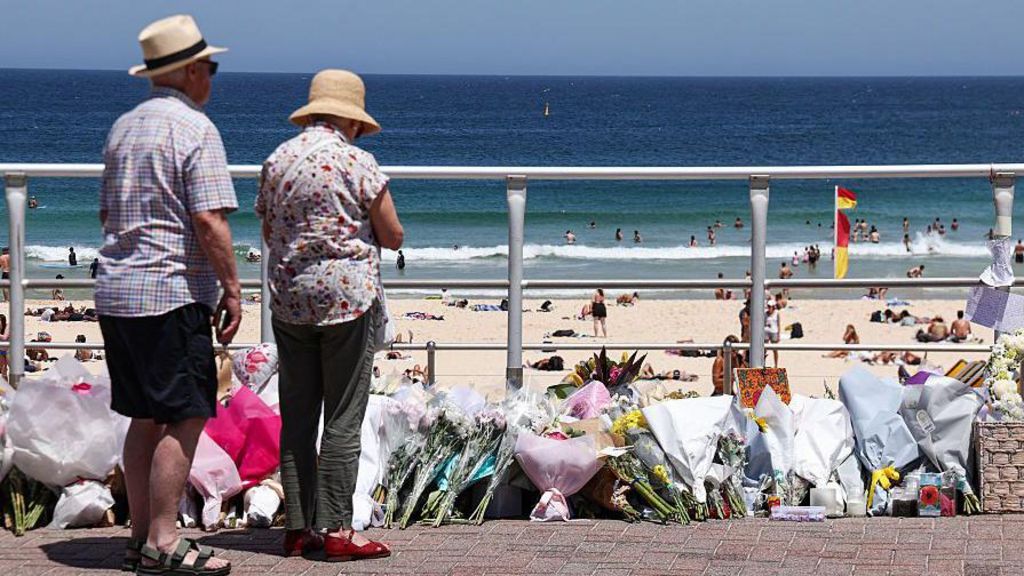
Almost five months after Australia’s deadliest mass shooting in three decades left 15 people dead at a Jewish community event on Bondi Beach, the country’s landmark federal royal commission focused on combating antisemitism has delivered its initial set of findings to the government.
The public inquiry, the highest-authority form of public investigation under Australian law, was convened in January 2025 – three weeks following the attack carried out by a father-son extremist duo. On December 14 last year, Sajid Akram, 50, and his 24-year-old son Naveed Akram, armed with rifles and shotguns, ambushed a public Sunday gathering at a Bondi Beach park. Sajid Akram was fatally shot by responding officers at the scene, while Naveed sustained critical injuries during the confrontation, and was later moved from a hospital correctional facility to prison after his condition stabilized. He currently faces 59 criminal charges, including 15 counts of murder and one charge of perpetrating a terrorist act.
Chaired by former High Court Justice Virginia Bell, the interim report tabled Thursday includes 14 actionable recommendations, with five of these proposals withheld from public release to protect ongoing national security operations.
Key public recommendations call for federal and state governments across Australia to prioritize updating and rolling out a uniformly enforced national firearms agreement, alongside advancing a national voluntary gun buyback program to restrict unauthorized access to deadly weapons. The report also urges New South Wales (NSW) authorities to expand the enhanced policing protocols already in place for major Jewish high holy days to cover all high-risk Jewish community events and festivals, particularly those open to the general public.
Additional recommendations include a full operational review of Australia’s joint counter-terrorism response teams, and a requirement that the prime minister and all national cabinet ministers participate in formal counter-terrorism preparedness exercises within nine months of every federal election.
Prime Minister Anthony Albanese announced Thursday that the nation’s National Security Committee has formally approved the implementation of every recommendation laid out in Bell’s report. While Albanese noted the interim findings did not identify a need for immediate emergency changes to existing policy, he emphasized that all levels of government have a continuous responsibility to strengthen protections for Jewish communities across the country.
The road to this royal commission was marked by political pressure. In the immediate aftermath of the attack, Albanese rejected widespread calls for a full royal commission, arguing it would risk fragmenting community cohesion, and instead initially convened a smaller internal review led by former Australian intelligence chief Dennis Richardson. After sustained pressure from victims’ families, cross-party politicians, prominent public figures, and community leaders, the prime minister reversed his position, folding the NSW state inquiry and the initial Richardson review into this broader federal royal commission. In the intervening months, the government has already passed targeted legislative reforms, including tighter gun ownership regulations and strengthened hate speech laws to counter rising antisemitic rhetoric.
The first round of public hearings for the full inquiry, which will examine broader rising antisemitism across Australian society and institutions as well as the sequence of events that led to the Bondi attack, is scheduled to open Monday. The hearings will open with sessions focused on formally defining antisemitism, mapping how it manifests in different sectors of Australian public life, and centering the lived experiences of Jewish Australians across all communities. Bell has previously noted that the scope of the inquiry’s evidence gathering will be restricted temporarily to avoid interfering with the ongoing criminal proceedings against Naveed Akram. The commission’s full and final report is set to be released on the one-year anniversary of the Bondi Beach attack.