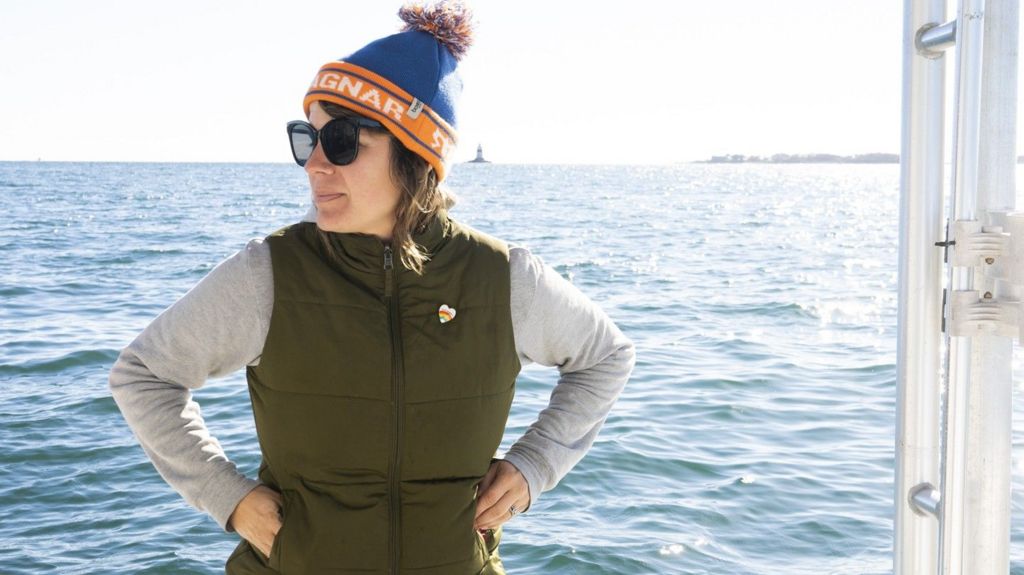
Ten years ago, Suzie Flores sat behind a desk in a Manhattan academic publishing firm, commuting daily from Jersey City with an English degree and a life that left her questioning her purpose. Today, she is the founder of Stonington Kelp Company, a pioneering seaweed farm operating out of a converted Connecticut marina where she lives and works with her family, on a mission to convince American consumers that the next era of sustainable food grows beneath the ocean’s surface.
On frigid February mornings, when most coastal New England residents stay hunkered indoors, Flores can often be found heading out from Stonington’s marina – one of the state’s last active commercial fishing ports – to check her sugar kelp lines, if conditions cooperate. The sea must be calm, boat hulls cleared of ice, and GPS buoys anchored where she left them. At this point in the growing season, only thin, tender fronds hang from the lines; by spring, they will stretch to a full meter long. She measures each growth stage, documents her findings with photos, and collects water samples for partner marine researchers before returning to shore.
Flores’ career pivot came after a period of major life upheaval. Her husband Jay, a former combat photographer who covered conflicts in Iraq and Afghanistan, returned home struggling to adjust to civilian life and retrained as an engineer. Around the same time, the couple welcomed three children in quick succession, prompting Flores to reevaluate the fast-paced urban career she had built. She asked herself a simple but profound question: What would she want her children to remember her for at her funeral? The answer was certainly not drafting market research for higher education software.
The family left New York City, purchased a dilapidated marina on the border of Connecticut and Rhode Island, and rooted themselves in coastal life. Flores went back to school to earn a degree in environmental science, reached out to Charlie Yarish, a University of Connecticut biologist widely recognized as the pioneer of American seaweed farming, who responded within the same day and connected her to GreenWave, a non-profit that helps new aquaculture farmers navigate complex permitting and regulatory processes. Flores recalls taking those early strategy calls with a newborn strapped to her chest, wondering if the risky transition could ever pay off. For her, everything felt aligned – almost too good to be true. That gut feeling held, except for one critical gap: when she harvested her first crop, thousands of pounds of sugar kelp sat with no market to absorb it.
“Had Jay and I known how much work building a market would be, I don’t know if we would have gone into it,” Flores admitted. Undeterred, she set out to create demand from scratch. She cold-called farm-to-table restaurants across New England, walking chefs through the unique qualities of East Coast sugar kelp: a mild, briny flavor and delicate texture that stands in stark contrast to the thick, rubbery Pacific kelp most Americans are familiar with.
Her grassroots pitch paid off. Today, Stonington Kelp Company sells out its entire harvest every season, supplying top-tier regional restaurants where chefs value both kelp’s culinary versatility and its local provenance. David Standridge, the 2026 James Beard Award finalist for Outstanding Chef and head of The Shipwright’s Daughter in Mystic, Connecticut, is one of Flores’ longest-standing customers. For Standridge, sugar kelp fills a unique seasonal gap: it is the first fresh local produce available in New England each year, ready to harvest weeks before any land-grown vegetable sprouts, giving him a bright green, local ingredient to feature when the winter lull leaves other options bare. “It’s just crunchy and light and salty and briny,” Standridge explained. “It doesn’t carry a lot of difficult flavours to pair. It kind of goes with a lot of things.” What draws him most, he added, is kelp’s ability to carry the character of the water it grows in – a quality analogous to wine’s terroir or oyster’s merroir. “There’s a lot of dishes where you might not taste the kelp, but it’ll just taste more like the ocean,” he said.
Despite Flores’ individual success, her journey highlights a major systemic barrier to the growth of America’s domestic seaweed industry. More than 90% of the seaweed consumed in the U.S. is imported, mostly from Asian countries where seaweed cultivation has been practiced for centuries. North America produces only a tiny fraction of global supply, and while the number of domestic kelp farms has grown steadily in recent years, supporting infrastructure for processing, distribution, and mass consumer outreach has failed to keep pace. For new farmers, the biggest challenge is no longer growing kelp successfully – it is building a large enough market and supply chain to support sustained, scalable operations.
Flores also faces the immediate, unpredictable risks of coastal farming. This past winter, repeated intense storms packing 70-mile-per-hour winds and deep freezes that locked surface gear in solid ice, combined with shifting underwater currents that tore cultivation lines apart, destroyed a huge portion of her harvest. She estimates she lost 40 to 50% of her crop, on top of the 30% loss that new kelp farmers are typically advised to budget for. Even with that major reduction, she still sold out her entire available stock, and is already adjusting her planning to account for more frequent extreme winter weather in coming years.
What keeps Flores pushing forward is both the environmental and economic promise of kelp farming. As sugar kelp grows, it naturally absorbs excess nitrogen pollution from runoff, improving coastal water quality and creating critical habitat for wild marine life. In the years since she launched her farm, blue mussels have begun colonizing her cultivation lines, and schools of fish cluster beneath the fronds, drawing seabirds back to the area in greater numbers.
For coastal communities like Stonington, kelp also offers a path to economic revitalization. The region’s once-dominant lobster industry has largely collapsed in recent decades, and the local commercial fishing fleet is rapidly aging. Flores’ vision is not to build a single large corporate kelp operation, but to grow a network of small, family-owned kelp farms – mirroring the successful, low-impact expansion of oyster aquaculture that has taken root across the New England coastline. Kelp can be grown in the off-season by existing fishermen who already own boats and gear, with far lower upfront costs than most new aquaculture operations, creating a new stream of income for coastal families.
“It hasn’t grown at a massively rapid rate,” Flores said of her own business. “But it’s always growth. We’re always going in the right direction.” Beyond her work on the water, Flores also teaches courses on kelp farming and sustainable aquaculture at Yale University and the University of Massachusetts Boston, and runs educational seaweed programs for local culinary schools. She notes that the youngest students are often the most skeptical, until she incorporates kelp into familiar comfort foods like macaroni and cheese – after that, most become quick converts.
Her three children have grown up with the farm as a backdrop to their daily lives, taking boat trips for lunch and helping with small chores as part of routine. Flores says she doesn’t necessarily expect them to take over the business; what she wants for them is the freedom to choose work that feels meaningful, rather than sticking to an unfulfilling path for stability. “There is nothing worse than not listening to yourself about what brings you joy,” she said. She learned that lesson in a Manhattan office, and hopes her children never have to learn it the same way.
“Kelp is the lobster roll of the future,” Flores joked, before pausing to add somberly: “The lobster roll is gone. In large part because of us.” Out on the calm waters of Long Island Sound, the ocean remains. Flores is betting that seaweed farming can help build a more sustainable future for both the water and the coastal communities that depend on it, one harvest at a time.