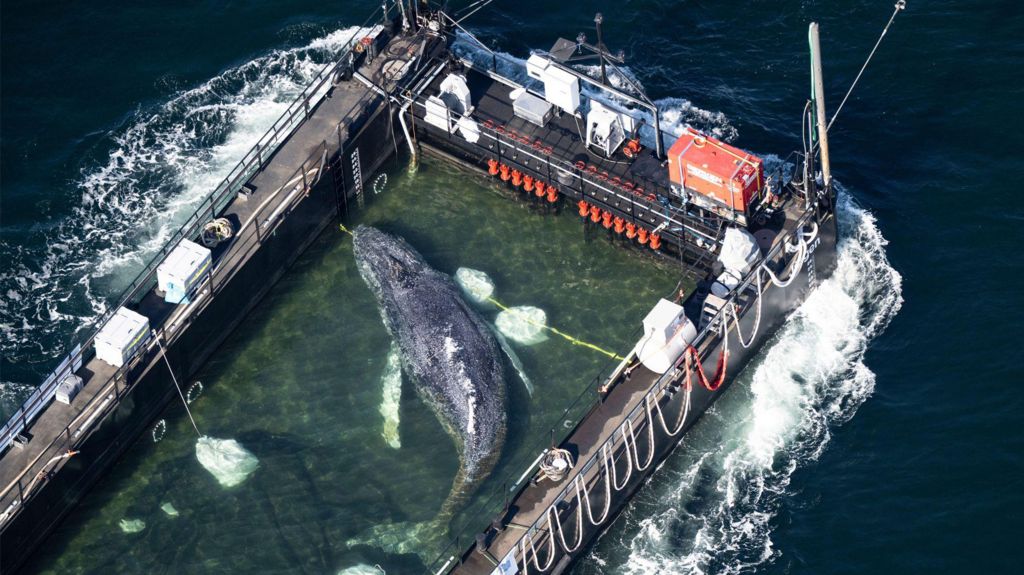
After more than five weeks of being stuck in the shallow coastal waters of Germany’s Baltic Sea coast, a young humpback whale nicknamed both “Timmy” and “Hope” has finally begun its journey to the deeper, open waters of the North Sea, carried in a custom water-filled barge towed through international waters. The unprecedented rescue operation has captured the attention of the entire German public, splitting marine experts and conservation groups over the wisdom and potential outcome of the risky mission.
The whale’s ordeal began in early March, when it likely became tangled in fishing netting before stranding on Timmendorfer Beach in Lübeck Bay on March 23. After initial efforts to dig a channel to coax the animal out to open water failed, the whale slowly moved east along the German coast, eventually settling in a shallow, low-salinity area off the coast of Poel Island, where it remained for 29 days. Over that period, the stranded whale became a national cause célèbre in Germany, with regular updates on its condition dominating local and national news cycles.
Multiple early attempts to lure the humpback away from the coast ended in failure, leaving rescuers to pursue a controversial, privately funded plan: coax the whale into a specially adapted water-filled barge, then transport it hundreds of kilometers around the Danish coast to the North Sea. The operation is funded by two German entrepreneurs, Karin Walter-Mommert and Walter Gunz, who have poured their resources into giving the whale a second chance. On Tuesday, the team achieved a major milestone when the whale voluntarily swam into the prepared barge, a moment that brought rescue workers to tears.
“I can’t even say how happy I am,” Walter-Mommert told reporters after the successful boarding, while Gunz added that he had never prayed as intensely as he had during the weeks of the rescue effort. Till Backhaus, environment minister for Germany’s northern Mecklenburg-Vorpommern state, who has become the public face of the mission, hailed the operation as a landmark example of collective action. “If everything goes well, it will be in the North Sea in two days,” he told reporters, adding that early monitoring suggested the whale was in stable condition, and even reportedly sang overnight after being secured in the barge. After the barge and its tow vessel Fortuna B exited German territorial waters, it traveled through the Baltic Sea into Danish waters, on a route that will take it around the northern tip of Jutland and through the Skagerrak Strait to its final destination.
Felix Bohnsack, the mission’s technical and rescue director, praised every partner involved in the operation, from state environmental agencies to the German lifeguard association DLRG, but cautioned that the hardest part of the journey is still ahead. “We are not yet out of the woods,” he warned Wednesday, reflecting on the 24 hours since the whale entered the barge. “The moment Hope swam into the barge was inconceivable; we had tears in our eyes; these are images I will never forget.”
The operation has faced widespread skepticism from mainstream marine experts and conservation organizations, however. An expert panel from the International Whaling Commission has already distanced itself from the plan, noting that while the effort was well intentioned, the whale appears severely compromised and is unlikely to survive even after being moved to deeper water. The Whale and Dolphin Conservation (WDC) group has echoed that assessment, warning that the whale has already sustained permanent skin damage from the low-salinity waters of the German Baltic coast. For the rescue to be successful, WDC officials note, the whale’s skin must fully heal and it must quickly learn to hunt for food independently in its new habitat. The German Oceanographic Museum has added that the weakened animal faces a constant risk of drowning during the transport due to its compromised condition.
A small number of experts have offered a more cautious optimistic take. Marine biologist Fabian Ritter told German press agency DPA that the whale has demonstrated a clear “will to live,” though he cautioned that this type of long-distance barge rescue is completely unprecedented, so no one can accurately predict what long-term effects the process will have on the animal. As the barge continues its northbound journey toward the North Sea, the entire nation of Germany remains closely watching for updates on the whale’s fate.