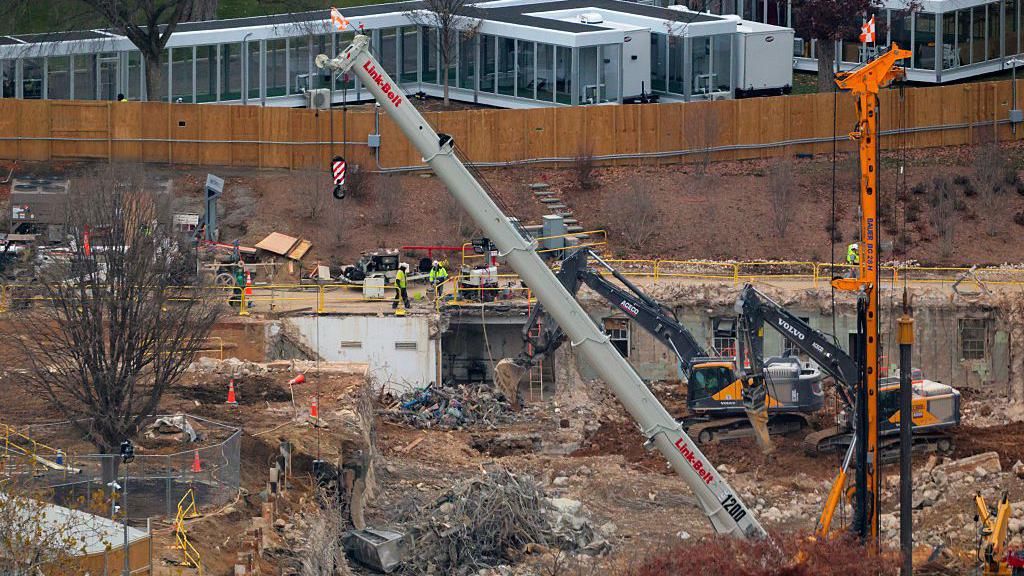
A high-stakes legal battle over former President Donald Trump’s $400 million White House ballroom project has escalated sharply, after the U.S. Department of Justice formally asked a federal judge to lift a pause on above-ground construction — arguing the recent shooting at the White House Correspondent’s Dinner proves the urgent need for a secure on-site presidential event space. The dispute dates back months, when preservation group the National Trust for Historic Preservation filed a lawsuit to block the project, which required the full demolition of the 1902 East Wing, a change that deviated from Trump’s original promise that the existing structure would remain untouched. The legal challenge argues that Trump lacks the legal authority to redevelop the federally owned property without formal approval from Congress and relevant federal agencies, a claim the Trump administration has rejected. Last week, Judge Richard Leon, a Bush-era appointee, sided with the preservationists temporarily and ordered all above-ground work halted, even as construction crews continued off-site and underground work. In a court filing submitted late Monday, acting Attorney General Todd Blanche and other senior administration officials made an urgent plea to reverse that order, leaning heavily on the chaotic shooting incident that unfolded at the Washington Hilton over the weekend. The incident saw an armed suspect attempt to breach the venue hosting the annual press dinner, forcing the emergency evacuation of Trump, 2,300 attendees including cabinet members, members of Congress, and senior government officials. Attendees scrambled to take cover as shots were fired, highlighting the vulnerability of large off-site presidential gatherings, administration officials argue. “Presidents need a secure space for large events that currently does not exist in Washington,” the filing reads. “This court’s injunction stalling this project cannot defensibly continue, for the sake of President Trump, future presidents and their families, Cabinets and staff.” Strikingly, the filing adopts language straight from Trump’s own social media rhetoric, attacking the preservation group as being driven by partisan animosity. It accuses the organization of suffering from “Trump Derangement Syndrome” — a catchphrase coined by Trump and his allies to dismiss critics of the president. “Because it is DONALD J. TRUMP, a highly successful real estate developer, who has abilities that others don’t, especially those who assume the Office of President, this frivolous and meritless lawsuit was filed,” the filing adds. Legal analysts who have followed the case say the DOJ’s last-minute appeal is unlikely to change Judge Leon’s mind, given his earlier ruling to pause construction. For their part, the National Trust for Historic Preservation shows no signs of backing down: in a public statement released Monday, group president and CEO Carol Quillen reaffirmed the organization has no intention of dropping the lawsuit, noting the legal challenge simply asks the administration to follow existing federal law and “endangers no one.” Trump has seized on the weekend shooting to repeatedly defend his project, framing it as a critical public safety measure. Speaking to CBS just one day after the incident, Trump argued the new ballroom would eliminate the risk of attacks at off-site events. “I’m building a safe ballroom, and one of the reasons I’m building it is exactly what happened last night,” he said. “And that ballroom is being built on the safest piece of property in this country, probably one of the safest pieces of land in the world.” Many observers have pointed out that the Correspondent’s Dinner is an independent, off-site event hosted by a private press organization, so it remains unclear how an on-site White House ballroom would have prevented or altered the outcome of Saturday’s attack. As the legal process moves forward, work on the project continues below ground, leaving the fate of the high-profile construction effort in the hands of the federal court.
DOJ cites Washington dinner shooting in lawsuit over White House ballroom