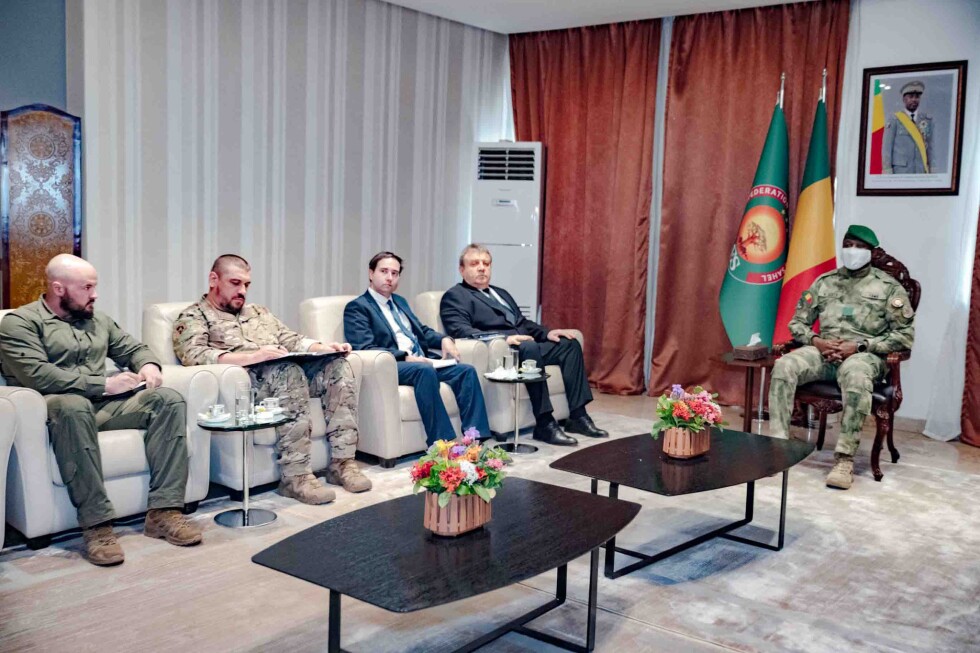
Three days after a massive, coordinated wave of attacks by al-Qaida-aligned Islamic militants and separatist fighters rocked the West African nation of Mali, the country’s ruling junta chief has made his first public appearance, meeting with a top Russian diplomatic delegation in the capital Bamako.
Authorities confirmed that Assimi Goita, the military leader who took power via a 2020 coup, held talks with a Russian team led by Ambassador Igor Gromyko on Tuesday. Photos released by Goita’s office show the meeting taking place in Bamako’s presidential palace. Russia, a key strategic and military ally of Mali’s junta, has framed the weekend attack as an attempted coup against the current government.
The coordinated attacks, launched simultaneously on Saturday by a coalition of militants and the separatist Azawad Liberation Front, targeted at least four population centers across Mali’s central and northern regions—areas long labeled as a global hotbed for terrorist activity. Assaults hit Bamako’s international airport, the nearby garrison town of Kati, and the northern cities of Kidal and Sevare.
In the wake of the violence, the Azawad Liberation Front claimed its fighters seized full control of Kidal after Malian and Russian military forces withdrew from the strategic northern city. The attack also resulted in the death of Mali’s Defense Minister General Sadio Camara. As of Tuesday, the full scope of casualties across all attack sites and the current status of territorial control in contested areas remain unconfirmed, with the Malian government yet to release a detailed public account of the incident.
The U.S. Embassy in Bamako responded to the ongoing instability by issuing an urgent security alert, warning of potential terrorist movements within the capital and confirming reports of forced school closures across the city. Bamako remains on high alert three days after the attacks, with many local residents reporting widespread anxiety over personal safety amid the unclear security situation.
Russia’s Ministry of Defense has issued an unusually detailed statement on the violence, echoing the ambassador’s framing of the offensive as a failed coup attempt. The statement claimed the attack was foiled by joint operations between Malian security forces and the Russian Africa Corps, the unofficial military contingent that provides support to Goita’s junta. Russian defense officials claimed roughly 12,000 attackers participated in the offensive, armed with advanced weaponry. The statement also acknowledged the withdrawal from Kidal, framing the move as a pre-planned strategic decision by the Malian government, noting that outnumbered Malian troops stationed in the city fought off four large-scale assaults for more than 24 hours while fully encircled by enemy forces.
To date, The Associated Press has not been able to independently verify the claims made in the Russian defense ministry’s statement, and the lack of official updates from Mali’s government has left critical details of the attack unresolved.