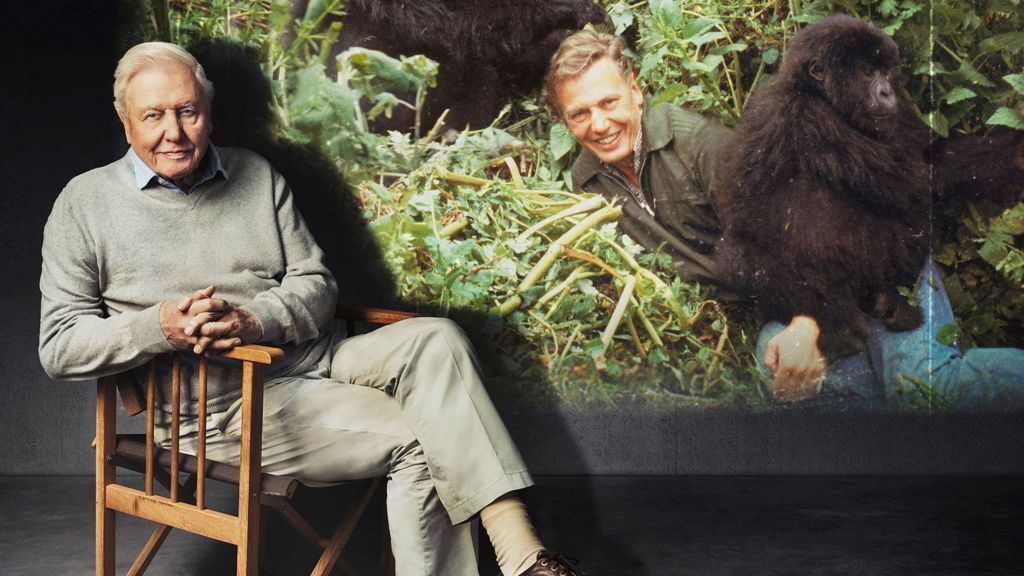
Nearly half a century after one of the most iconic moments in natural history television, Sir David Attenborough is revisiting his life-changing encounter with wild mountain gorillas in Rwanda for two new documentaries, timed to coincide with his upcoming 100th birthday on May 8.
The 1979 landmark series *Life on Earth* made broadcasting history with its raw, intimate footage of Attenborough sharing a forest clearing with a family of mountain gorillas – a moment the legendary broadcaster still calls the most memorable of his decades-long career. In the original footage, a curious female gorilla approaches Attenborough to within a few feet and locks eyes with him, an exchange he says holds deeper meaning and connection than any interaction he has shared with another animal.
What many viewers never saw was the dramatic, high-stakes journey that got that footage onto screen. In January 1978, Attenborough and his small crew climbed 3,000 meters up steep 45-degree slopes in Rwanda’s Virunga Mountains, with one simple goal: to capture close-up footage of a gorilla’s thumb to illustrate how primate anatomy enabled tool grip. At the time, mountain gorillas were on the brink of extinction: poaching for trophies and zoo captures had pushed the Virunga population down to fewer than 285 individuals, and the shy apes were nearly impossible for outside groups to approach.
The crew’s only path to access came through Dian Fossey, the pioneering American primatologist who founded the Karisoke Research Center in Volcanoes National Park to study the gorillas in their natural habitat. Though Fossey was famously protective of her study groups and had previously turned outside film crews away, she responded to Attenborough’s letter with an invitation to visit. Without her, Attenborough says, the encounter never would have happened. Fossey taught the crew critical protocols to avoid agitating the gorillas: avoid direct eye contact, keep heads lowered, and communicate with soft belch vocalizations to signal non-threat. That guidance allowed the team to get far closer than they ever dared expect.
When the crew finally settled in to film Attenborough’s planned segment to camera, the gorillas upended every expectation. A young gorilla named Poppy began trying to pull off Attenborough’s shoes, while three-year-old Pablo, an orphaned infant abandoned by his mother, climbed onto the broadcaster and lay down across his chest. Moments later, an adult female rested a hand on Attenborough’s head, turned his face to meet her gaze, touched a finger to his lips, and belched a greeting. While the camera crew worried about wasting limited film stock on unscripted play, Attenborough stayed in the moment, calling the encounter one of the most privileged, breathtaking experiences of his life. Just one to two minutes of the interaction was captured on film, but that short footage would change public perception of gorillas forever.
The drama did not end when the crew left the mountain. As they drove down from the research site, they heard gunshots, and were stopped at a military roadblock. Rwandan authorities detained the crew overnight, questioned them at police headquarters, and held Attenborough and his cameraman in an army compound in Kigali for hours before releasing them. Miraculously, the footage was not confiscated, and the crew left the country relieved to have preserved the historic sequence.
When *Life on Earth* aired in 1979, it was a global phenomenon, broadcast to an estimated 500 million viewers across nearly every country on Earth, and redefined what natural history television could be. The gorilla encounter also left a lasting conservation legacy: Attenborough worked with the conservation charity Fauna and Flora to launch the Mountain Gorilla Project, bringing global attention and resources to protect the species.
Fossey, who dedicated her life to protecting the apes, was murdered in 1985, seven years after her collaboration with Attenborough. Her death brought even greater international attention to the gorillas’ plight, sparking widespread investment in community education and sustainable eco-tourism. Today, the Virunga mountain gorilla population has grown to roughly 600 individuals, a rare conservation success story that traces its roots back to that 1978 forest encounter.
The two new documentaries revisit both the original filming adventure and the ongoing story of the gorilla family Attenborough met. The BBC’s *Making Life on Earth: Attenborough’s Greatest Adventure*, which premieres May 3 on BBC One and BBC iPlayer, retraces the original 1978 expedition. Netflix’s *A Gorilla Story: Told by David Attenborough* picks up the generational story of Pablo’s family line, tracing how the curious orphan who climbed into Attenborough’s lap grew to become the dominant silverback leader of his group, before dying at 33 while defending his family.
Filming the Netflix documentary over 250 days brought more unscripted drama, just as it did in 1978: the crew captured a complex power struggle between three of Pablo’s descendant males, that included conflict, a killing, and group mourning. For Dr. Tara Stoinski, chief executive of the Dian Fossey Gorilla Fund, the original encounter remains powerful because it broke down the artificial divide between humans and wild apes. Viewers saw that gorillas share familiar, relatable behaviors – a curious toddler will climb onto your lap just like a human child, and their social bonds, emotions, and interactions mirror our own. That short, gentle meeting between genetic cousins erased the myth of gorillas as savage jungle beasts, revealing their rich emotional lives of cooperation, care, conflict, and adaptation. As Attenborough observed in the original footage: “We see the world in the same way as they do.”