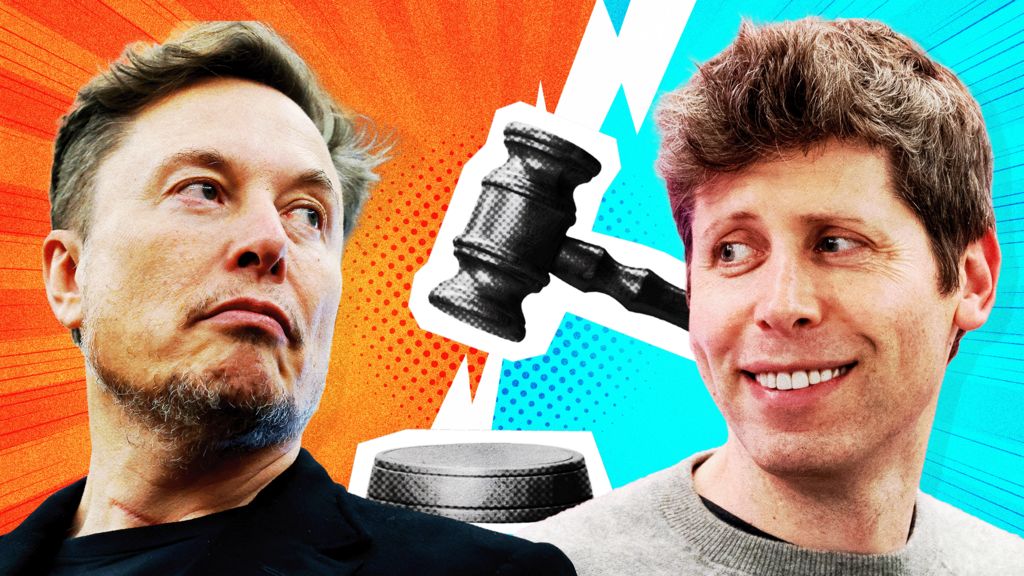
A years-long public feud between two of the technology sector’s most powerful figures, Elon Musk and OpenAI chief executive Sam Altman, is set to move from social media exchanges to a California federal courtroom this week, opening a month-long trial that could reshape the trajectory of the global race for advanced artificial intelligence.
What began as a collaborative vision for ethical AI development in 2015 has devolved into a bitter legal battle, with Musk accusing his former co-founder of betraying the project’s core non-profit mission to build artificial general intelligence (AGI) — AI that outperforms human-level capability — for the benefit of all humanity. In his lawsuit, which also names OpenAI president Greg Brockman and Microsoft as co-defendants, Musk alleges Altman defrauded him out of millions in early donations, orchestrated an illegal shift to a profit-driven structure, and reneged on the founding promises that drew him into the project in the first place.
The roots of the rift stretch back more than a decade. The pair were first introduced by a Silicon Valley investor in 2012, when Altman, then in his 20s and head of influential startup incubator Y Combinator, viewed Musk as a personal hero. By 2015, they launched OpenAI together as a non-profit, with Musk, already a household name as CEO of Tesla and SpaceX, backing the project with roughly $40 million in early funding. For a time, the pair aligned on the need to develop AI cautiously, warning the technology carried existential risks even as it promised to reshape humanity.
Tensions emerged by 2017, however, when OpenAI leadership began pushing for a transition to a for-profit structure to scale up development. OpenAI counters that Musk agreed to the shift but walked away after his demand for full, absolute control of the company was rejected. A 2018 email from Musk ahead of his departure made his frustration clear: he threatened to cut off funding unless the group committed to remaining a non-profit, before ultimately exiting the project entirely that year.
The rift erupted into open conflict after OpenAI’s 2022 launch of ChatGPT, which ignited a global consumer AI boom and amassed 100 million monthly active users in just months. By 2024, Musk launched his own competing AI firm, xAI, which has trailed market leaders with its chatbot Grok, before filing the lawsuit against OpenAI. OpenAI has hit back, arguing Musk’s legal action is driven by jealousy and regret over leaving the company, and that he is seeking to sabotage a leading competitor in the race to AGI.
Public animosity has spilled into viral social media exchanges repeatedly since the suit was filed. Last year, Musk led a consortium offering $97.4 billion to buy OpenAI’s assets, an offer the company rejected, with Altman quipping on X (formerly Twitter) that OpenAI would buy Musk’s platform for a tenth of that price if he was interested. Musk responded by calling Altman “Swindler”, and most recently rebranded him “Scam Altman” in a Monday post on the platform. Legal observers have noted that Musk’s repeated failed attempts to acquire OpenAI have cast doubt on his stated motives for the lawsuit.
A nine-person jury was sworn in on Monday ahead of the trial, overseen by Judge Yvonne Gonzalez Rogers, who has already made clear that the pair’s celebrity, wealth and influence will earn them no special treatment in her Oakland courtroom. Both Musk and Altman are expected to testify, along with Microsoft CEO Satya Nadella, former OpenAI leaders Ilya Sutskever and Mira Murati, and even former OpenAI board member Shivon Zilis, who is mother to four of Musk’s children. Pre-trial procedural wrangling has already produced colorful headlines: the judge barred discussion of Musk’s use of the stimulant colloquially called “rhino ket” in Silicon Valley, and one of Musk’s attorneys has drawn attention for moonlighting as a clown in his spare time.
Microsoft, which has pumped billions into OpenAI as part of a strategic partnership, denies any wrongdoing, and Musk is demanding the return of billions in alleged “wrongful gains” to be redirected to OpenAI’s non-profit division, as well as the removal of Altman from his leadership role.
The stakes of the trial extend far beyond the two billionaires, experts say, as the outcome could reshape the competitive landscape for AGI, a technology that is projected to carry enormous global economic and social power. If Musk prevails, he would effectively eliminate one of his biggest rivals in the global AI race, notes Rose Chan Loui, executive director of the Lowell Milken Center for Philanthropy and Nonprofits at UCLA. While Musk has positioned himself as a defender of OpenAI’s original non-profit mission, many observers worry his motives are not neutral, given his own significant stake in xAI.
Sarah Federman, a conflict resolution professor at the University of San Diego, compared the clash to a heavyweight title fight, or a battle between King Kong and Godzilla: two larger-than-life giants whose fight leaves bystanders to navigate the damage they leave behind. “Musk and Altman are so big, so larger than life, and so unrelatable,” she said. “That’s what makes them so delicious to watch as they clash.”
As the public continues to grapple with AI’s rapid integration into daily life, experts say the trial will pull back the curtain on the ambitions and intentions of the two men who have done more than almost any others to bring consumer AI to the global public. Whatever the verdict, the outcome will set a path that the rest of the world will have to live with for decades to come.