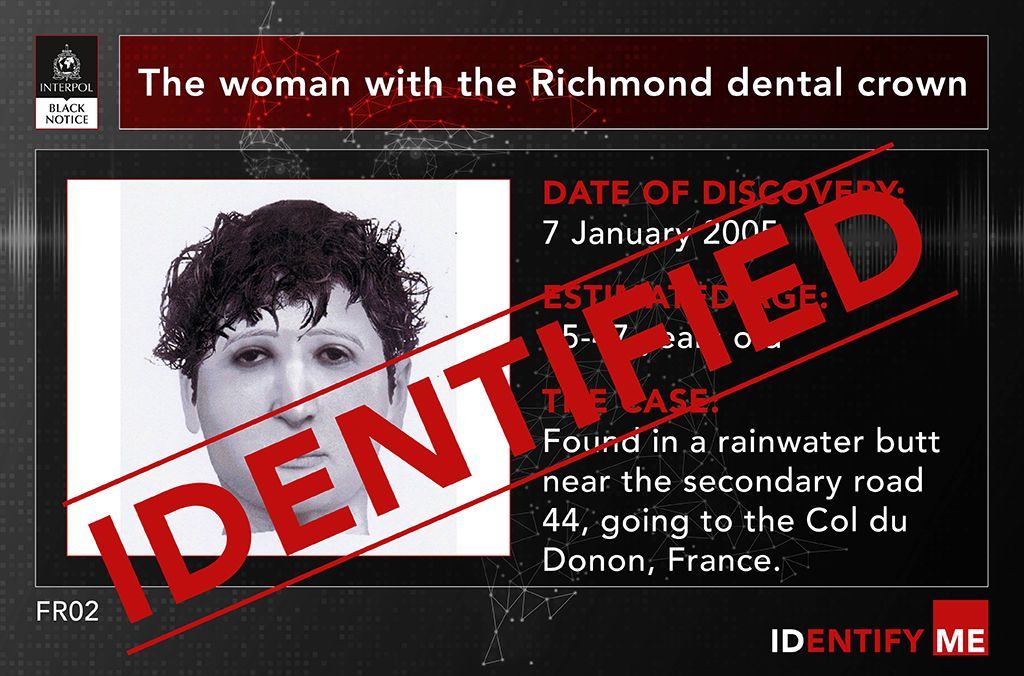
More than two decades after her mutilated body was found hidden in a rural French village, an unidentified murder victim has finally been named, and a suspect has been taken into custody — marking a historic milestone for Interpol’s global cold case initiative.
The victim, now confirmed as 34-year-old Algerian-born Hakima Boukerouis, was the fifth unidentified woman to be identified through Operation Identify Me, an international effort launched in 2023 by the global law enforcement agency Interpol to name hundreds of unclaimed female bodies found across six European countries. Until this breakthrough, investigators had only referred to Boukerouis by the chilling nickname “the woman with the Richmond dental crown”, after a distinct, high-cost dental procedure she had undergone shortly before her death that authorities previously suspected was performed in Germany.
Boukerouis’ remains were first discovered in January 2005, tied, wrapped in black garbage bags, and concealed inside a covered water butt in the small northeastern French village of Saint-Quirin. For nearly 20 years, no matches to missing person reports could be found, leaving the case stuck in the growing backlog of cross-border cold cases. That changed when French law enforcement used familial DNA searching to connect Boukerouis to her relatives, unlocking the long-awaited identification.
The arrest of a suspect in Boukerouis’ murder is the first made since Operation Identify Me launched, a win that Interpol leaders say highlights the value of persistent, cross-border collaboration on unsolved cases. “This identification underscores how important it is to keep investigating unresolved cold cases,” Interpol Secretary General Valdecy Urquiza said in an official statement released Tuesday. “As part of the Identify Me campaign, the efforts of the French authorities have helped identify a murder victim whose case had remained open for many years.”
Due to ongoing investigations and active judicial proceedings, neither French police nor Interpol have released the identity of the arrested suspect, and only limited details about the case have been made public.
Operation Identify Me was created to address a growing challenge for European law enforcement: rising global migration and transnational human trafficking have left an increasing number of people reported missing outside their home countries, making it far harder to match unidentified bodies to missing person reports. The campaign pulls 47 unsolved cases of women found dead under suspicious or violent circumstances in France, Belgium, the Netherlands, Germany, Italy and Spain into a single public, cross-border effort. For the first time, Interpol has issued public black notices — its official requests for information on unidentified deceased persons — for these cases, shared critical records including fingerprints with law enforcement agencies worldwide, and reignited public and investigative attention to these long-forgotten cases.
Before Boukerouis’ identification, four other women have been named through the initiative: 31-year-old British citizen Rita Roberts, murdered in Belgium in 1992 and identified after her family spotted a photo of her tattoo in a BBC report; 33-year-old Paraguayan national Ainoha Izaga Ibieta Lima, found dead in a Spanish poultry shed in 2018; 31-year-old Russian national Liudmila Zavada, found on a Spanish roadside in 2005 and identified in September 2024; and 35-year-old German citizen Eva Maria Pommer, found on a Dutch beach in 2004 and identified the following month.
With five identifications complete, investigators still working through the campaign are pushing to name the remaining 42 women. Most of the remaining unidentified victims are confirmed murder victims, most believed to have been between 15 and 30 years old at the time of their death, with some cases dating back decades.