Amid a fresh wave of armed conflict in South Sudan’s Jonglei State, thousands of displaced civilians trapped in an isolated, swamp-ringed village have been blocked from receiving emergency humanitarian aid by government officials, military and local authorities, according to eyewitness accounts and statements from leading international aid organizations interviewed by the Associated Press.
The crisis began in December 2023, when opposition forces aligned with Riek Machar — the long-time political rival of President Salva Kiir who was suspended from his post as first vice president and placed under house arrest last year over alleged subversion — seized multiple military outposts across Jonglei. Government counteroffensives the following month pushed thousands of civilians to flee their homes, many toward the remote settlement of Nyatim, a day’s walk from the contested town of Lankien. Among the evacuees was Thomas Nim, a 43-year-old pharmacist who trekked through swampland with his pregnant wife, three children and elderly mother to escape advancing government troops. “Some of the most vulnerable, like the elderly and children, ended up in Nyatim because they couldn’t make it any farther,” Nim explained to the AP.
Trapped in the desolate location with no access to clean water or sufficient food, displaced residents relied on a Starlink satellite internet connection to send out pleas for emergency assistance. Eyewitnesses report dozens of people have already died, many from apparent starvation, with residents reduced to foraging for leaves and wild roots to stay alive.
When international aid groups including Doctors Without Borders (MSF) and the U.N. World Food Programme (WFP) applied for official government clearance to deliver relief supplies to Nyatim, their requests were repeatedly rejected. “It was a ‘no’ from local and national authorities and from the military,” stated Yashovardhan, MSF’s South Sudan mission head, who uses a single name. WFP country director Adham Effendi confirmed the blockade, noting the agency had been blocked despite “numerous engagements with both national and local authorities” — an unusually public rebuke from an agency that has historically avoided public criticism of South Sudan’s government over aid access restrictions.
Both government and opposition representatives have traded blame for the ongoing crisis. Gatkhor Dual, an opposition aid coordinator in Jonglei, accused county commissioner James Bol Makuei of intentionally cutting off aid to the area because he believes Nyatim’s residents support the opposition. Makuei has countered that access is restricted because the population estimate of 30,000 cited by MSF is exaggerated, and claimed the main opposition group SPLM-IO is holding civilians hostage in the area to gain political leverage and attract aid near the county seat of government. But Nim, the displaced pharmacist who fled to Nyatim, denies any opposition military presence in the village.
While concerns over aid diversion are not unfounded in South Sudan — where armed groups on both sides have a long track record of seizing humanitarian supplies for military use, and the U.N. reports fighters looted more than two dozen aid-run health facilities during recent Jonglei fighting — the blockade has left thousands of vulnerable people with no source of life-sustaining support. Some residents have already abandoned the remote village and returned to their conflict-ruined homes out of desperation. “People are returning to their homes,” said Koang Pajok, one of those who left Nyatim. “There was no food and shelter.”
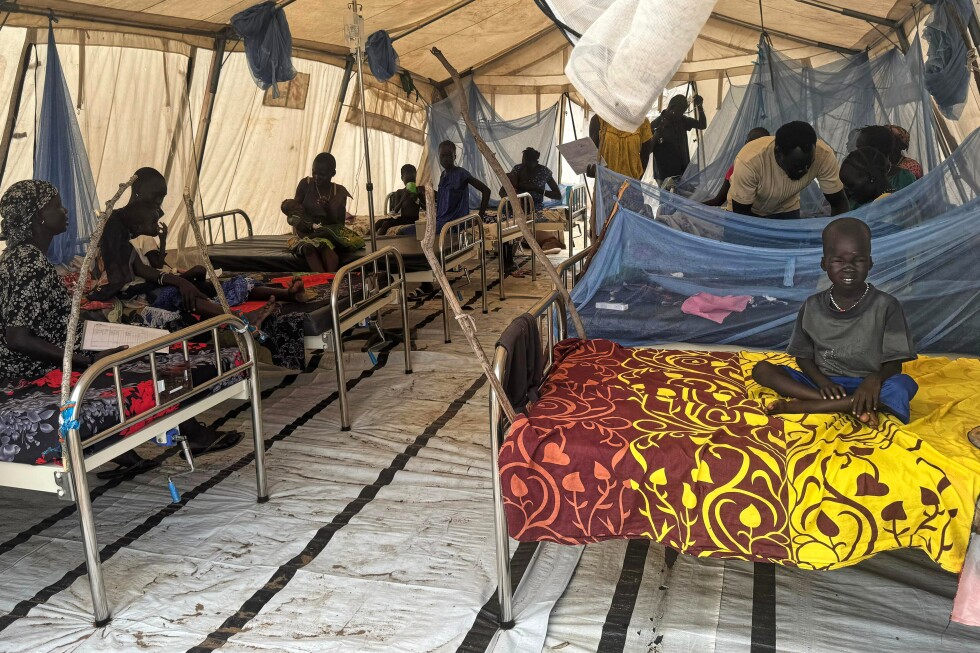
Delivering aid across South Sudan has long been a challenge, hampered by crumbling infrastructure, repeated attacks on river transport routes, and mandatory bureaucratic clearance from government officials. The ongoing crisis in Nyatim has deepened an already catastrophic humanitarian situation across the region: in the nearby community of Chuil, where the government has allowed aid access, MSF screening in March found more than half of 1,000 tested children were acutely malnourished. The aid organization has been forced to repeatedly expand its small treatment facility in Chuil from four beds to 100 to keep up with the influx of starving civilians.
Barred from overland or river access to remote areas, WFP has carried out airdrops of 415 metric tons of food to the Chuil region since March. But the arrival of aid has also drawn armed men with military weapons to the area, sparking fears the site could become a target for airstrikes. When a surveillance plane flew over the region in April, anxious civilians scattered, recalling that a similar overflight preceded a December airstrike on Lankien that killed at least 11 civilians.
The current crisis is the latest chapter in decades of cyclical violence in South Sudan, which gained independence from Sudan in 2011 before descending into a civil war between Kiir and Machar that killed an estimated 400,000 people between 2013 and 2018. A 2018 peace deal formed a fragile unity government between the two rivals, but fighting has reemerged in recent months, with consistent reports that armed groups on both sides have weaponized aid to punish civilian populations aligned with opposing factions.
This reporting is supported by a grant from the Gates Foundation, with the AP retaining full editorial control over all content.