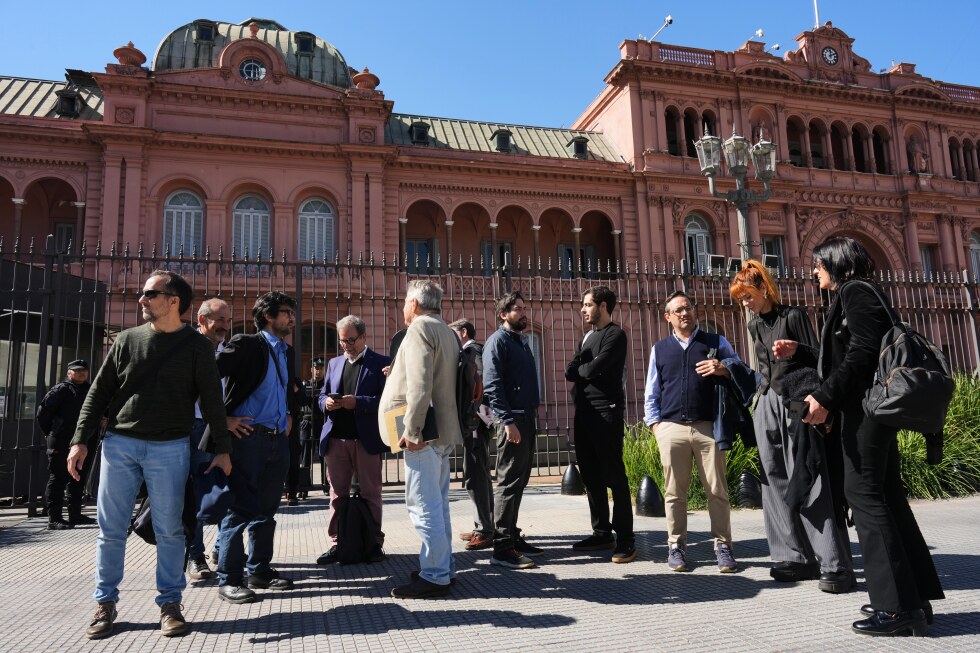
BUENOS AIRES, Argentina — In a move that has sent shockwaves through Argentina’s democratic landscape, President Javier Milei has barred the entire corps of accredited reporters from entering the Casa Rosada, the country’s iconic presidential headquarters, capping off a months-long pattern of aggressive hostility toward independent journalism that mirrors the anti-media rhetoric of his ideological ally, former U.S. President Donald Trump.
The unprecedented ban, implemented last week, followed a dispute over unauthorized footage filmed inside the presidential complex by reporters from Argentina’s Todo Noticias network. According to presidential spokesperson Javier Lanari, the move was implemented as a “preventative measure” after the outlet aired footage captured with hidden smart glasses, which the government frames as illegal espionage. But the network’s journalists push back against this characterization, noting they notified administration press officials of their filming plans in advance, and the footage only captured publicly accessible areas of the building that have been featured on national television before.
Rather than limiting criticism of his administration, the ban has sparked unified condemnation from across Argentina’s political spectrum, press freedom organizations, and watchdog groups. For a nation that has celebrated a vibrant, independent press since the end of its military dictatorship in 1983, observers say the full exclusion of the press from the presidential seat marks the most severe attack on press freedom in four decades.
“It’s the culmination of the government’s contempt for journalism and its value in a democracy,” explained Fernando Stanich, president of the Argentine Journalism Forum, a leading professional press association.
Cristina Zahar, Latin America coordinator for the New York-based Committee to Protect Journalists, framed the administration’s actions as a clear sign of authoritarian drift, even as Argentina remains formally democratic. “An autocrat who tries to curtail press freedoms, who tries to prevent journalists from reporting and keeping society informed about public interest matters,” Zahar said.
Milei, a radical libertarian outsider who rose to the presidency in 2023 on a platform of slashing government spending and upending Argentina’s established political order, has never moderated his provocative, anti-establishment rhetoric since taking office. An avid daily user of the social platform X, the president has leaned increasingly heavily into anti-media attacks in recent months. An analysis of Milei’s X feed conducted by leading Argentine daily *La Nación* between April 2 and 5 found that Milei published 86 original posts taunting and insulting journalists over just four days, and reshared an additional 874 similar attacks. Many of these posts repeated his signature slogan, “We don’t hate journalists enough,” repeated his false claim that 95% of Argentine journalists are active criminals, and included crude sexual innuendo or targeted insults directed at individual reporters critical of his administration.
Hours after the press ban was implemented, Milei published an angry all-caps post attacking reporters as “disgusting scum,” adding “how about you try stopping the lies? Oh I forgot, you lot are corrupt junkies hooked on advertising bucks and bribes.” He also shared an AI-generated deepfake image that depicted a prominent Argentine television reporter wearing an orange prison jumpsuit, a clear threat of political prosecution against critical journalists.
Long before the full ban on press access, Milei had restructured how his administration communicates with the public, sidelining traditional journalistic institutions in favor of unmediated social media outreach, a strategy also honed by Trump. Milei has never held a formal presidential press conference in his tenure, rarely grants interviews to established national outlets, and instead pushes his messaging through viral slogans and AI-generated memes. He frequently appears on right-wing influencer radio programs, and has hired prominent social media provocateurs for senior administration roles, a move that has emboldened his base to adopt stigmatizing, hostile language toward working journalists.
Following Trump’s playbook of using legal action to harass critical outlets, Milei has filed defamation lawsuits against at least eight independent journalists over the past 12 months, and encouraged his political allies to do the same. Alejandro Alfie, a media reporter for Argentina’s largest newspaper *Clarin* who has investigated networks of anonymous pro-Milei troll accounts, currently faces four defamation lawsuits from Milei’s close allies that seek millions of pesos in damages. Alfie says he has faced ongoing threats of violence, doxxing, and harassment from Milei’s supporters, demonstrating that the president’s rhetoric carries tangible, dangerous real-world consequences.
“People say, ‘Oh, it’s not real. It’s just social media.’ But when you have someone telling you on Instagram every day that they will kill your children, it is something else entirely,” Alfie said.
Milei has also taken systemic steps to weaken press access beyond personal attacks and lawsuits. In 2024, he shut down Telam, Argentina’s long-running state news agency, which he accused of operating as a propaganda outlet for left-wing opposition parties — a move echoing Trump’s push to cut federal funding for U.S. public media outlets PBS and NPR over claims of biased coverage. Telam has since been restructured into a state-run advertising agency. Milei also signed changes to Argentina’s open records law that drastically reduced the volume of government information available to the public and reporters.
Many correspondents who were barred from the Casa Rosada last week say the full ban did not come as a surprise. Over the past year, the administration has incrementally restricted press movement inside the building, closing off entire wings to reporters and capping attendance at official press briefings. Earlier this month, six accredited outlets were already barred from both the Casa Rosada and Argentina’s lower congressional chamber over unsubstantiated claims that their reporters were involved in Kremlin-backed disinformation, claims the outlets have emphatically denied.
The Todo Noticias smart glasses incident, observers say, was merely a convenient pretext to extend existing restrictions to the entire press corps. “It was the perfect excuse to extend the punishment to the entire press corps,” said Jaime Rosemberg, a political correspondent for *La Nación* who was among the 60 blocked reporters.
The backlash to the ban has been swift: an opposition lawmaker has already filed a lawsuit against the administration over the order, and a cross-party group of a dozen legislators has called for an urgent meeting with senior government officials to address what they call an “institutional undermining of freedom of expression.”
The anti-press campaign comes as Milei faces growing political and economic headwinds: recent polling from AtlasIntel shows the president’s public approval rating has fallen to the lowest point of his presidency. His signature campaign promise to eliminate Argentina’s decades-long chronic inflation has stalled, unemployment has risen, and the national economy has contracted. Adding to his troubles, close ally and chief of staff Manuel Adorni is currently under investigation for misuse of public funds, a corruption scandal that echoes the elite misconduct Milei campaigned against.
Many political analysts and journalists draw a direct line between the administration’s mounting challenges and its escalating attacks on the media, which have long served as a convenient scapegoat for unpopular outcomes. “It’s a very bad moment for the president,” Rosemberg said. “And often the easiest thing to do in that moment, what you have closest at hand, is to blame the press for everything.”