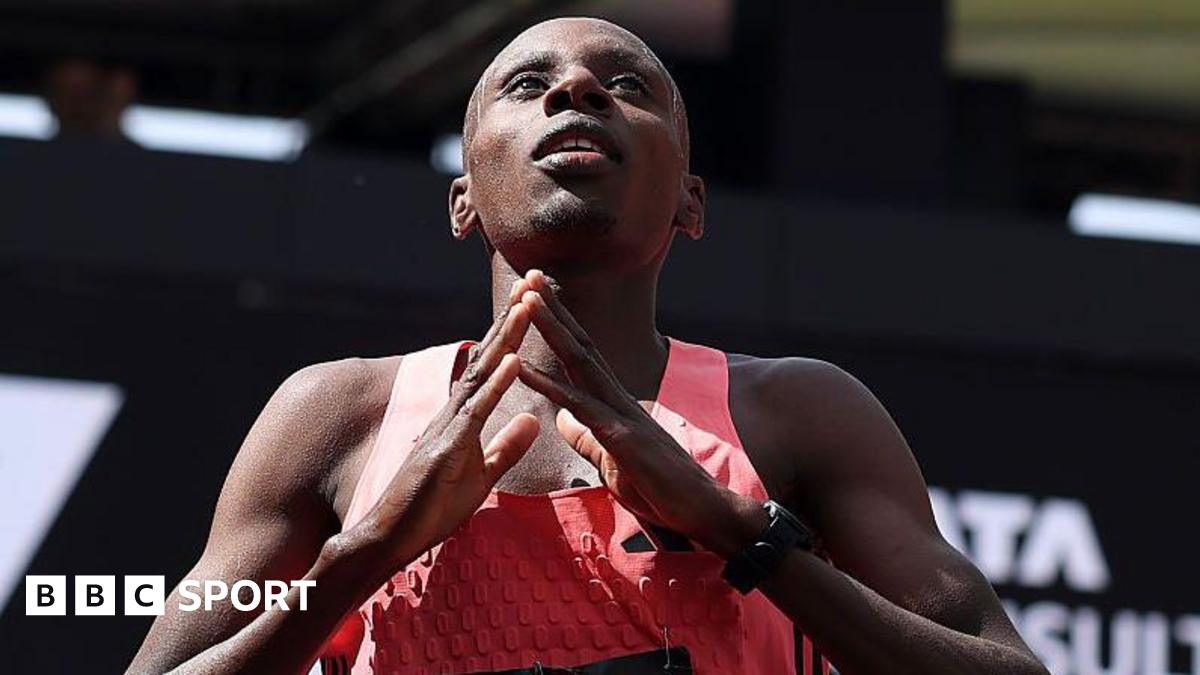
On a crisp, ideal April Sunday morning in London, long-distance running entered a new era. Thirty-year-old Kenyan athlete Sabastian Sawe crossed the finish line of the London Marathon in 1 hour 59 minutes 30 seconds, becoming the first runner in history to complete a World Athletics-sanctioned competitive marathon in under two hours, shattering the previous world record by an astonishing 65 seconds. This milestone, long dismissed by many as an impossible barrier that would not fall in their lifetime, redefines the limits of human endurance. Even Sawe himself said the result exceeded his own expectations, noting that his primary goal entering the race was defending his 2025 title, not chasing a world record. “It was not in my mind. I was well prepared for this year’s London Marathon, but what came surprised me because I was not thinking to run a world record,” he told BBC Sport 24 hours after his historic run. When asked about his performance, Sawe added that even faster times are within reach: “It was possible to run faster yesterday. Even 1:58 is possible.”
Sawe’s path to this iconic victory was far from straightforward. Born in Kenya’s Rift Valley to a maize-farming father, he was raised mostly by his grandmother and moved to Iten, Kenya’s famous running hub, in 2017 to pursue his athletic dreams. For years, his progress stalled, and the coronavirus pandemic left him struggling to make ends meet as races were postponed and injuries interrupted his training. A turning point came when his uncle, Ugandan 800m record holder Abraham Chepkirwok, introduced him to esteemed Italian coach Claudio Berardelli. Berardelli immediately recognized Sawe’s unique marathon potential and shifted his training away from the track, crediting the athlete’s rare physiological advantages paired with his relentless work ethic. Even now, with only four marathons under his belt, Berardelli insists Sawe has not yet reached his full potential.
In the years before his London breakthrough, Sawe had already given hints of his extraordinary talent. In 2022, he entered the Seville Half Marathon as an untested pacemaker with no professional road race experience, dropped every competitor within the first 10 kilometers, and won the race with a new course record. In 2024, he ran the second-fastest marathon debut in history in Valencia, clocking 2:02:05 — just 12 seconds slower than the late Kenyan great Kelvin Kiptum’s debut, two years before Kiptum broke the world record in 2023. After his debut, Sawe notched wins at the 2025 London and Berlin Marathons, but his first attempt at the world record in Berlin was derailed by unseasonable 25°C heat. Even more remarkably, his 2026 London preparation was delayed by a stress fracture in his foot sustained after Berlin and a back injury that left him nearly ready to abandon training in January, pushing his full training start back to early February. Compounding the surprise of his record is the fact that the London course is widely considered slower than the flat, fast routes of Berlin and Chicago, and had not hosted a men’s marathon world record since 2002.
This historic day was made even more extraordinary by the performances of other top runners. Debutant Yomif Kejelcha also finished under the two-hour mark, while half marathon world record holder Jacob Kiplimo crossed the line faster than Kiptum’s previous world record. Eliud Kipchoge, who became the first man to run a sub-two-hour marathon in a controlled, non-competitive exhibition event in 2019, congratulated the pair on Instagram, writing: “Seeing two athletes break the magical two-hour barrier at London Marathon is the proof that we are just at the beginning of what is possible when talent, progress and an unwavering belief in the human potential come together. Breaking the sub-two-hour barrier in the marathon has long been a dream for runners everywhere, and today you’ve made that dream come true.” London Marathon race director Hugh Brasher called the moment “unbelievable”, adding, “Nobody thought that a sub-two-hour marathon under World Athletics conditions would be done in their lifetime. This is sport and history in the making.” Former women’s marathon world record holder Paula Radcliffe echoed that sentiment, noting that the two-hour barrier had been debated for decades, with many questioning if it was even physiologically possible.
Sawe’s breakthrough comes as much from cutting-edge innovation as it does from raw talent and relentless training. After crossing the finish line, he held up his Adidas Adios Pro 3 “supershoe”, which had his historic finishing time written on its side, acknowledging the role of footwear technology in his performance. Weighing just 97 grams, 30% lighter than the previous generation of the shoe, Adidas claims the model delivers an 11% greater forefoot energy return and a 1.6% improvement in running economy compared to its predecessor, and it retails for £450. Ethiopian star Tigst Assefa also wore the same shoe when she broke the women’s marathon world record on the same London course on Sunday. Beyond footwear, advances in endurance race fuelling have also helped push boundaries: Sawe consumed 115 grams of carbohydrates per hour during the race, following a pre-race breakfast of two honey-topped bread slices and tea, and he maintains a 200-kilometer weekly training volume at altitude, an effort he calls central to his progress. That consistent, high-volume training allowed him to hold an average pace of 2:50 per kilometer (4:33 per mile) for the full 26.2 miles, and even pick up speed in the final 5 kilometers between 35km and 40km, posting a split of 13:42 on his way to the finish line.
Amid a wave of high-profile doping scandals involving top Kenyan distance runners — including women’s marathon world record holder Ruth Chepngetich — Sawe has moved proactively to prove his performance is clean. Sponsor Adidas committed $50,000 to the Athletics Integrity Unit, the global governing body’s anti-doping arm, to fund frequent out-of-competition testing for Sawe over a 12-month period leading up to the London Marathon. That program included 25 unannounced tests in the lead-up to his 2025 Berlin race, and continued at the same frequency through his London preparation. Sawe says transparency is non-negotiable for his career: “It’s very important to me because it gets out the doubt in my career of athletics and yesterday’s performance. It shows Sabastian Sawe is clean. It shows running clean is good, and we can run clean and we can run faster. It keeps the awareness that Sabastian Sawe is not to be doubted, and he is a clean athlete.”
With just four marathons completed and his coach confirming there is far more speed left in the tank, the running world will be watching closely to see what Sawe achieves next. Already, he holds four of the 17 fastest marathon times in recorded history, and his landmark run in London has opened a new chapter for the sport, proving that the limits of human endurance are still far further than we once imagined.