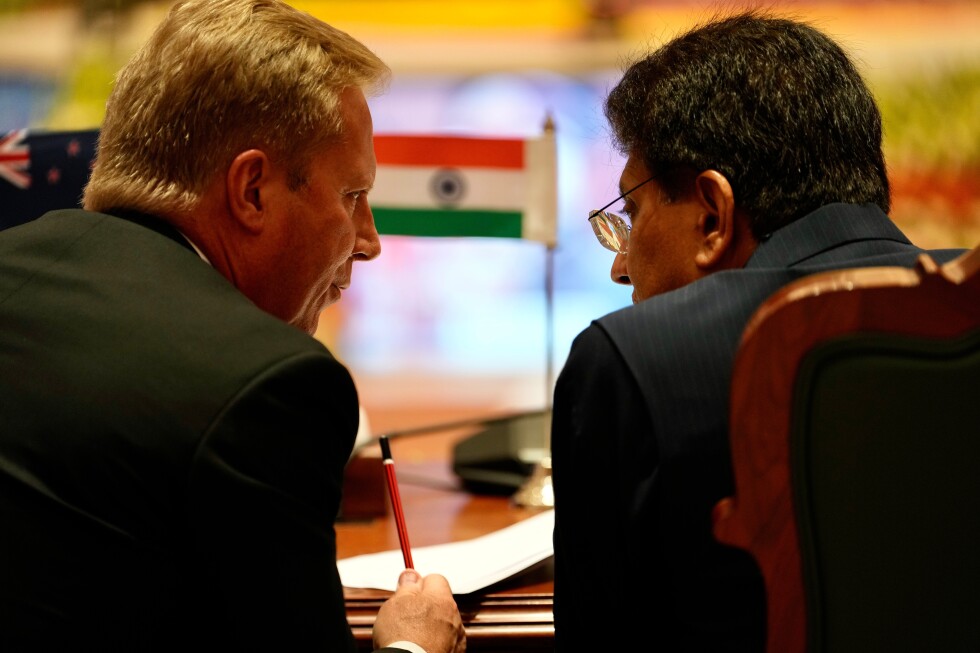
Against a backdrop of rising global trade fragmentation and economic volatility, India and New Zealand formalized a transformative free trade agreement (FTA) in New Delhi on Monday, a deal designed to boost bilateral economic integration and open new reciprocal market access for both nations. The signing ceremony brought together India’s Minister of Commerce and Industry Piyush Goyal and New Zealand’s Minister of Trade and Investment Todd McClay, who was visiting the Indian capital for the event.
After nine months of closed-door negotiations that concluded with a preliminary agreement in December, the deal delivers sweeping tariff changes: 95% of New Zealand’s goods exported to India will see tariffs cut or removed entirely, while every Indian product shipped to New Zealand will enter duty-free. In a supplementary commitment, New Zealand has pledged to channel $20 billion in investment into India over the coming 15 years.
For both governments, the agreement comes as a strategic response to shifting global trade pressures. New Delhi has been actively pursuing alternative export markets to offset the economic strain of steep tariffs imposed by the United States on Indian goods, as well as growing disruptions to key shipping and energy routes linked to regional tensions. For New Zealand, the deal advances a long-running policy goal of reducing overreliance on China, its single largest trading partner, by diversifying its trade relationships across the Indo-Pacific.
McClay framed the agreement as an unprecedented opportunity for long-term growth, noting that it comes at a moment of heightened global trade friction and policy uncertainty. Official trade data puts bilateral commerce between the two nations at $2.15 billion for the 12-month period ending June 2025, with India currently ranking as New Zealand’s 12th-largest export market. “This is a once-in-a-generation opportunity to deepen our economic ties at a time when the global order is shifting,” McClay said of the deal.
Goyal echoed the significance of the moment, calling the FTA a “defining milestone” for both countries. “At a time when the world economy is being recast, India and New Zealand have chosen each other,” he stated, adding that the agreement establishes clear frameworks for cross-sector investment and regulatory cooperation that will benefit businesses on both sides.
Key sectors set to gain expanded market access for Indian exporters include textiles and apparel, engineering goods, leather and footwear, and marine products. New Zealand exporters will see new openings for shipments of horticultural goods, timber, coal, wool and meat. To protect its large domestic farming community, India carved out exclusions for dairy products and a selection of other agricultural goods in the final text of the agreement.
India’s export sector has faced mounting pressure since August last year, when the United States imposed steep new tariffs on a range of Indian goods, hitting labor-intensive sectors including textiles, auto components and metals particularly hard. New Delhi continues to hold separate bilateral trade negotiations with Washington even as it expands trade ties with other partners across the globe.
In New Zealand, the FTA enjoys broad bipartisan support, a standard for the country’s major trade agreements. The deal now moves to parliamentary ratification, and it is widely expected to pass after the center-left opposition New Zealand Labour Party pledged its backing. The only notable opposition comes from New Zealand First, a small populist party that is part of the current governing coalition.
Reporting for this story was contributed by Graham-McLay from Wellington, New Zealand.