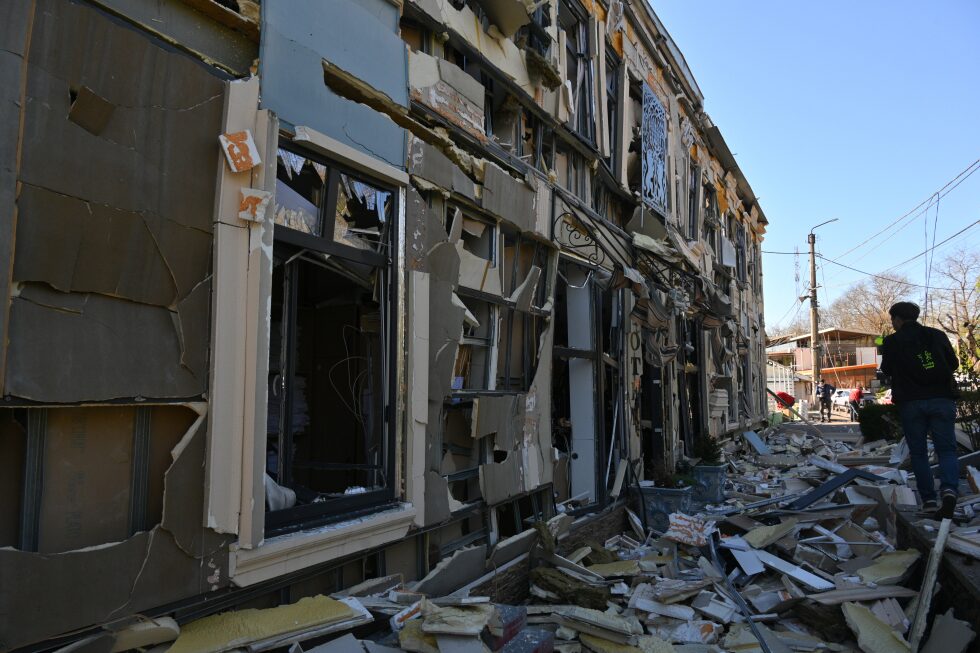
KYIV, Ukraine – As Moscow’s full-scale invasion of Ukraine enters its third year, a pre-dawn Russian drone assault on the southern Ukrainian port city of Odesa left 14 people injured, including two minors, local officials confirmed Monday. The attack targeted residential blocks and key civilian infrastructure, according to Serhii Lysak, head of Odesa’s city military administration. As a strategically critical Black Sea export hub, Odesa has been repeatedly targeted by Russian strikes throughout the ongoing conflict.
Oleh Kiper, governor of Odesa’s regional military administration, added that five of the wounded — all suffering from shrapnel injuries — were admitted to local hospitals for treatment. The assault marked the latest in a continuous wave of Russian attacks on populated civilian areas across Ukraine.
In a parallel development reported by Russian-installed officials, a Ukrainian drone strike left two elderly civilians dead in Dnipriany, a village located in the Russian-occupied portion of Ukraine’s Kherson region. Moscow-appointed regional governor Vladimir Saldo confirmed that the deceased victims were a 70-year-old man and a 70-year-old woman.
In an update posted to the social platform X on Monday, Ukrainian President Volodymyr Zelenskyy disclosed the staggering scale of Russian strikes over the previous seven days: approximately 1,900 attack drones, close to 1,400 heavy precision-guided aerial bombs, and around 60 missiles of multiple variants launched across Ukrainian territory. Zelenskyy noted that years of wartime innovation have allowed Ukraine to develop cutting-edge domestic air defense capabilities, enabling Ukrainian forces to intercept more than 90% of the Russian drones targeting the country. Even so, he emphasized that Ukraine still urgently requires additional American-made Patriot air defense systems to counter Russia’s ballistic missile threats, which current systems are not fully equipped to intercept at scale.
Beyond developments on the frontline, Zelenskyy highlighted a series of recent diplomatic and economic wins for Kyiv. NATO member states outside the United States have finalized a funding framework to procure U.S.-manufactured weapons for Ukraine, the European Union has formally approved a €90 billion ($106 billion) lending package to support Ukraine’s wartime and reconstruction budget, and the bloc is preparing to roll out additional economic sanctions targeting Moscow. Separately, Norway became the latest European nation to formalize a joint drone production partnership with Ukraine, the Ukrainian Defense Ministry announced Monday. Zelenskyy also added that Ukraine is now sharing its anti-drone expertise with Middle Eastern and Gulf nations facing attacks from Iranian unmanned aerial vehicles amid regional tensions tied to the ongoing Iran conflict.
On the offensive side, Ukraine has stepped up long-range drone and missile strikes against Russian energy infrastructure deep within Russian territory, targeting oil terminals and refineries to disrupt Moscow’s core energy export economy. The Institute for the Study of War, a Washington D.C.-based independent think tank, reported Sunday evening that it has verified geolocated evidence of at least 10 separate Ukrainian strikes against Russian oil and gas infrastructure over the past 14 days.
This coverage is part of ongoing reporting on the Russia-Ukraine war from The Associated Press, with full updates available at https://apnews.com/hub/russia-ukraine.
A predawn Russian drone strike hits Ukraine’s Odesa, wounding 14; 2 killed in Russian-held Kherson