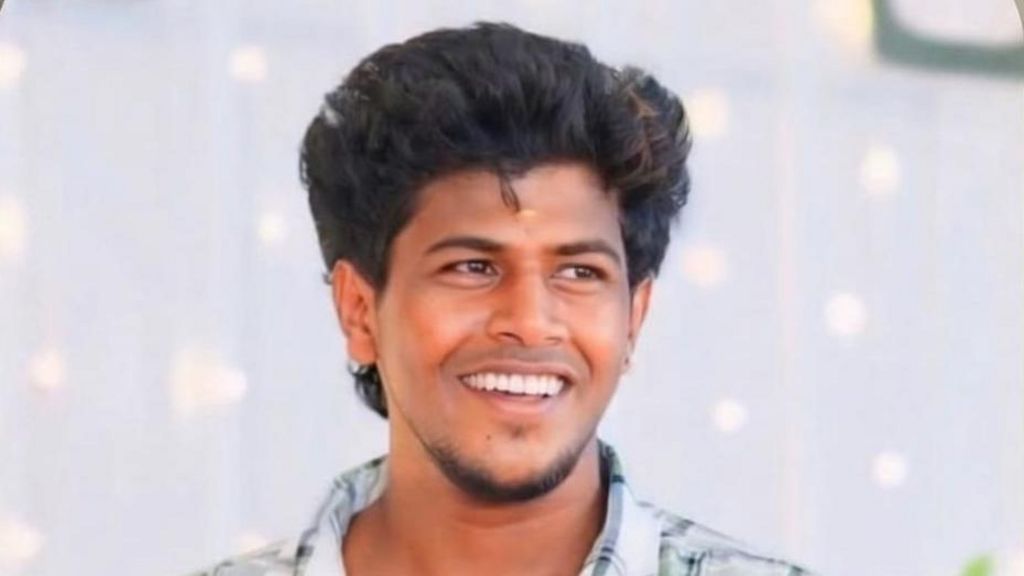
Nearly two months after 26-year-old Akash Delison died in a Tamil Nadu government hospital, his body remains unclaimed in a morgue, held hostage by a grieving family’s demand for justice. Akash, a member of India’s marginalized Dalit community who aspired to become a lawyer to serve his people, died on March 8, just 48 hours after he was taken into police custody alongside a friend in an ongoing criminal case. What began as a local tragedy has now reignited national and international scrutiny of India’s long-running crisis of custodial death and police torture, a problem that disproportionately targets the country’s most vulnerable communities.
Akash’s parents, Rajesh and Anandhi Delison, allege their son was brutally tortured by officers during his detention. Anandhi, who visited her son hours before he succumbed to his injuries, told the BBC he had been blindfolded and beaten severely; an autopsy later confirmed more than 20 external and internal injuries, including a fractured right leg, brain hemorrhaging, and swelling of the heart and lungs. Gopi, the second man arrested alongside Akash, remains in judicial custody. Local police have rejected the torture claims, asserting Akash suffered fatal injuries when he jumped off a bridge while attempting to escape custody.
Widespread public outcry over the incident has already led to administrative action: six police officers have been suspended from duty, and the Tamil Nadu state government has ordered a full probe by the state’s top anti-crime agency. Still, Akash’s family refuses to retrieve his body for funeral rites until all officers deemed responsible for his death are taken into custody. Dalit organizations across the state have condemned the killing and thrown their full support behind the family’s campaign for accountability.
Akash’s death is not an isolated incident. It marks the third reported custodial death in Tamil Nadu alone in 2026, putting a fresh spotlight on a pattern of unlawful violence that stretches across the entire country. Just weeks before Akash’s arrest, the Central Bureau of Investigation (CBI) concluded that the 2025 custody death of 27-year-old Ajith Kumar, a temple security guard held in connection with a false robbery complaint in Sivaganga district, was directly caused by police excessive force. Earlier in April, a special court in Madurai handed down death sentences to nine police officers for the 2020 custody killings of a father and son, a case that previously sparked massive nationwide protests.
Official data from India’s federal home ministry underscores the scale of the crisis: between 2025 and March 15, 2026, 170 custodial deaths have been recorded across the country. The northern state of Bihar reported the highest number at 19, followed by Rajasthan with 18 and Uttar Pradesh with 15. Beyond formal custody deaths, rights groups also document widespread extrajudicial “encounter killings,” staged confrontations that police use to eliminate suspects without going through the formal legal process, a practice disproportionately reported in Uttar Pradesh and Assam.
The crisis has drawn sharp condemnation from the international community. In its 2026 Global Torture Index, the World Organisation Against Torture ranked India as a “high risk” country for torture and ill-treatment by security forces, placing it alongside Pakistan, Nigeria, Colombia and Mexico. The report explicitly notes that severe abuse, including beatings and forced confessions, disproportionately targets marginalized groups: Dalits, Adivasi tribal communities, Muslims, LGBTQIA+ people, and informal migrant workers.
In February 2026, United Nations human rights experts sent an open letter to the Indian government calling for independent, transparent investigations into what they described as “alarming allegations of hundreds of extrajudicial killings and torture-related deaths.” The letter raised particular alarm over the normalized practice of “encounters” and “half-encounters,” warning that the routine use of unlawful violence risks eroding the rule of law. To date, Alice Edwards, the UN Special Rapporteur on torture, confirmed the Indian government has not responded to the letter, and the 60-day deadline for a reply has expired. The BBC has reached out to India’s federal home ministry, Tamil Nadu’s home secretary, and the state’s police director general for comment on Akash’s case and the broader allegations, but has not received a formal response as of publication.
Legal experts and human rights activists say that while holding individual officers accountable for high-profile cases like Akash’s is a critical step, deep systemic reform is the only way to end the ongoing crisis. India’s constitution and existing criminal code already include formal legal safeguards against custodial abuse, but consistent enforcement remains weak across the country. Anupama Arigala, a New Delhi-based legal consultant, argues that police, magistrates, and prosecutors must shift away from a culture prioritizing arrests and convictions over due process.
“These three parties must carefully analyze if there’s really a need for police or judicial custody, or if the accused can participate in the investigation just as effectively while out on bail,” Arigala explained. She added that magistrates must proactively screen for signs of torture when suspects are brought to court, a step that is often skipped due to overloaded dockets and systemic understaffing that plagues India’s judicial system.
UN experts and activists alike have also called on India to ratify the UN Convention Against Torture, a step that would require the country to pass a standalone national law explicitly criminalizing torture—legislation that does not currently exist on India’s federal books. While activists acknowledge that a new law will not eliminate custodial abuse overnight, they say it would mark a critical formal recognition of the crisis and create a framework for long-term institutional change.
For Rajesh Delison, that change cannot come soon enough. He told the BBC his family has yet to recover from the shock of losing Akash, a young man who worked in his shop while studying to become a lawyer to help his marginalized community. “They have snuffed out the life of an active young man who had big dreams for the future,” he said. For now, his family remains resolved: they will continue to leave Akash’s body in the hospital morgue until they get the justice they have pledged to fight for.