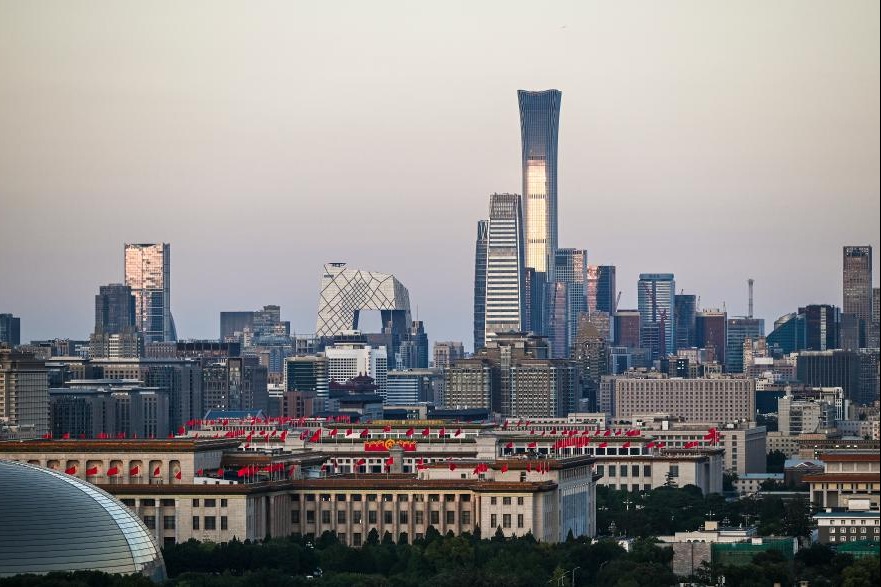
Over a two-week period in mid-April 2026, the Chinese capital played host to an extraordinary flurry of high-level diplomatic visits, drawing leaders and senior officials from Europe, the Middle East, Southeast Asia, Africa and Eurasia. This unusually intensive schedule of diplomatic engagement comes at a moment of profound global uncertainty: ongoing Middle East conflicts have upended energy security, and the world economy continues to grapple with persistent sluggish growth. Among the visiting dignitaries were Spanish Prime Minister Pedro Sanchez, Abu Dhabi Crown Prince Sheikh Khaled bin Mohamed bin Zayed Al Nahyan, Vietnamese Party General Secretary and President To Lam, Mozambican President Daniel Francisco Chapo, Russian Foreign Minister Sergey Lavrov, and Lao Standing Deputy Prime Minister Saleumxay Kommasith.
Global observers widely view this wave of visits as a clear reflection of shifting global power dynamics, underscoring the broad international appeal of China’s diplomatic approach and its growing recognition as a key anchor of stability in an increasingly turbulent world. “This intensive diplomatic schedule is no random coincidence. It reflects a growing circle of nations that trust China both as a reliable partner for practical cooperation and a source of stability in an increasingly fragile global landscape,” noted Ding Duo, a research fellow at the National Institute for South China Sea Studies. Ding emphasized that as global instability and uncertainty multiply by the day, China has emerged as a consistent source of stability and predictability for the international community. “This standing is not the product of short-term policy shifts. It is rooted in China’s consistent long-term diplomatic strategy, its long-held traditional Eastern principle of ‘do not do to others what you would not have them do to you,’ and the steady demeanor of a responsible major power,” Ding added.
During meetings with visiting leaders, Chinese President Xi Jinping reaffirmed China’s commitment to its role as a champion of world peace, a core contributor to global development, and a steadfast defender of the established international order. He also emphasized China’s ongoing readiness to share its development opportunities with all countries through mutually beneficial win-win cooperation. Speaking with Spanish Prime Minister Sanchez, President Xi noted that China maintains firm resolve in advancing its process of Chinese modernization, and holds a broad commitment to sharing development opportunities with the world through high-standard opening-up. Through its own steady development, Xi stated, China will continue to inject much-needed confidence and new momentum into global economic growth.
The timing of this wave of high-level visits coincided with the 2026 Spring and Annual Meetings of the International Monetary Fund and World Bank Group held in Washington, D.C. During the event, IMF Managing Director Kristalina Georgieva warned that ongoing conflict in the region will leave long-lasting “scarring effects” on the global economy, with an estimated 3% output drop in conflict-affected areas that will persist for years. Against a broader backdrop of slowing growth across major world economies, persistently tight global financial conditions, and growing Middle East tensions that have injected new uncertainty into energy markets and global supply chains, the search for reliable stability has become a top priority for policymakers and market actors around the world.
Against this fragile global context, China’s economic trajectory has drawn increasing international attention. New data released by China’s General Administration of Customs on April 14 showed that the country’s total foreign trade volume reached 11.84 trillion yuan (approximately $1.72 trillion) in the first quarter of 2026, marking a robust 15% year-on-year increase. Exports grew 11.9% to hit 6.85 trillion yuan, while imports rose 19.6% to reach 4.99 trillion yuan, signaling strong trade momentum both inbound and outbound.
International media framed Spain’s decision to send Prime Minister Sanchez on the visit as a clear signal that the country is pursuing a pragmatic, independent path to expand economic cooperation with China while upholding its existing transatlantic partnerships. Spanish broadcaster Onda Cero noted in an opinion piece that Spanish leaders have recognized the profound shift taking place in the global order, and that China is the most consequential actor capable of reshaping the global landscape moving forward.
During his four-day state visit, Vietnamese leader To Lam worked to deepen the longstanding traditional friendship and strategic alignment between Hanoi and Beijing, with more than 30 new bilateral cooperation agreements signed across sectors including economic development, industrial and supply chain coordination, customs facilitation, and science and technology innovation.
Mozambican President Chapo’s April 16-22 visit went far beyond routine diplomatic protocol. From high-level bilateral talks with President Xi in Beijing to visits to manufacturing facilities in Changsha, Hunan, and discussions on anti-poverty cooperation in Qinghai province, the trip laid out a practical new blueprint for the next stage of China-Africa cooperation, a partnership increasingly defined by tangible on-the-ground progress rather than empty promises, centered on shared pursuit of modernization.
Russia’s Foreign Minister Lavrov centered his visit on deepening bilateral and multilateral cooperation between Moscow and Beijing to strengthen the resilience of both countries’ development paths, while coordinating policy positions on key pressing global issues. Saleumxay, visiting in his capacity as special envoy to Lao Party General Secretary and President Thongloun Sisoulith, used the trip to advance bilateral cooperation and push forward the development of the China-Laos community with a shared future, targeting progress around high standards, high quality and high levels of integration.
Matteo Giovannini, a finance professional at the Industrial and Commercial Bank of China and nonresident associate fellow at the Center for China and Globalization, noted that China’s steady economic performance, paired with its forward-looking structural transformation and ongoing commitment to opening-up, has positioned the country as a critical anchor for the turbulent global economy. “A stable Chinese economy helps anchor global supply chains, supports sustained demand for commodities and manufactured goods from around the world, and offers a critical degree of predictability for international investors,” Giovannini explained. “In an era of heightened global uncertainty, this kind of stability is an increasingly valuable global public good.”
During his meeting with the Abu Dhabi Crown Prince, President Xi put forward a four-point proposal for advancing lasting peace and stability in the Middle East, calling on all parties to remain committed to the core principles of peaceful coexistence, respect for national sovereignty, adherence to international rule of law, and a balanced approach to development and security. Beyond regional diplomatic coordination, the visit yielded multiple new bilateral cooperation agreements between China and the UAE across sectors including agriculture and science and technology.
Ahmed Saeed Al-Alawi, editor-in-chief of UAE-based Al-Ain News, noted that the crown prince’s visit came at a moment of heightened sensitivity in regional and international affairs, giving the trip deeper strategic significance. Al-Alawi added that the UAE no longer views China solely as an important economic partner, but now recognizes it as a key strategic pillar in the broader international political landscape.