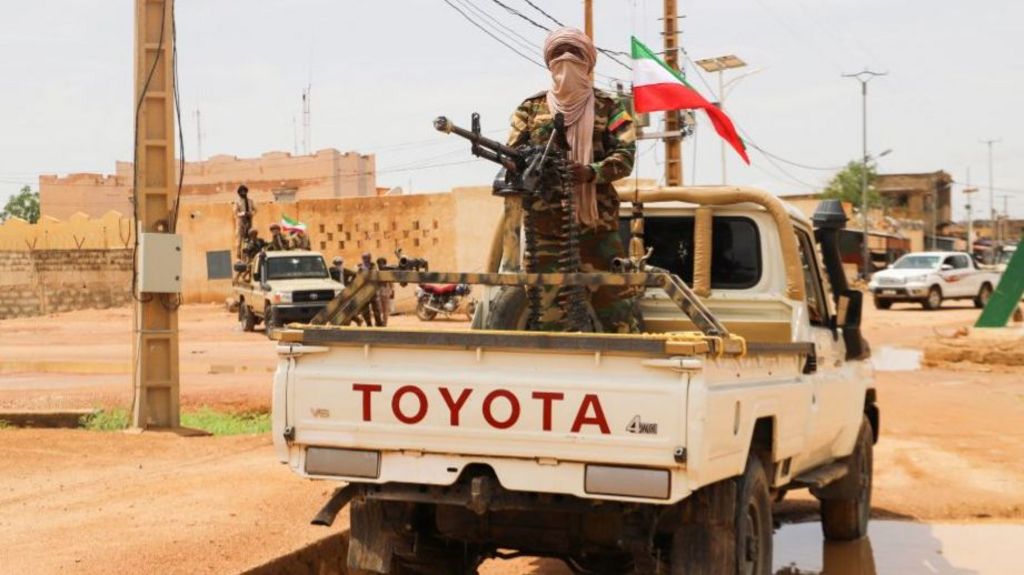
Mali has been plunged into a new wave of deadly violence following a sweeping series of coordinated attacks carried out by separatist insurgents and jihadist militants across the country on Saturday, which has left top officials dead, triggered major military clashes, and shifted control of a strategic northern city. The Azawad Liberation Front (FLA), a separatist group fighting to establish an independent ethnic Tuareg state in northern Mali, announced that Russian mercenaries deployed by Mali’s ruling military junta have agreed to withdraw from the northern city of Kidal following two days of intense urban fighting. The FLA now claims full control of Kidal, a city that served as the separatist movement’s unofficial headquarters for more than a decade before Malian government forces backed by Russian mercenaries seized control of it in late 2023.
The wave of violence began Saturday, when the FLA joined forces with multiple armed groups to launch synchronized assaults across Mali, stretching from the capital Bamako to northern and central regions. The assault targeted a range of key sites, including Kati, a major military base located just outside Bamako, the northern cities of Gao and Kidal, and the central Malian hubs of Sevare and Mopti. According to regional analysts, the assault was split between two sets of attackers: the FLA focused its operations on key northern population centers, while the al-Qaeda-affiliated jihadist group Jama’at Nusrat al-Islam wal-Muslimin (JNIM) carried out parallel strikes across multiple locations nationwide.
Ulf Laessing, head of the Sahel programme at the Konrad Adenauer Foundation in Mali, described the coordinated assault as the largest unified jihadist attack on Mali in several years. One of the most shocking developments to emerge from Saturday’s violence was the reported death of Mali’s Defence Minister Sadio Camara, who was killed in a car bomb attack on his convoy near Kati. Multiple news agencies, citing confirmation from Camara’s family and French media, reported that the attack also killed at least three of his family members. The Malian government has not officially confirmed Camara’s death, but military officials have acknowledged ongoing fighting across multiple regions.
On the ground in Kidal, FLA spokesman Mohamed Elmaouloud Ramadane noted that the city was not fully captured during Saturday’s initial attacks, as small contingents of Malian army troops and Russian mercenaries remained holed up in parts of the city. Clashes between FLA fighters and pro-government forces resumed in Kidal on Sunday, but just hours after fighting restarted, Ramadane announced a breakthrough: a deal had been reached to allow Russian mercenaries, now part of the officially recognized Africa Corps, to withdraw from Kidal under secure conditions. Shortly after Ramadane’s social media announcement, the FLA confirmed that its fighters were escorting the withdrawing Russian mercenary contingent out of the city’s boundaries. One FLA field commander who participated in the offensive told the BBC that the group had spent months planning the assault, and that its next objectives are to seize control of Gao before moving on to Timbuktu, which the commander claimed would fall easily.
Mali’s state broadcaster ORTM has given a far more muted account of the violence, reporting that only 16 people – a mix of civilians and soldiers – were injured in the attacks, which it said caused only limited damage. The broadcaster also claimed that multiple “terrorists” had been killed in government counterattacks, and that the situation across all affected areas is “completely under control.” Despite the government’s claims, Malian military officials confirmed in an official statement Sunday that fighting is still ongoing in Kidal, Kati, and other regions across the country. The statement warned that the recent wave of violence would “not go unanswered,” and announced that a nationwide security alert had been issued. Authorities have stepped up large-scale patrols, reinforced border and urban checkpoints, and imposed curfews in multiple high-risk areas. In Bamako, a curfew is in effect from 21:00 local time to 06:00 GMT, scheduled to expire Monday.
The international community has quickly condemned the surge in violence. United Nations Secretary-General António Guterres released a statement condemning the “acts of violence” and expressed his solidarity with the people of Mali. The Economic Community of West African States (ECOWAS), the West African regional bloc that Mali, Niger, and Burkina Faso left following a string of military coups that brought military juntas to power in all three nations, also issued a formal condemnation. Mahmoud Ali Youssouf, chair of the African Union Commission, said he was monitoring the rapidly evolving situation with deep concern.
Mali has been mired in continuous instability for more than a decade. The FLA has waged a long-running separatist campaign for an independent Tuareg homeland in northern Mali, and currently holds de facto control over large swathes of that territory. The country is currently ruled by a military junta led by General Assimi Goïta, who first seized power in a 2020 coup after widespread public anger over the government’s failure to contain the insurgency. The junta claimed it would restore security and push back against armed groups, and initially enjoyed broad popular support for its promise to resolve the long-running crisis that began with the 2012 Tuareg rebellion, which was later hijacked by transnational Islamist militant groups. After the junta took power, UN peacekeepers and French counter-insurgency forces that had been deployed to Mali withdrew from the country, and the military government turned to Russian mercenaries to support its counter-insurgency operations. Despite this partnership, the jihadist insurgency has only expanded, and large portions of northern and eastern Mali remain outside of government control.