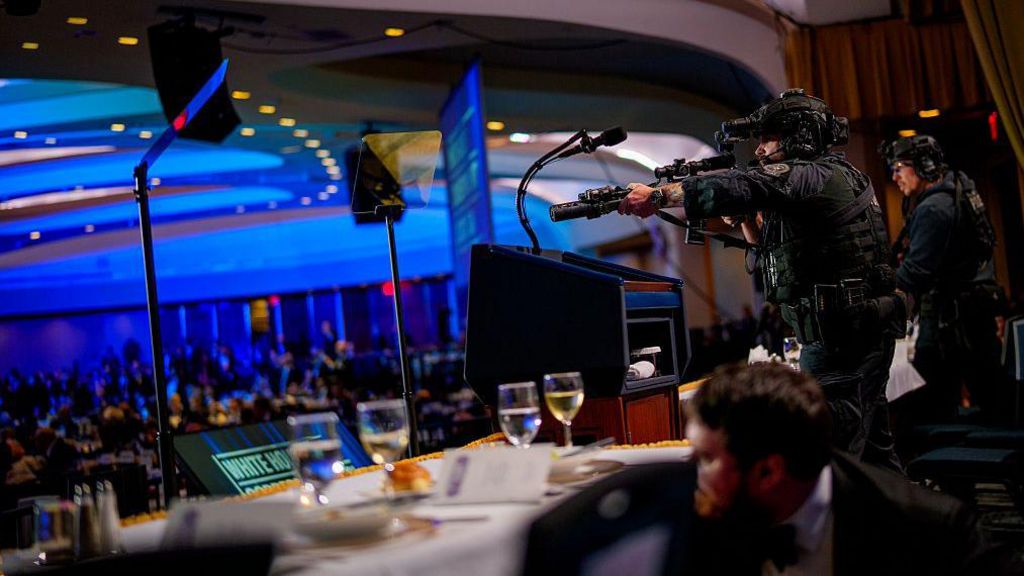
On a Saturday evening in Washington D.C., gunfire interrupted the annual White House Correspondents’ Association dinner at the Washington Hilton, throwing the nation’s capital into another national security crisis and triggering urgent questions about gaps in presidential protection protocols.
Even hours after the incident was contained, U.S. President Donald Trump appeared before reporters in a crisp black tuxedo, reflecting on the recurring threats that have followed him through his political career. “I can’t imagine that there’s any profession that is more dangerous,” he told assembled media. While Trump remains the most heavily protected public figure in the world, guarded by a large contingent of Secret Service agents around the clock, three major security incidents targeting the president in less than two years have exposed persistent vulnerabilities in the system designed to keep him safe.
This latest incident marks the third high-profile attempt on Trump’s life since summer 2024. The first saw a bullet graze his ear during a campaign rally in Butler, Pennsylvania. Just 64 days later, a second would-be assassin targeted Trump while he played golf at his private course in Florida. Now, just months into his second term, a shooting at one of Washington’s most high-profile annual political gatherings has once again put presidential security under intense public and political scrutiny.
The suspected shooter has been identified as 31-year-old Cole Tomas Allen, a registered guest at the Washington Hilton. Authorities confirmed Allen was armed with a shotgun, a handgun, and multiple edged weapons when he attempted to breach security checkpoints leading to the dinner ballroom. Closed-circuit footage shared on social media by Trump shows Allen charging through a Secret Service checkpoint located one floor above the main gala space. He exchanged gunfire with responding law enforcement officers before being taken into custody, and no civilians or protecting agents were seriously injured during the confrontation. Trump and Vice-President JD Vance were immediately evacuated from the stage by Secret Service agents and were never in imminent danger, according to official statements.
Multiple witnesses who attended the dinner, including senior journalists and foreign diplomats, have raised sharp questions about the laxity of on-site security arrangements. BBC Chief North America Correspondent Gary O’Donoghue, who was present at the event, noted that while surrounding roads were closed for hours ahead of the dinner, security screening at the venue itself was surprisingly minimal. “The man on the door outside only took a cursory look at my ticket from what must have been six feet away,” he recalled. Former UK ambassador to Washington Kim Darroch, a veteran of multiple past correspondents’ dinners, criticized the layered security setup for the event, telling the BBC’s *Sunday with Laura Kuenssberg*: “If you were there [as a hotel guest] and you had bad intentions about breaking into this dinner, there’s just one security thing you had to get past… and then you’re in the ballroom.” The hotel remained open to regular paying guests throughout the gala, a decision that allowed Allen access to the building without additional screening.
Acting U.S. Attorney General Todd Blanche told NBC News that early investigations indicate Allen intended to target senior administration officials, “likely including the president.” Trump later used the incident to bolster his case for a new, purpose-built White House event ballroom, a project currently tied up in litigation. He described the Washington Hilton as “not a particularly secure building” and argued the new facility would address critical security gaps. “It’s actually a larger room, and it’s much more secure. It’s drone proof. It’s bullet-proof glass. We need the ballroom,” he emphasized. At the same time, he praised the Secret Service agents who responded to the threat, saying they did “a great job” evacuating him and the Vice-President and stopping the suspect quickly.
Law enforcement and presidential security experts have offered mixed assessments of the incident response. Many argue that the system worked as intended: the gunman never breached the ballroom where hundreds of high-profile guests were gathered, and agents followed their training to protect the president immediately. Former FBI special agent Jeff Kroeger told the BBC: “This is exactly what the Secret Service is trained do to. When gunshots were heard they converged on the president, creating a body barrier.” Former Secret Service agent Barry Donadio similarly noted that there was no shortage of personnel deployed to the event, adding that the suspect was stopped well before he could reach primary targets. Moving forward, experts predict security protocols for all Trump-related events will be tightened, most notably with expanded secure perimeters around venues.
Beyond immediate questions about security at the dinner, the incident has refocused national attention on the growing crisis of political violence in the United States. Official data shows threats against sitting members of Congress and senior executive branch officials have risen sharply in recent years: U.S. Capitol Police investigated more than 8,000 threats against lawmakers in 2023, a 50% increase compared to 2018.
This shooting is just the latest in a long string of high-profile political attacks stretching back nearly a decade. In 2017, House Majority Whip Steve Scalise and four other people were shot and wounded during a congressional baseball practice in Virginia. In 2022, Paul Pelosi, husband of then-House Speaker Nancy Pelosi, was attacked with a hammer and suffered a fractured skull. Just last year, Minnesota State Representative Melissa Hortman and her husband were shot and killed, while State Senator John Hoffman and his wife were seriously injured in a targeted attack. Just months later, prominent conservative commentator Charlie Kirk was assassinated while speaking at a Turning Point USA event in Utah, with the attack filmed and spread widely across social media platforms.
Notably, the 1981 assassination attempt on former President Ronald Reagan also took place outside the Washington Hilton, the same venue that hosted Saturday’s dinner. Reagan survived a punctured lung from the gunshot wound inflicted by would-be assassin John Hinckley Jr.
When asked about the recurring threats against him, Trump noted that he had studied the history of presidential assassination attempts, pointing out that iconic past presidents including Abraham Lincoln also faced repeated threats. “They’re big names, and I hate to say I’m honoured by that, but I’ve done a lot [for the US],” he said.