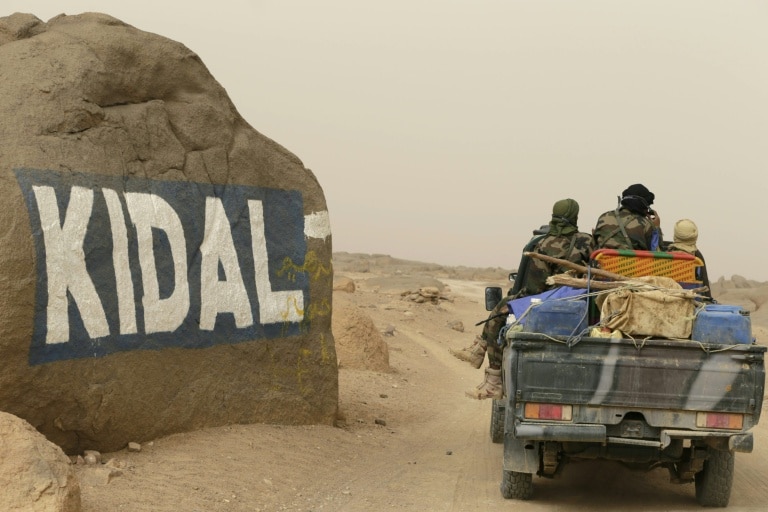
Renewed armed confrontation broke out on Sunday in Kidal, the strategically critical northern Malian town long centered in the country’s decade-long conflict, pitting Tuareg rebel forces aligned with jihadist fighters against Malian government troops backed by Russian personnel. The outbreak of new fighting comes just 24 hours after insurgents launched a wave of coordinated attacks across the restive Sahel country, the most violent assault to hit Mali since the ruling military junta seized power in 2020.
Mohamed Ramdane, a spokesperson for the Tuareg rebel coalition the Azawad Liberation Front (FLA), confirmed Sunday that hostilities had resumed in Kidal. “Fighting resumed in Kidal this morning. We want to drive out the last Russian fighters who have taken refuge in a camp,” Ramdane stated. A local elected official, speaking on condition of anonymity, also verified the renewed clashes, confirming that residents across the town have heard sustained gunfire.
Kidal, long considered a historic stronghold of the Tuareg movement, was recaptured by Malian army forces in November 2023 with backing from Russia’s Wagner paramilitary group. That seizure ended more than 10 years of direct rebel control over the northern town, making it a powerful symbolic prize for both sides in the ongoing conflict. Beyond Kidal, the FLA has also claimed to have seized new positions in Mali’s northern Gao region, expanding the scope of their recent offensive.
A anonymous security source speaking to Agence France-Presse clarified the strategic logic behind the recent insurgent campaign: “The aim of the attackers was not to seize and control cities permanently, but to carry out coordinated actions in order to at least capture Kidal, which is a rather powerful symbol.”
Mali has been ravaged by jihadist insurgency and intercommunal conflict for more than 11 years, but Saturday’s coordinated attacks marked the deadliest and most extensive assault since the 2020 military coup that brought the current junta to power. Strikes were launched not only in northern regions but also on the outskirts of Mali’s capital Bamako, hitting multiple population centers across the large West African nation.
In an official statement released Saturday evening, the Malian government reported that the violence left 16 civilians and military personnel wounded, alongside what it described as “limited material damage.” The government also claimed that “the situation is totally under control in all the localities” targeted in the attacks.
However, developments in the capital and surrounding areas have sparked widespread anxiety among residents. Multiple witnesses and a medical source confirmed that on Sunday morning, Malian soldiers deployed heavy security around a Bamako clinic where Defense Minister Sadio Camara was admitted the previous day. Residents also reported that Camara’s official residence in Kati, a garrison town adjacent to Bamako that serves as a key stronghold of the ruling junta, was heavily damaged in a powerful explosion. Aides to the defense minister have denied claims that Camara was wounded in the attack.
An AFP journalist reporting from Bamako confirmed that access to all military facilities in the capital has been blocked by road barriers and makeshift barricades of burning tires. In Senou, the outlying Bamako district that houses the city’s main airport and saw heavy fighting on Saturday, residents remain on high alert. “I still hear the blasts ringing in my ears. It’s traumatising,” one local resident told reporters. In Kati, while calm has returned to the area after jihadist fighters withdrew, residents continue to live in constant fear of new attacks. “The jihadists left the area, but we are living in fear,” one Kati resident said Sunday.
United Nations Secretary-General António Guterres has formally condemned the wave of violence across Mali. “The Secretary‑General is deeply concerned by reports of attacks in several locations across Mali,” his spokesperson Stephane Dujarric said in an official statement. Guterres also called for unified global action to address the growing security crisis in the Sahel, adding: “The Secretary-General calls for coordinated international support to address the evolving threat of violent extremism and terrorism in the Sahel and to meet urgent humanitarian needs.”
In recent years, Mali’s ruling military leadership has shifted the country’s foreign policy dramatically, cutting long-standing security and diplomatic ties with former colonial power France and other Western nations, and forging a close alliance with Russia. Following the mutiny that ended the Wagner Group’s operations in Mali, the Russian Africa Corps, a paramilitary organization under direct control of the Russian Ministry of Defense, has taken over Wagner’s role supporting Malian government forces in their fight against insurgent and jihadist groups. Mali holds significant untapped reserves of gold and other valuable strategic minerals, making its ongoing instability a critical concern for global markets and regional security.