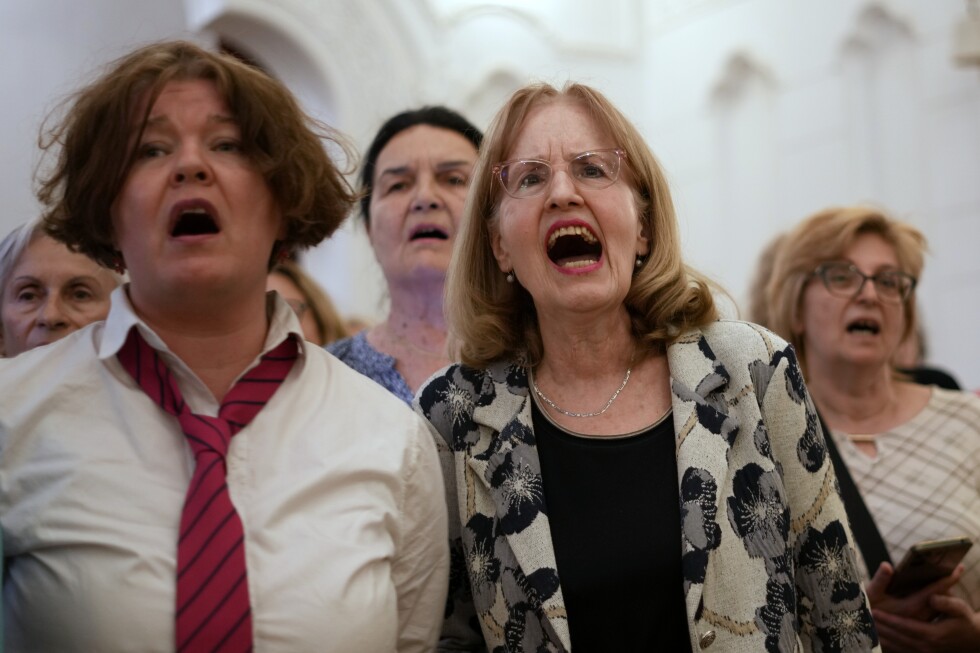
Four years after launching with just a couple dozen singers in the small central Serbian town of Gornji Milanovac, an unconventional amateur pop choir has grown into a nationwide movement, offering a much-needed outlet for joy and connection in a country grappling with persistent political division and social tension.
Founded by trained music educator Nenad Azanjac and his wife, Pop Hor (Pop Choir) operates on a radical, inclusive founding principle: anyone can sing, no experience required. Unlike most traditional vocal groups, the organization has no auditions, no mandatory music reading skills, and no voice tests—an approach that sets it apart in Serbia, where community choirs remain far less common than in many other parts of the world. Modeled after inclusive international community singing projects, the initiative invites participants ranging in age from 5 to 105, framing group singing as a tool for stress relief and joy rather than professional performance.
Today, the movement has expanded to 10 cities across the Balkan nation, attracting hundreds of members, the vast majority of whom are women of all generations. Since its 2022 founding, roughly 2,000 people have sung with Pop Hor, and the group’s founders have ambitious plans to expand across the entire Balkan region. Weekly performances regularly fill community halls and venues across Serbia, with the choir’s repertoire drawing primarily from popular Serbian music, alongside occasional tracks from Croatian and Bosnian artists. Despite its entirely amateur status, the group has even been invited to perform at festivals and public events both across Serbia and in neighboring countries.
For many members, the choir has become a vital escape from the daily stress of Serbia’s volatile political climate. Seventy-two-year-old member Nevenka Bila, who participates in ongoing pro-democracy protests across the country, explained that the choir offers a gentle, positive counterpoint to the tension of public activism. “In this madness that we are living, where I spend half of my free time in the streets fighting for basic human rights, I found something that feels so good for me,” Bila said. “I discovered a new world.”
Sixty-two-year-old economist Radmila Kozarac echoed that sentiment, saying the choir has transformed her life for the better. “I never miss a class,” Kozarac said, noting that she has formed deep new friendships through the group and looks forward to post-rehearsal coffee and chats with fellow members. “It is joyful, it reduces stress,” she said of the group’s impact on her mental health.
Experts back up the perceived mental health benefits of the choir’s model. Aleksandra Djuric, a psychologist and professor at Belgrade’s Singidunum University, explained that group singing has well-documented positive neurobiological and psychological effects. When people sing together, she noted, shared collective energy lowers stress hormone (cortisol) levels while boosting production of endorphins and other positive mood hormones tied to connection and happiness. At a time when most people are constantly bombarded by overwhelming, often distressing news and information, Djuric emphasized the critical need for dedicated spaces to disconnect, relax, and build social connection.
Serbia has a long history of systemic stress: the country endured years of armed conflict, international sanctions, and crippling economic crisis in the 1990s, and remains politically fractured today, with ongoing economic struggles. In 2024, widespread youth-led protests erupted against the government of populist President Aleksandar Vucic, triggered by a deadly train station accident that many blamed on systemic negligence and corruption in large state-run infrastructure projects.
Azanjac said many new members join the choir on the recommendation of their therapists, who prescribe group singing as a natural way to manage chronic stress. For these participants, the biggest benefit is not singing itself—but the sense of belonging and togetherness the group fosters. “Singing comes second, socializing comes first,” Azanjac said, adding that participants “find a sense of belonging here, they enjoy it.” With growing momentum across Serbia, Azanjac says the movement will continue expanding: his end goal is to get the entire Balkan region singing together.