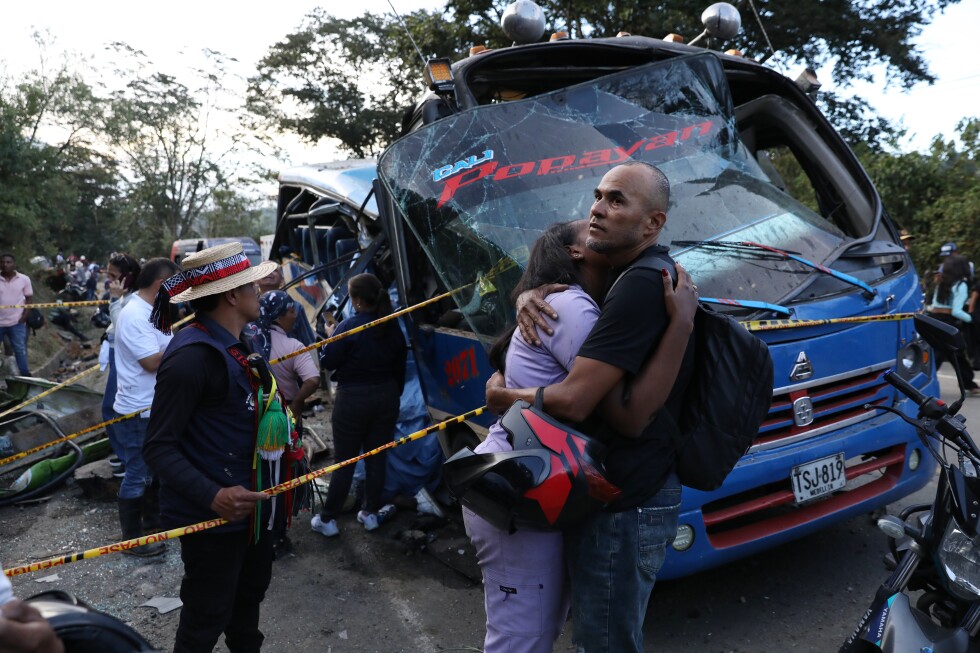
On a routine Saturday commute along southwestern Colombia’s critical Pan-American Highway, a hidden explosive device detonated aboard a civilian passenger bus, leaving 13 people dead and at least 38 others injured, including five children. The attack, labeled a deliberate act of terrorism by the country’s top military commander, comes as violent clashes between drug trafficking-linked illegal armed groups intensify across the contested Cauca and Valle del Cauca regions.
Regional Cauca Governor Octavio Guzmán first confirmed details of the attack in a post on the social platform X, noting the blast occurred in the municipality of Cajibio as the bus traveled through the area. Carolina Camargo, the region’s health secretary, shared with local broadcaster Noticias Caracol that five minors had been hurt in the explosion, a detail that has amplified public outrage over the attack.
General Hugo López, head of Colombia’s Armed Forces, told reporters during an urgent press briefing that the attack can be traced to the network of Iván Mordisco—one of the nation’s most wanted fugitives—and the Jaime Martínez faction. Both groups are made up of dissident fighters who split from the now-disbanded Revolutionary Armed Forces of Colombia (FARC) and have refused to honor the 2016 peace agreement signed between the original FARC organization and the Colombian government.
Colombian President Gustavo Petro publicly condemned the deadly strike in his own X post, emphasizing that the majority of victims—many of whom were Indigenous civilians—were innocent bystanders caught in the crossfire of criminal power struggles. “Those who carried out the attack and killed seven civilians — and wounded 17 others — in Cajibío — many of them Indigenous people — are terrorists, fascists, and drug traffickers,” he wrote.
This bus bombing is not an isolated incident. López confirmed that the attack is the deadliest in a rapid series of at least 26 violent targeting attempts across southwestern Colombia over just 48 hours, all of which have exclusively impacted civilian communities and public infrastructure.
Other incidents in the two-day wave of violence include an armed shooting attack on a rural police outpost in Jamundi, and an assault on a Civil Aviation radar installation in El Tambo. Early Saturday, security forces successfully disabled three explosive-laden drones targeting the radar facility before they could detonate, resulting in no injuries. On Friday, two car bombs were set off near military bases in the cities of Cali and Palmira, causing extensive material damage but no reported fatalities.
The sharp escalation of violence across the region forced an emergency gathering of top national and local security officials in Palmira on Saturday, led by Colombian Defense Minister Pedro Sánchez. The deadly bus blast occurred while the delegation, which included regional governors and local law enforcement leaders, was already in session to address the growing security crisis.
“These criminals seek to instill fear, but we will respond with firmness,” Sánchez wrote on X following the attack. Francisca Toro, governor of Valle del Cauca, has issued an urgent appeal to the national government for immediate support, calling for reinforced security deployments, expanded intelligence operations, and decisive action against criminal groups amid what she describes as a “terrorist-level escalation” of violence.
Security analysts and government officials confirm that Cauca and Valle del Cauca are strategic hotly contested territories for illegal armed groups fighting to control smuggling routes that lead to the Pacific port of Buenaventura, one of the most important transit points for cocaine shipments bound for consumer markets in Central America and Europe.
In response to the wave of attacks, authorities have issued substantial rewards for information leading to the capture of key criminal leaders. The national government is offering more than $1 million for tips that lead to the arrest of Marlon, the identified head of the local dissident faction. Local authorities in Cali have separately offered a $14,000 reward for information that helps identify and locate those responsible for Friday’s car bomb attacks in Cali and Palmira.