Tensions and shifting developments continue to roil the ongoing Middle East conflict this week, bringing a cascade of new changes that have thrown future diplomatic efforts and regional stability into question.
One of the most significant developments came from United States President Donald Trump, who announced Saturday in an interview with Fox News that he had called off a planned diplomatic trip by US envoys to Pakistan, where the delegation was set to hold negotiations with Iranian officials aimed at de-escalating the ongoing war. “They were getting ready to leave, and I said, ‘Nope, you’re not making an 18 hour flight to go there. We have all the cards. They can call us anytime they want, but you’re not going to be making any more 18 hour flights to sit around talking about nothing,’” Trump told Fox News during a phone interview. The president emphasized that the decision to scrap the diplomatic trip does not signal an imminent resumption of full-scale hostilities, leaving the door open for Tehran to initiate new communication at any time.
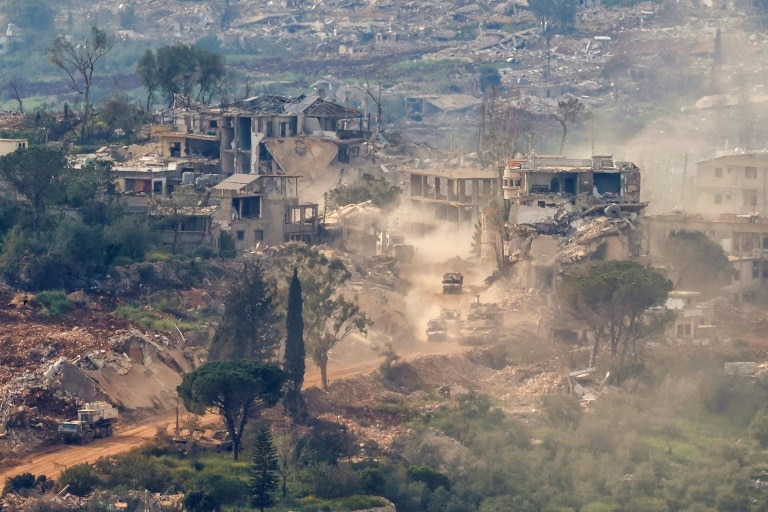
Across southern Lebanon, violence persists despite a recently extended ceasefire between Israeli forces and the Iran-aligned militant group Hezbollah. Lebanon’s national health ministry confirmed that four civilians and combatants have been killed in fresh Israeli airstrikes across the southern region of the country. Photographic evidence captured from northern Israel on April 25 shows Israeli tanks and military armored vehicles moving along roads flanked by destroyed residential structures in southern Lebanon, underscoring the widespread destruction that has accompanied the ongoing clashes.
Looking toward post-conflict security efforts, Germany has announced plans to deploy a minesweeper to the Mediterranean Sea in preparation for a potential security mission in the Strait of Hormuz once active hostilities between the US and Iran conclude. A spokesperson for the German defense ministry confirmed the deployment plans in a statement to Agence France-Presse.
Iranian officials have pushed back against US actions, framing Washington’s position as a desperate bid to exit a conflict it cannot win. “The United States is looking for a face-saving way to escape the war quagmire it has become trapped in,” a spokesman for Iran’s defense ministry said. The Iranian military further issued a stark warning that it will launch a full military response if the US continues its blockade of Iranian ports, a policy Tehran has labeled “state-sponsored banditry.”
Domestically, Iran has extended its wave of wartime executions, putting to death a man the country’s judiciary claims carried out covert operations on behalf of Israel’s national intelligence agency during large-scale anti-government protests that swept the country in January.
In a separate development welcomed by Washington, an American-Kuwaiti journalist who contributed to prominent international outlets including The New York Times, PBS, and Al Jazeera English has been released from custody in Kuwait. Ahmed Shihab-Eldin was arrested on March 3 amid a government crackdown on individuals sharing footage of the US-Iran war, facing charges including spreading false information, endangering national security, and misuse of a mobile communications device. A US State Department official confirmed his release after weeks of detention.
As part of Washington’s ongoing pressure campaign against Tehran, US Treasury Secretary Scott Bessent announced that American authorities have seized and frozen $344 million worth of cryptocurrency assets linked to Iranian entities. The move comes as the US seeks to ramp up economic pressure on Iran amid widespread war-related disruptions to global energy supplies.