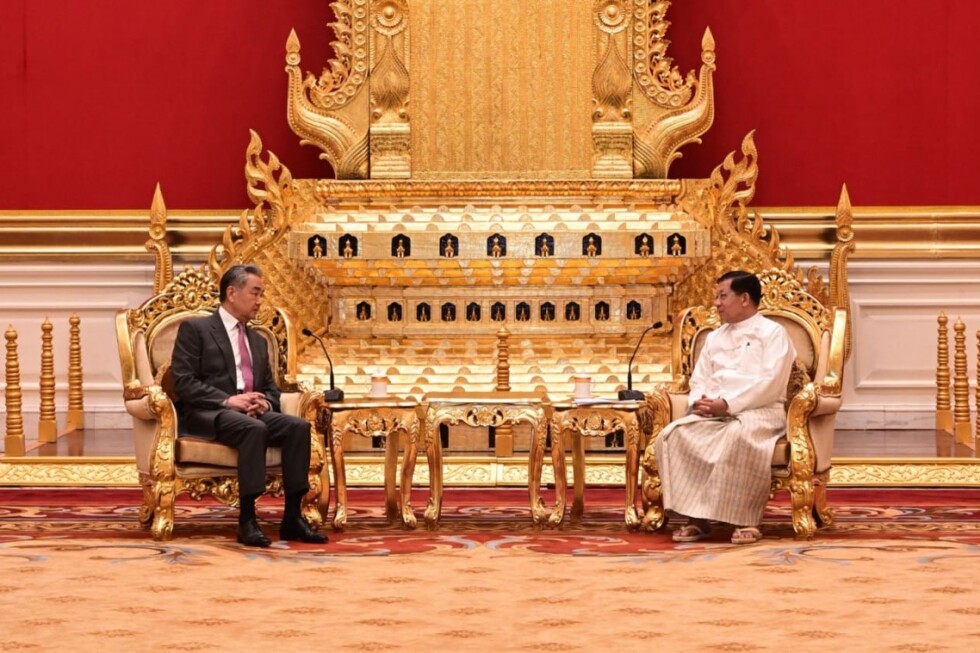
During a regional tour focused on deepening Beijing’s political, security, and strategic partnerships across Southeast Asia, China’s top foreign policy official arrived in Myanmar’s capital Naypyitaw on Saturday to hold talks with the leader of the country’s military-aligned administration.
The meeting brought together Chinese Foreign Minister Wang Yi and Myanmar President Min Aung Hlaing, who was sworn into office on April 10 following a general election widely dismissed by international critics as neither free nor fair. The poll was structured to cement the military’s hold on national power, five years after the armed forces seized control from Aung San Suu Kyi’s democratically elected civilian government. State-run Myanmar Radio and Television (MRTV), the junta’s official broadcaster, reported that the two leaders discussed strengthening Myanmar’s diplomatic engagement globally and advancing cooperative initiatives within the Association of Southeast Asian Nations (ASEAN). Per MRTV’s account, Min Aung Hlaing expressed gratitude for the rapid congratulations extended by Chinese President Xi Jinping, who sent a formal message within hours of Min Aung Hlaing’s election result being confirmed.
China holds extensive geopolitical and economic stakes in Myanmar, holding the status of the country’s largest trading partner and a long-standing strategic ally. Beijing has poured billions of dollars into critical Myanmar infrastructure, including cross-border mines, oil and gas pipelines, and large-scale energy and transport projects. It also ranks alongside Russia as one of Myanmar’s top suppliers of military hardware. Notably, China is among the small handful of nations that have openly endorsed Myanmar’s 2025 election and extended formal congratulations to Min Aung Hlaing following his inauguration.
The 11-nation ASEAN bloc has declined to recognize the outcome of the election, after most major opposition groups were barred from participating, public dissent was heavily restricted, and voting was cancelled entirely in large swathes of the country gripped by ongoing civil conflict. Myanmar’s military leadership has been locked out of top-level ASEAN summits since 2021, after failing to implement a bloc-brokered peace roadmap that required an immediate end to hostilities, inclusive dialogue between all stakeholders, and unimpeded delivery of humanitarian aid. The previous military junta led by Min Aung Hlaing only allowed limited aid entry under strict conditions and failed to comply with any other core terms of the agreement. In his inauguration address earlier this month, Min Aung Hlaing named the restoration of full normal relations with ASEAN as one of his administration’s top policy priorities.
Saturday’s meeting also covered a broad range of other shared priorities, including cross-border stability, expansion of bilateral trade, joint efforts to dismantle transnational cybercriminal networks, and Myanmar’s domestic peace-building initiatives. Beyond its formal ties with Naypyitaw’s central government, China also maintains long-standing working relationships with several major ethnic armed groups operating along the Sino-Myanmar border. One of the most powerful of these is the Three Brotherhood Alliance, which has waged a decades-long campaign for greater autonomy from Myanmar’s central government. Between late 2023 and 2024, the alliance seized control of large areas of territory along the Chinese border and in western Myanmar, a advance that emboldened national resistance forces opposed to military rule to expand their operations across the country. However, a series of ceasefire agreements brokered by China last year halted the alliance’s military progress, allowing Myanmar’s military to recapture key territory and reassert its strategic advantage from mid-2025 onward.