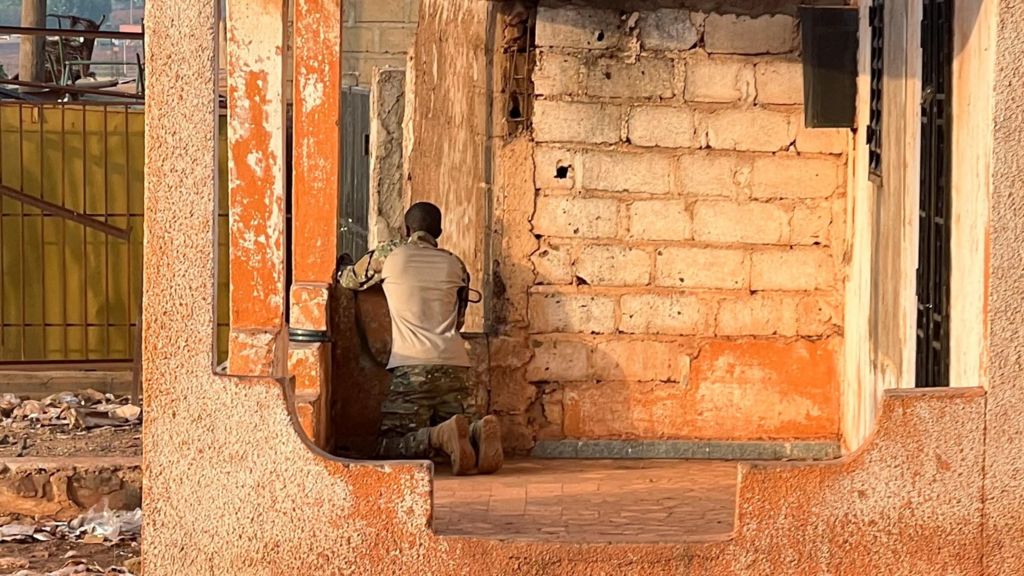
On a fateful Saturday, coordinated violent attacks unfolded across multiple regions of Mali, sending shockwaves through the West African nation already grappling with a decade-long security crisis. Explosions and continuous gunfire were first reported in Bamako, the country’s capital, with heavy clashes concentrated around the Kati military base, a key defense installation on the outskirts of the city. Military forces quickly moved to secure the area, blocking major access roads as counteroffensive operations got underway.
Mali’s ruling military junta confirmed in an official statement that fighting remained active as of Saturday morning, noting that defense and security personnel were fully engaged in repelling the invading attackers. Parallel attacks were also reported in three other key cities spanning the country: Gao in the volatile eastern region, Kidal in the restive north, and Sevare in central Mali. Regional security analysts characterize the synchronized assault as the largest-scale jihadist offensive targeting the country in several years.
All commercial flights into Bamako were suspended early Saturday, according to a traveler who spoke to the BBC, though it remains unconfirmed whether the Modibo Keita International Airport itself sustained damage or was directly targeted. The U.S. Embassy in Mali issued an urgent security advisory shortly after the attacks began, urging all U.S. citizens to shelter in place, avoid all non-essential travel, and stay clear of areas near the airport and the Kati military base amid ongoing active combat.
Ulf Laessing, director of the Sahel Programme at the Konrad Adenauer Foundation based in Mali, told the BBC that the coordinated nature of the attacks marks them as the most expansive and organized jihadist operation Mali has faced in years. While the military has confirmed it is battling unidentified terrorist groups, full details on the scope of casualties, captured territory, and attacker affiliations remain unclear as operations continue. Social media videos have circulated claiming responsibility from two groups: Jama’at Nusrat al-Islam wal-Muslimin (JNIM), a major al-Qaeda-linked jihadist faction, and the Tuareg Azawad Liberation Front (FLA), a separatist rebel group.
FLA spokesperson Mohamed Elmaouloud Ramadane claimed in a social media post that the group’s fighters had seized control of multiple strategic positions in both Gao and Kidal, and called on neighboring military-led states Burkina Faso and Niger to refrain from intervening in the conflict. The BBC has not independently verified these claims amid ongoing restricted access to conflict zones.
The current assault comes against a long-running backdrop of instability in Mali, which has been ruled by a military junta led by General Assimi Goïta since he seized power in a 2020 coup. The junta initially rode a wave of popular support after promising to resolve the country’s decade-long security crisis, which began with a 2012 ethnic Tuareg separatist rebellion that was later co-opted by transnational Islamist militant groups.
In 2013, a United Nations peacekeeping mission and French counterinsurgency forces deployed to Mali to roll back advancing jihadist control. Both forces have fully withdrawn from the country since the junta took power, and the military government replaced them with Russian mercenary fighters to lead counterinsurgency operations. Despite this shift, the jihadist insurgency has only expanded, with large swathes of northern and eastern Mali remaining outside of central government control to this day.
Most recently, Mali joined with neighboring military-led states Niger and Burkina Faso to exit the Economic Community of West African States (Ecowas), the region’s long-standing political and economic bloc. The three countries have formed a new bloc called the Alliance of Sahel States, which aims to coordinate shared security resources, develop cross-border infrastructure, establish a common market and currency, and enable free movement of people, with a long-term goal of deeper regional political and economic integration.