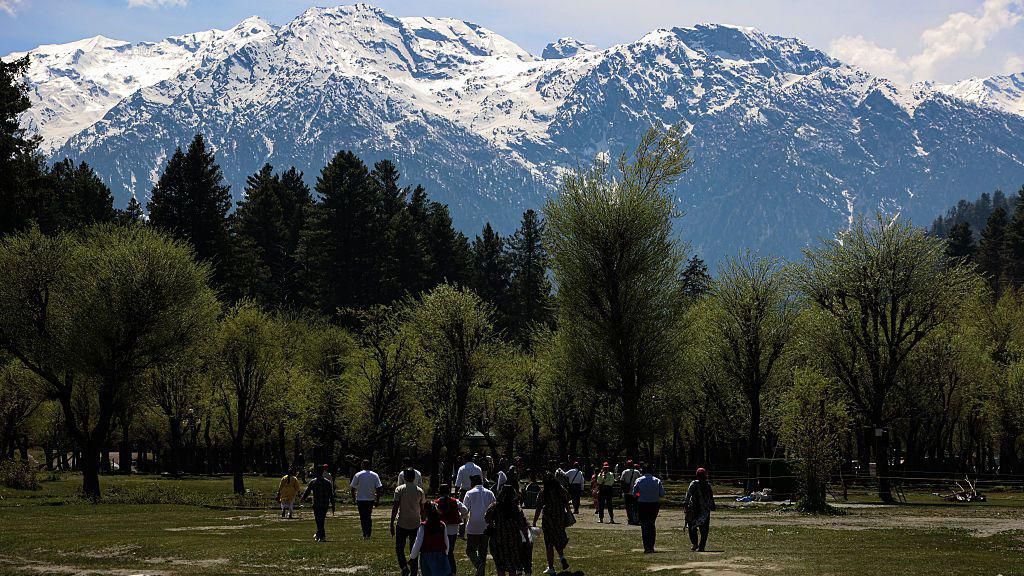
Nestled in the breathtaking Himalayan alpine landscapes of Indian-administered Kashmir, the town of Pahalgam once drew millions of visitors annually to its snow-capped peaks, rolling meadows and pine-fringed river valleys. Today, one year after a militant attack that left 26 tourists and local residents dead, this iconic tourism destination is still grappling with the lingering aftermath of violence—its economy fractured, community trauma unhealed, and the delicate balance between daily life and long-running regional instability shattered.
For 30-year-old local tourist guide Nazakat Ali, the new routine of daily life revolves around a single, repeated task: reassuring anxious prospective visitors that Pahalgam is safe to visit. “There is a lot of fear,” Ali explains, as he takes yet another evening call from a traveler planning a trip. “We have to convince them that everything is fine.” But the numbers tell a stark story of how far the region is from full recovery. Official data shows total visitor arrivals across Indian-administered Kashmir plummeted from nearly 3 million in 2024 to fewer than 1.2 million in 2025. Between January and mid-April 2026, Pahalgam recorded just 259,000 visitors—less than 55% of the 469,000 that visited the town in the same period before the attack. While most regional tourist sites have reopened in the year since the attack, Baisaran meadow, the site of the killings, remains closed to the public, with a quiet memorial erected nearby to honor the victims.
The attack, one of the deadliest targeting tourists in Kashmir in decades, sent shockwaves far beyond Pahalgam’s town limits. The Himalayan region has been contested for decades, with both India and Pakistan claiming full sovereignty over the territory, and decades of insurgency and conflict have claimed thousands of lives. Within days of the Pahalgam attack, the violence triggered a four-day military confrontation between the two neighboring nuclear powers, after India accused a Pakistan-based militant group of orchestrating the assault—an accusation Pakistan swiftly denied. A ceasefire was eventually reached, but the damage to Pahalgam’s reputation as a safe tourist destination was already done.
The economic collapse has upended livelihoods across the town, where nearly every resident relies directly or indirectly on tourism. Just four months before the attack, 25-year-old Mohammad Abubakar invested 2 million Indian rupees (equivalent to roughly $21,250) to open his own small hotel in Pahalgam. Within weeks of the attack, however, bookings dried up completely. “After April, we earned almost nothing,” Abubakar says, confirming he was forced to shut down the business permanently. Mushtaq Ahmad Magrey, head of Pahalgam’s hotel association, reports that up to 80% of hotel rooms across the town sit empty on most nights. “Last year my target was to earn around 20 million rupees but I could only make 1.5 million,” Magrey says. Even for independent workers like horse riders and tour guides, work has become sporadic and uncertain. Guides now gather along Pahalgam’s main roads for hours each day, waiting for clients that rarely arrive, and most visitors who do come only stay for a few hours rather than booking overnight stays, leaving the town nearly deserted after dark.
The impact of the attack extends far beyond lost tourism revenue. In the immediate aftermath, Indian authorities launched an intensive security crackdown across the region, detaining nearly 3,000 young men for questioning and authorizing the demolition of homes belonging to suspected militants, a policy critics denounce as collective punishment that punishes innocent families for the actions of others. In Pulwama district, Abdul Rashid and his family have lived in a makeshift makeshift shelter for a full year after authorities demolished their family home in the crackdown. Rashid’s son, who had joined a militant group, was killed a year before the attack, leaving his family to bear the consequences of state policy. “Temperatures dropped below zero last winter,” Rashid says. “If someone has committed a crime, why should the family suffer?” Authorities maintain that home demolitions are a necessary deterrent to future militancy.
For Pahalgam’s community, the attack broke a fragile unspoken pact that had allowed the town’s tourism industry to survive decades of regional unrest. For years, even as unrest flared in other parts of Kashmir, Pahalgam remained largely insulated from direct violence, allowing residents to rebuild their livelihoods again and again after periods of tension. By targeting tourists directly, the attack disrupted that fragile balance, leaving a lasting psychological scar on both visitors and locals. “We’ve seen difficult times before,” says Abdul Waheed Bhat, head of Pahalgam’s pony riders’ association. “But this attack is different. This has sent a very negative message.”
Many residents still carry vivid, traumatic memories of the day of the attack. Rayees Ahmad Bhat, a local horse rider who was among the first first responders to reach Baisaran meadow after the shooting, still struggles with the trauma a year on. “I saw bodies lying all around,” he says. “People crying for help.” In the months after the attack, he sought professional therapy to process what he saw. For Syed Haider Shah, the loss is permanent: his 26-year-old son Adil, a pony rider and the family’s only breadwinner, was killed while shielding tourists and guiding them to safety from the attackers. “We miss him every day,” Shah says. “But we are proud of him.”
Regional officials have sought to frame the security situation as stabilized, pointing to overall violence levels that are near their lowest in three decades, and say outreach campaigns across India are working to rebuild traveler confidence. Syed Qamar Sajad, Kashmir’s tourism director, says that “confidence is gradually returning,” adding, “We are hinged to hope.” The recovery effort also aligns with the Indian federal government’s long-running goal to frame Kashmir as stable and open for business after the 2019 revocation of the region’s semi-autonomous special status, a move that triggered a months-long security lockdown and communication blackout, and a temporary collapse in tourism that the government has worked for years to reverse.
A small number of cautious travelers have begun to return. Kiran Rao, who visited Pahalgam with his family from the southern Indian state of Kerala, says that while the group had concerns before booking, they felt secure during their trip. “There were worries before we booked,” he says. “But it feels good to be here.”
But for most of Pahalgam’s residents, the road to recovery remains long and uncertain. For Nazakat Ali, the work of reassuring potential visitors never ends. Even as he repeats his assurances line by line, call after call, he acknowledges that the town has changed irrevocably. “Nothing in the landscape has changed, and yet the place does not feel entirely the same,” he says. “The place feels cursed now.” Then the phone rings again, and he begins the work of reassurance once more.