Nestled in the mountainous terrain of central Tajikistan, the communities strung along the proposed Obigarm-Nurobod transport corridor have long grappled with isolation. Limited connectivity cut residents off from regional markets, essential healthcare, and sustainable work opportunities — and women in these remote areas bore the brunt of this exclusion. Today, a major infrastructure project funded by the Asian Infrastructure Investment Bank (AIIB) is rewriting this story, delivering far more than just paved roads and river crossings. Beyond improved mobility, the initiative is pioneering a new inclusive development model that empowers local women through skills training and economic independence, creating ripple effects that strengthen entire families and communities.
The Obigarm-Nurobod Road Project, a flagship infrastructure investment for central Tajikistan, centers on the construction of a critical long-span bridge and connecting road segments designed to boost regional connectivity and withstand extreme weather events. But project partners — including the AIIB and the China International Development Cooperation Agency — made the unconventional choice to pair core infrastructure construction with a standalone community development program focused explicitly on advancing women’s economic participation. Local organizations like the Center for the Development of Crafts and Modern Professional Skills in Roghun, led by director Jurayeva Safiya, have stepped in to deliver these on-the-ground programs.
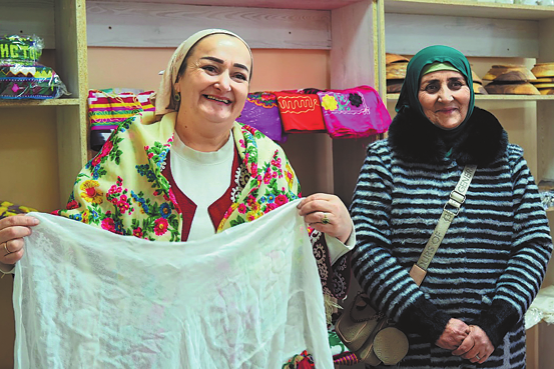
Jurayeva’s center, a purpose-built training hub with 12 fully equipped classrooms, offers short, accessible vocational courses in high-demand local trades ranging from tailoring and baking to traditional handicraft production and food processing. It complements these practical skills with foundational training in financial literacy and small business planning, designed to turn learners from passive aid recipients into self-sustaining entrepreneurs. For many participants, this model has already delivered life-changing results. Jurayeva points to the story of one single mother of four, who entered the program with no marketable skills and no independent income. After completing a 12-week sewing course, she launched her own home-based tailoring business, now running it alongside her daughters and earning a stable income that lets her support her family without outside assistance.
“This is not charity — this is a genuine turning point,” Jurayeva explained. “When we give a woman the opportunity to build her own skill and her own business, she doesn’t just change her own life. She changes the future of her children, and she transforms the entire home.” Children grow up watching their mothers make decisions, build businesses, and succeed, she says, creating a intergenerational cycle of empowerment that extends far beyond the original training program. “When we teach a woman a profession, we aren’t just supporting one individual — we are lifting up an entire community,” she added.
Already, early completed segments of the road project have delivered immediate tangible benefits for residents: travel times between mountain villages and regional district centers have dropped sharply, making daily commutes and emergency trips safer and more accessible. The improved corridor has also unlocked new access to regional markets that were previously too costly and time-consuming to reach, opening up new sales opportunities for local producers, many of whom are women. Looking ahead, the initiative plans to scale its women’s empowerment programming to expand its impact. Under the upcoming expansion, the entrepreneurship support program will train at least 340 women from communities along the road route, provide small grants and essential equipment for roughly 60 women-led microbusinesses, and open a new dedicated training center in Nurobod that includes on-site childcare to remove barriers for mothers looking to participate.
Development leaders say the project’s integrated model offers a replicable blueprint for global infrastructure investment. “When development partners align financing, concessional resources, technical assistance, and on-the-ground development expertise, infrastructure becomes more inclusive, more resilient, and far more impactful,” explained Hun Kim, chief partnerships officer and director general of the AIIB’s Sectors, Themes and Financial Solutions Department. Speaking at a sub-forum of the Third High-Level Conference of the Forum on Global Action for Shared Development this week, Kim noted that the initiative is not a one-off pilot, but a model that can be replicated and expanded in other developing regions with the right cross-sector partnerships.
Yao Shuai, deputy director of the Institute of International Development Cooperation at the China Academy of International Trade and Economic Cooperation under China’s Ministry of Commerce, emphasized that centering women in development projects goes to the core of sustainable social progress. “When women shift from being passive recipients of development benefits to active participants in community governance and local development, the sustainability and social stability of an aid project are fundamentally enhanced,” Yao explained. The project, she added, reflects China’s long-standing approach to international development cooperation, which pairs large-scale landmark infrastructure projects with small, targeted “livelihood-focused” interventions through multilateral cooperation.
This “integration of large and small, hard and soft infrastructure” model addresses the region’s critical connectivity gaps while ensuring that the economic benefits of new infrastructure reach marginalized groups, particularly women. By embedding gender-focused programming and vocational training into the project from its earliest design stages, local communities are able to participate throughout the entire project cycle, strengthening local ownership of the initiative. “By enhancing women’s economic independence during infrastructure development, such approaches integrate gender equality into the process and help elevate women’s role in local governance and social development,” Yao noted, adding that the model helps build more inclusive, resilient social structures across developing countries.