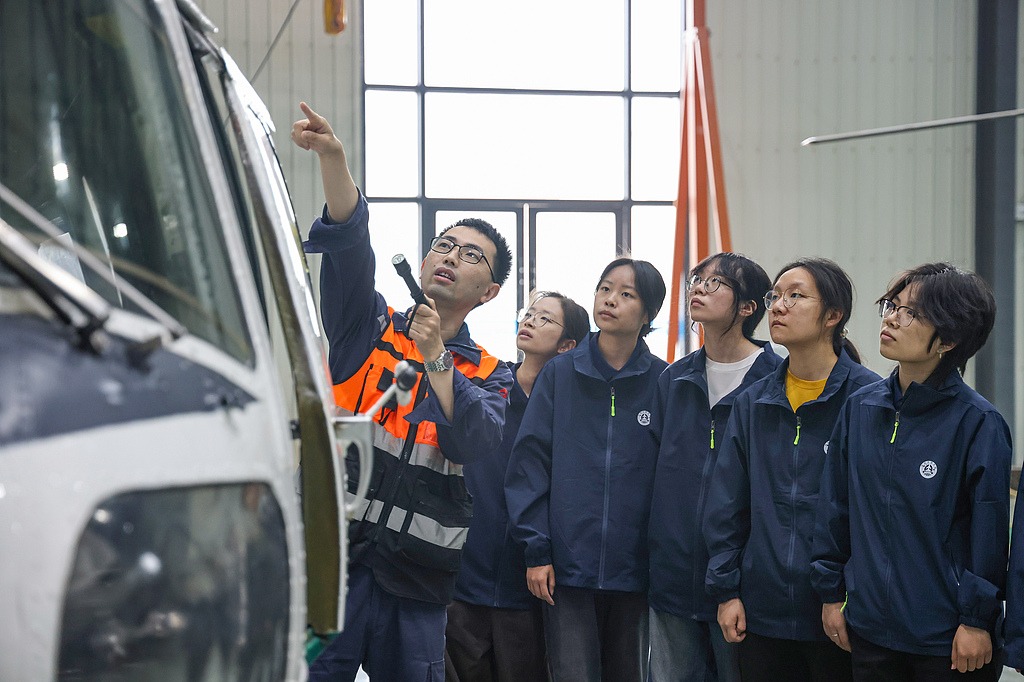
China has launched its first ever nationwide pilot initiative that merges professional higher education with systematic standardization training, a landmark move designed to build a skilled workforce that combines deep industry expertise with mastery of uniform industry rule-setting and implementation. The initiative, announced jointly by the State Administration for Market Regulation and the Ministry of Education on Tuesday, has approved 281 individual projects hosted by 253 higher education institutions across 30 of China’s provincial-level administrative regions.
The training program targets strategically important growth industries and core livelihood sectors, spanning high-priority areas from artificial intelligence and intelligent manufacturing to the fast-expanding low-altitude economy, food quality and safety, and modern consumer and business services. To bridge the gap between academic learning and real-world industry demand, more than 80% of the approved projects have partnered with external stakeholders including manufacturing enterprises, research institutes, and other standardization-focused bodies, bringing 373 separate organizations into the initiative overall. Authorities project the program will train close to 40,000 skilled professionals who combine strong disciplinary foundations with advanced proficiency in standardization knowledge and practice.
Three distinct training models have been rolled out to cater to different talent development goals, each with clear enrollment and curricular requirements. The foundational public education model requires participating institutions to offer at least three standardization-focused public elective courses, totaling a minimum of three academic credits, and reach at least 400 enrolled students within a two-year timeline. This model is focused on building a broad base of core knowledge in standardization theory and methodological frameworks.
The targeted professional education model, by contrast, centers on applying standardization practices to on-the-ground industry challenges. Participating institutions must deliver at least four specialized standardization-integrated courses, or one or more “mini-major” programs consisting of no fewer than six courses totaling 10 academic credits. This pathway trains students to apply standardization methodologies to solve complex professional problems in their core fields.
For institutions aiming to cultivate high-level specialized talent, the multi-degree model supports the creation of full second bachelor’s degree programs in standardization-related fields, requiring a minimum enrollment of 20 students within a four-year implementation window. This pathway is designed to produce senior talent that combines deep expertise in a core industry discipline with advanced specialized knowledge of standardization.
Leading national higher education institutions including Renmin University of China and Beijing University of Posts and Telecommunications are among the selected pilot participants. Industry and academic leaders have widely welcomed the initiative, pointing to a critical nationwide gap in skilled standardization talent that has held back industry growth and global competitiveness.
Jia Xiaoshuang, an associate professor at Renmin University of China’s School of Information Resource Management, explained that many of China’s top technical experts in cutting-edge fields from high-speed rail to artificial intelligence possess world-class technical skills, but lack training in translating technical concepts into formal standard language. “Standardization is an independent academic discipline, and many technical practitioners remain unfamiliar with its core rules and processes,” she noted. As China works to expand its global industrial influence, demand for professionals capable of drafting national, industry, and group standards has risen sharply, making the pilot program a critical first step to address this gap.
Jia emphasized the strategic importance of standardization leadership in global trade and technology: “A long-held business adage holds that second-rate companies manufacture products, while first-rate companies set industry standards. If China cannot secure a meaningful voice in global standard-setting, its domestic products and technologies will face significant barriers to gaining widespread international acceptance.”
For the fast-evolving artificial intelligence sector, standardization training is an especially urgent priority, according to Gu Xinyu, an associate professor at Beijing University of Posts and Telecommunications’ School of Artificial Intelligence. “AI technology is advancing at breakneck speed and penetrating deep into every vertical industry, and it increasingly touches on issues of public safety, data compliance, and cross-system interoperability,” Gu explained. “Without unified, widely accepted standards, the sector will face persistent problems of technical incompatibility, isolated data silos, and unaddressed safety risks.”
Using intelligent transportation as a case in point, Gu noted that AI can only reach its full transformative potential if all stakeholders adopt common data formats, communication protocols, and interface specifications. “If AI models, sensors, and control systems from different manufacturers cannot connect and share data seamlessly, data silos and fragmented systems will drastically undermine overall system coordination,” she said. “Standardization acts as the critical bridge that moves AI from laboratory prototypes to large-scale industrial deployment, ensuring the technology remains controllable, trustworthy, and interoperable across platforms.”
In line with the pilot program requirements, Beijing University of Posts and Telecommunications is integrating “standardization thinking” directly into its core artificial intelligence curriculum. Core AI courses will now include dedicated modules covering intelligent communication standards, AI ethics standards, data quality standards, model development and evaluation standards, and system security standards. “Our goal is to train students not just as technology innovators, but as active participants and even lead formulators of global industry rules — professionals who can embed standardization best practices directly into their technical work,” Gu said.