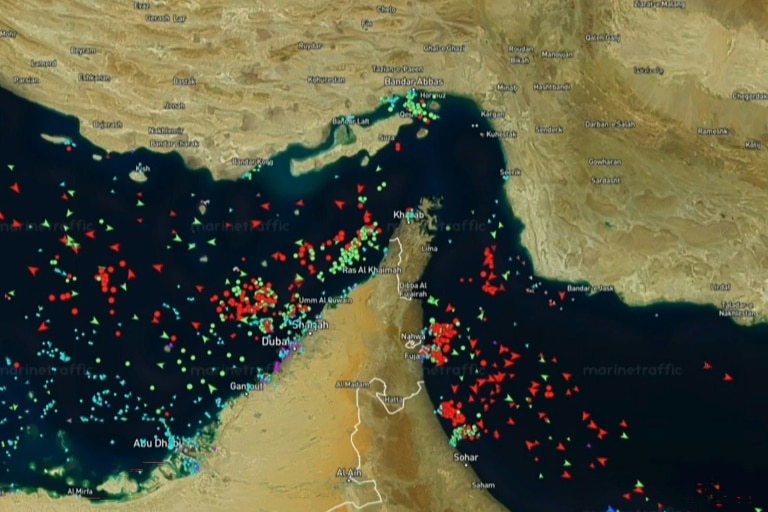
The ongoing Middle East conflict has entered a new phase of heightened tension centered on the strategic Strait of Hormuz, with a series of fast-moving developments unfolding across the region in recent days that threaten to further disrupt global energy markets and regional security.
In one of the most confrontational moves, former U.S. President Donald Trump, who currently holds the U.S. presidency in this timeline, has issued a direct military order targeting Iranian activity in the Strait of Hormuz. In a public social media post, Trump vowed that the U.S. Navy will destroy any small craft caught laying naval mines in the key waterway, ramping up American pressure on Tehran to immediately reopen the passage that carries roughly a fifth of the world’s daily oil consumption. “I have ordered the United States Navy to shoot and kill any boat, small boats though they may be… that is putting mines in the waters of the Strait of Hormuz,” Trump’s post read.
Iran, which has effectively blocked the Strait of Hormuz since the outbreak of open conflict with the U.S. and Israel, has already collected its first batch of revenue from controversial new tolls it imposed on vessels passing through the waterway, a senior Iranian parliamentary official confirmed Thursday. Deputy speaker of parliament Hamidreza Hajibabaei told state-run Tasnim news agency that the initial toll revenue has already been deposited in an account held by Iran’s Central Bank. Tehran has repeatedly rejected calls to reopen the strait, tying any move to lift the blockade to an end to the U.S. naval blockade of Iranian ports. Speaking after the first round of indirect peace talks hosted in Islamabad, Iranian parliament speaker Mohammad Bagher Ghalibaf emphasized that the strait will remain closed as long as U.S. sanctions and blockades remain in place. “A complete ceasefire only has meaning if it is not violated through a naval blockade, Reopening the Strait of Hormuz is not possible amid a blatant violation of the ceasefire,” Ghalibaf stated.
U.S. defense officials have pushed back against recent reporting that suggested the Pentagon estimates clearing all Iranian-laid mines from the Strait of Hormuz could take up to six months to complete. The Pentagon called the original Washington Post report, which cited three anonymous officials familiar with a classified briefing for House Armed Services Committee members, “cherry picking” and outright false. U.S. forces have already stepped up maritime interdiction operations targeting Iranian oil shipments in recent days: this week alone, U.S. military boarding teams have seized two vessels linked to illicit Iranian oil exports, including the stateless oil tanker M/T Majestic X, which was intercepted in the Indian Ocean while carrying sanctioned Iranian crude. As part of its broader blockade against Iran, U.S. Central Command announced late Wednesday that it has ordered 31 vessels to turn around or return to port, the vast majority of which are oil tankers, with most complying with the U.S. directions.
Tensions have also flared along the Israel-Lebanon border following an Israeli airstrike that killed a Lebanese journalist in southern Lebanon. Lebanese national leaders have formally accused Israel of committing a war crime in the targeted strike, while the Israeli military announced it is conducting an internal review of the incident. In a diplomatic development, Israel and Lebanon are set to convene a new round of ceasefire talks in Washington on Thursday. Ahead of the negotiations, Lebanese officials plan to request a one-month extension of the current bilateral ceasefire, which is set to expire in coming days. Israeli officials struck a conciliatory tone ahead of the talks, stating the country holds no “serious disagreements” with the Lebanese government, and called for joint action against the Iran-aligned Hezbollah movement – which has refused to participate in the negotiations and opposes any deal reached through them.
In a separate development within Iran, Iranian authorities hanged Sultan-Ali Shirzadi-Fakhr earlier this week after convicting him of membership in the banned opposition group People’s Mujahedin Organisation (MEK) and alleged espionage collaboration with Israeli intelligence services. The conviction and execution were confirmed by Iran’s judiciary via its official Mizan Online website.
The closure of the Strait of Hormuz has already sent global oil and gas prices soaring, delivering a major shock to already fragile economies around the world and disrupting global energy supply chains.