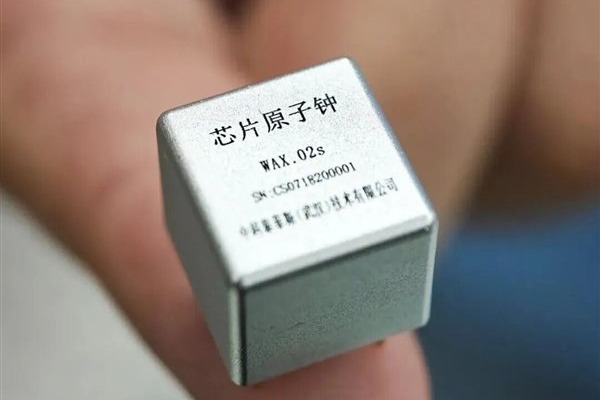
China has marked a landmark breakthrough in quantum precision measurement and high-precision timekeeping technology, with the successful mass production of an ultra-compact, fingernail-sized chip-scale atomic clock boasting extraordinary accuracy: it deviates by just one second over 30,000 years of operation. This advancement delivers a robust, high-precision time foundation for critical national strategic sectors ranging from low-Earth-orbit satellites to underwater BeiDou navigation systems, cementing China’s position as a global leader in the field.
Developed by the Satellite Navigation and Positioning Technology Research Center at Wuhan University in central China’s Hubei Province, and commercialized via spin-off enterprise Zhongke Taifeisi (Wuhan) Technology Co, the finished device measures a mere 2.3 cubic centimeters — approximately one-seventh the volume of comparable atomic clock products manufactured in the United States, while delivering matching performance levels.
“Time is a fundamental strategic resource. Nations that master the highest precision in timekeeping gain a decisive competitive edge across technology, economics, and even national defense,” explained Chen Jiehua, a professor at the Wuhan University research center and legal representative of Zhongke Taifeisi, in an interview with Hubei’s local newspaper Changjiang Daily. Chen, whose team has spent decades advancing the technology, emphasized the critical link between timing accuracy and navigation performance: “In navigation and positioning, time equals distance. A timing error of just one nanosecond — one billionth of a second — translates to a positioning deviation of 0.3 meters. Even the most accurate consumer timepieces drift by more than 10 seconds annually, which is why holding the “power of time” in China’s own hands has been such a critical national priority.”
Unlike traditional timing solutions that rely on satellite calibration, chip-scale atomic clocks provide an independent, stable time reference in environments where satellite signals cannot reach or become compromised. These use cases include underwater exploration, underground infrastructure, deep space missions, and battlefields where global positioning signals are intentionally jammed.
Traditional large atomic clocks operate by counting stable frequency signals produced when microwave fields interact with atoms. However, the long wavelength of microwaves imposes hard limits on how small these devices can be made. Chip-scale atomic clocks take a different approach, using microwave-modulated lasers that can be guided through extremely compact spaces. This innovation allows the devices to deliver ultra-high precision while cutting both physical size and power consumption by dozens of times compared to legacy designs.
Chen highlighted the enormous untapped market potential for the technology, noting the device’s combination of tiny form factor (just a few cubic centimeters) and low power draw (less than 200 milliwatts). For example, on the seabed where satellite signals cannot penetrate and solar power is unavailable, autonomous synchronization systems require both ultra-precise time references and long-duration low-power operation — a combination that makes the new chip-scale atomic clock an ideal core frequency source component.
To date, Zhongke Taifeisi is the first and only Chinese company to achieve large-scale commercial production of chip-scale atomic clocks. The devices have already been successfully deployed in real-world use cases, including time synchronization systems for underwater BeiDou navigation, low-Earth-orbit satellites, and drone swarms. As of 2024, the product had already sold several hundred units, with sales continuing a steady upward trajectory through 2025.
Gou Fei, a representative of Yangtze River Industry Group — which holds a more than 20% stake in Zhongke Taifeisi — noted that quantum technology is designated as a top strategic priority for China’s future industrial development, with quantum precision measurement standing out as a key subfield where chip-scale atomic clocks act as a core enabling device.
“Professor Chen Jiehua’s team has developed the world’s smallest chip-scale atomic clock, and in doing so has completely broken the long-standing foreign technology monopoly in the sector,” Gou said. “The product delivers a comprehensive leap forward: it is smaller than competing alternatives, matches or outperforms them in functionality, and supports scalable mass production. This achievement places China at the cutting edge of the global quantum industry.”
Despite this milestone, mass market adoption still faces hurdles: currently, production is constrained by the performance limitations and high cost of imported laser components. To address this gap, Gou noted that Yangtze River Industry Group will deploy its capital and industrial resources to help Zhongke Taifeisi breakthrough key domestic component technologies, scale up automated production to bring down costs, and expand use cases across both military and civilian communications networks. The expansion will also strengthen Hubei’s already strong competitive position in the global quantum precision measurement sector.
This breakthrough aligns directly with China’s 15th Five-Year Plan (2026-2030) for national economic and social development, which prioritizes achieving key technology breakthroughs in quantum precision measurement and positioning quantum technology as a core new growth driver for the national economy.
Globally, the sector is also growing rapidly. According to QYResearch, a global industrial market research firm with dual headquarters in Beijing and Los Angeles, the global market for chip-scale atomic clocks hit 405 million yuan ($60 million) in sales last year, and is projected to grow to 737 million yuan by 2032, reflecting rising demand across defense, navigation, telecommunications and scientific research sectors worldwide.