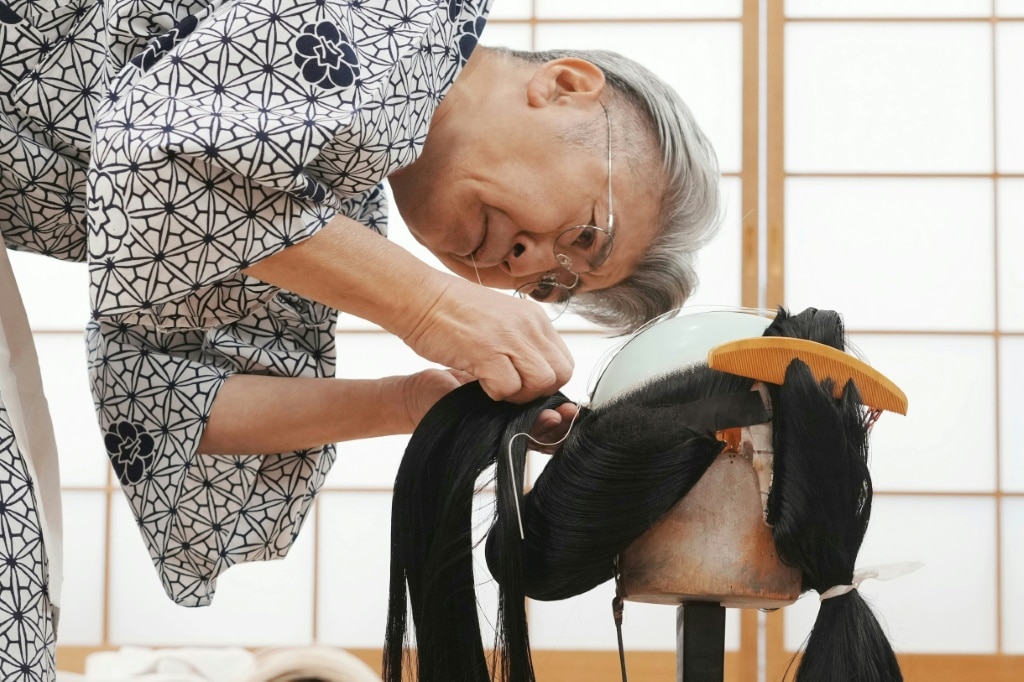
Beneath the bright lights of Tokyo’s iconic Kabuki-za Theatre, before a packed audience leans in to watch centuries of traditional drama unfold, one quiet craftsperson lays the final foundation for a performer’s transformation. For kabuki, the iconic Japanese performing art famed for its dramatic stylized makeup, lavish period costumes and expressive storytelling, the wig is not just an accessory—it is the critical bridge between an actor and their character.
Sixty-year-old Tadashi Kamoji, a fourth-generation master kabuki wig artisan known as a tokoyama, knows this weight of responsibility better than most. Ahead of a recent performance, he carefully positioned a handcrafted topknot wig on 33-year-old rising performer Nakamura Tanenosuke, who stars in a new production centering on a 19th-century noble family feud. “A kabuki actor cannot step onto stage as his ordinary self,” Kamoji explained in an interview with AFP. “It is only when the wig is in place that he truly becomes the character he is meant to play. That is why we carry such a heavy responsibility for our work, and why we hold such pride in what we do.”
For decades, these skilled artisans have worked largely out of public view, tucked away in backstage ateliers far from audience applause. But the unsung craft of kabuki wig making has recently stepped into the international spotlight after the hit Japanese drama *Kokuho* earned an Oscar nomination for Best Makeup and Hairstyling. The film, which follows the lives of two onnagata—male actors who specialize in playing female kabuki roles—has brought long-overdue attention to the hidden craft that underpins every kabuki performance.
Kabuki itself dates back to 17th-century Japan, blending dynamic dance, emotional drama and traditional music into a performance form that remains a cultural cornerstone of the country. Every element of a kabuki production is intentional: from the archaic dialect actors use to the elaborate hand-painted sets, each detail works together to transport audiences to another era. Nowhere is this intentionality more clear than in the wigs.
After master craftsmen construct each wig from raw human hair, tokoyama like Kamoji take over to shape, style and customize the piece to fit both the actor and their character. This work goes far beyond simple hairdressing, Kamoji explains. “To create a wig that feels true, you have to first understand the core of the character,” he said. Kamoji joined the family trade when he was just 18, following in the footsteps of multiple generations of artisans, and he still learns new techniques from his 85-year-old father today.
Whether the role calls for a righteous middle-aged samurai, a high-ranking Edo-era courtesan or a professional sumo wrestler like Tanenosuke’s recent part, each wig is designed to communicate specific details about the character’s age, social standing, occupation and personality to the audience before the actor even speaks a line. For Tanenosuke’s sumo role, Kamoji spent two hours in his atelier shaping the wig into the traditional curved mage topknot, a hairstyle that fell out of common use in Japan more than a century ago. Working kneeling on a traditional tatami mat, he sectioned the hair with hand-carved wooden combs, smoothed strands with heated steaming irons, and pulled tight securing knots with his teeth—a technique that has been passed down through generations of tokoyama.
For performers like Tanenosuke, who has worked with wig masters since he began training in kabuki at age five, these artisans are entirely irreplaceable. “There is almost no traditional kabuki performance that does not rely on handcrafted wigs,” he said. “The wig is the final touch that completes the transformation into character. Every step of getting into costume and makeup is a switch that prepares you, but it is not until the wig is set that you fully step into the role. The audience’s enjoyment of kabuki depends on the skill of the actors, yes, but also on the beauty of the costumes, sets and wigs—our work would not be complete without the masters.”
The scale and diversity of the craft is staggering: there are roughly 400 distinct wig styles for female roles alone, and more than 1,000 unique variations for male parts. Every wig is custom made from scratch for each production and tailored to fit the individual actor who will wear it, with simple pieces taking only a few hours to complete and complex, one-of-a-kind designs requiring up to a month of meticulous work.
Even after 42 years in the profession, Kamoji says he is still honing his craft. “To this day, I still learn new things from my father,” he said. “This is a craft of endless improvement. When I watch the most senior masters work, it looks like the hair is dancing in their hands. I have not reached that level yet; I think I will only truly master that control when I am my father’s age.”
Still, all the long hours of meticulous work feel worthwhile to Kamoji when the curtain rises and the audience erupts in applause for the performer on stage. “When the audience cheers that the actor looks brilliant, I feel a part of that success,” he said. “To know that the wig we created helped bring the character to life, that suited the actor perfectly—that brings me a huge sense of joy.”