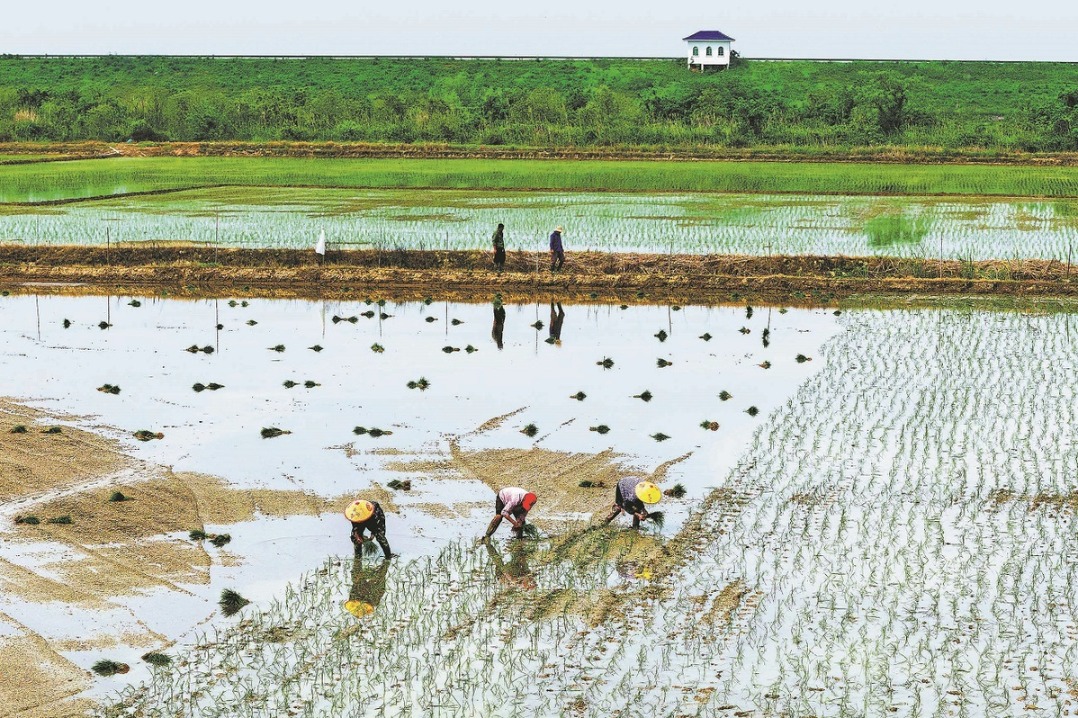
Against a backdrop of rising global food security uncertainties fueled by geopolitical turbulence, a landmark long-term agricultural outlook report released Monday projects that China will record a modest but steady uptick in domestic grain output in 2026, while seeing the first decline in imports of major agricultural commodities – most notably soybeans – in recent years.
The *China Agricultural Outlook (2026-2035)*, compiled by the agricultural market analysis and early-warning team under China’s Ministry of Agriculture and Rural Affairs, forecasts total national grain production will hit 716 million metric tons this year, a 0.2% year-on-year increase. Oilseed output is also set for stronger growth, projected to rise 2.6% to 42.04 million tons. The expansion is driven by consistent improvements in crop productivity, with average national grain yields expected to cross the 6,000 kilograms per hectare threshold in 2026.
“Large-scale improvements in crop productivity will continue to support a stable grain supply,” noted Xu Shiwei, head of the Ministry of Agriculture and Rural Affairs’ key laboratory of agricultural monitoring and early warning technology. Alongside rising domestic output, the report forecasts a pullback in imports of several major agricultural goods, paired with ongoing growth in exports of China’s competitive agricultural products. Xu confirmed that soybean imports will fall 6.1% year-on-year in 2026, marking the first drop for that metric in recent years. Pork imports are projected to decline 8.2%, while dairy imports will see a 4.1% decrease, per the report.
At the same time, exports of high-demand Chinese agricultural products are on track to expand: vegetable exports are forecast to grow 6.4% in 2026, and fruit exports are set to rise 5%. Even with the projected decline in some import volumes, the report stresses that global agricultural markets will remain a critical supplement to China’s domestic supply, noting that imports of goods including poultry are still expected to increase this year.
The report comes as global agricultural markets face mounting headwinds from global geopolitical instability. Li Ganqiong, head of the agricultural monitoring and early-warning research center at the Chinese Academy of Agricultural Sciences, pointed out that rising geopolitical risks – including ongoing conflict in the Middle East – have driven up global oil prices, fertilizer costs and shipping expenses, creating greater uncertainty for global agricultural production and trade. “These factors could heighten risks to global food security,” Li said, adding that shoring up domestic agricultural production remains the most critical strategy for buffering against external volatility.
Beyond 2026, the report outlines a decades-long trajectory of steady growth for China’s agricultural sector. Total national grain output is projected to climb gradually to 733 million tons by 2030 and 753 million tons by 2035, with average grain yields per hectare expected to rise 6.3% over the next 10 years. On the demand side, national grain consumption is forecast to grow slowly before peaking at 842 million tons around 2032, after which it will stabilize and enter a gradual decline.
As domestic productivity improves and China’s agricultural goods gain stronger global competitiveness, the country’s reliance on imports for major agricultural commodities will continue to decrease over the long term, Xu explained. By 2035, total grain imports are projected to drop to 115 million tons, a 25.5% reduction from the 2023-2025 average. Soybean imports are set to fall to 82.55 million tons by 2035, a 21.5% drop from current average levels.
Other agricultural sectors are also set for structural adjustment and steady growth. The Chinese dairy industry will continue expanding, with domestic milk production projected to reach 45.07 million tons by 2030 and 51.17 million tons by 2035, for an average annual growth rate of 2%. This growth aligns with shifting domestic consumer demand: the report notes rising demand for fresh milk, alongside growing use of cheese and butter in beverages and baked goods across China.
For the pork sector, the report forecasts a gradual output decline over the next decade, as the industry transitions from a period of rapid expansion to a focus on higher-quality, more efficient production. By 2035, pork output is projected to reach 55.11 million tons, with an average annual decline of roughly 0.5%.
First launched in 2014, the annual China Agricultural Outlook report has become a core authoritative platform for evaluating China’s agricultural trends, supporting more accurate market forecasting and guiding evidence-based policy planning, the Ministry of Agriculture and Rural Affairs said.