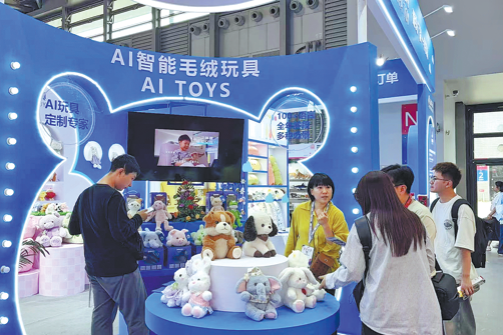
In the heart of Xiong’an New Area, Hebei Province, a fluffy plush puppy named Xiaowen does far more than sit on a child’s shelf waiting for a hug. This isn’t an ordinary stuffed animal: when called, it responds with a playful, sarcastic quip that turns everyday interaction into a spontaneous moment of fun. “Yeah? What’s up? I’m so tired of endless work. Do you even have a job?” it teases, and after a gentle pat on its soft body, it quickly shifts to a apologetic tone: “I promise it won’t happen again. Please forgive me!” This viral fan favorite is the AI Apology Dog, the brainchild of 62-year-old industry veteran Zhang Qingli, whose decades-long career in manufacturing has taken him from clothing to contract toy production, and now to pioneering AI-integrated plush companions.
Zhang’s journey into smart toy development didn’t happen overnight. Starting out in clothing manufacturing back in the 1990s, he pivoted to the plush toy industry in 2011, setting up his production base in Rongcheng County, a region long recognized as one of China’s leading plush toy manufacturing hubs. Like most local factories at the time, Hebei Hai Fa Toy Co operated primarily as an original equipment manufacturer (OEM), producing goods for external brands. This model brought with it slim profit margins and almost no control over product design or pricing, leaving Zhang searching for a path to long-term growth.
The 2017 establishment of Xiong’an New Area, China’s high-tech, smart development demonstration zone, became the turning point Zhang needed. “We couldn’t just keep making ordinary toys,” he explained. “Xiong’an is about high-end and smart development.” The specific inspiration for his AI pivot came in 2022, when a friend asked Zhang to help locate an exact replica of his daughter’s well-worn, decade-old childhood bunny toy. After a months-long search across the country, Zhang finally tracked down a matching replacement in Guangdong Province. That experience drove home a powerful truth: plush toys are far more than fabric and stuffing — they carry deep emotional attachment for their owners. That realization sparked his idea to give traditional plush toys a digital “brain.”
By 2023, Zhang had assembled a dedicated in-house artificial intelligence R&D team, combining cross-functional software and hardware expertise to develop the company’s first line of fully independent smart toys. The AI Kids series launched in 2024, boasting more than 60 functions spanning early childhood education, interactive entertainment, and long-distance companionship.
Gao Mengyang, head of the company’s R&D division, explained the core design: “We combine AI technology with plush toys, putting a self-developed core inside to make them smart. With one-press chat, children can talk remotely with their parents anytime.” The product also includes a patented near field communication (NFC) system that lets children trigger customized learning content simply by holding a themed card near the toy, solving the common problem of inaccurate voice recognition for young children with underdeveloped speech.
The road to success wasn’t smooth. The first month of sales for the new AI line only moved a few thousand units — less than one-tenth of the factory’s daily sales volume for traditional plush toys. Early design choices, including the removal of a manual switch to create a seamless interaction experience, led to user complaints about frequent false triggers, and the team quickly recognized the domestic AI toy market was still in its early stages of growth.
Instead of abandoning the project, Zhang and his team doubled down on iterative upgrades. Version 2.0 introduced multi-touch responsive interaction, adding nuanced emotional engagement: when the toy is lifted high off the ground, it will squeak “Too high, I’m scared!” in a soft, playful voice. A major breakthrough came in early 2025, when similar AI plush toys gained massive viral popularity overseas, sparking a surge in consumer interest for domestic smart toy products. Sales of Hebei Hai Fa’s AI Kids line began climbing steadily, and the product line quickly earned widespread consumer recognition.
Today, the AI Apology Dog stands as the company’s breakout hit. Soft, huggable, and integrated with a large language AI model, it can chat with users, tell jokes, deliver early childhood education, detect user emotions, and respond physically to touch. “It helps users release stress,” Zhang said. “Children see it as a friend and teacher, while parents use it as a companion and assistant.” The most popular functions across the full AI Kids line include voice conversation, NFC card learning, remote parent-child messaging, music and storytelling, emotional support, and daily habit reminders.
The company has already expanded its global footprint, exporting products to 30+ markets across Europe, Japan, South Korea, Southeast Asia, the Middle East and North America. International versions of the AI toys support more than 100 languages and meet all regional product safety and technology standards. In 2025, the company sold millions of traditional plush toys alongside more than 100,000 AI-powered models, with one-third of all AI units shipped to overseas buyers.
Now partnering with leading AI and chip specialists who have relocated to Xiong’an New Area to take advantage of the zone’s high-tech policy support, Zhang is already planning his next line of innovative smart products. Upcoming projects include a smart memory pillow that can store and play a loved one’s voice, and AI-enabled companion pets tailored for elderly care that can monitor basic health metrics, provide daily companionship, and connect seniors with their far-flung family members.
For Zhang, the evolution of the toy industry marks a fundamental shift in what these products mean to consumers: “Toys are no longer just toys. They are companionship, education, stress relief and warmth. Our goal is to build Xiong’an smart plush toys into a recognized global brand.”