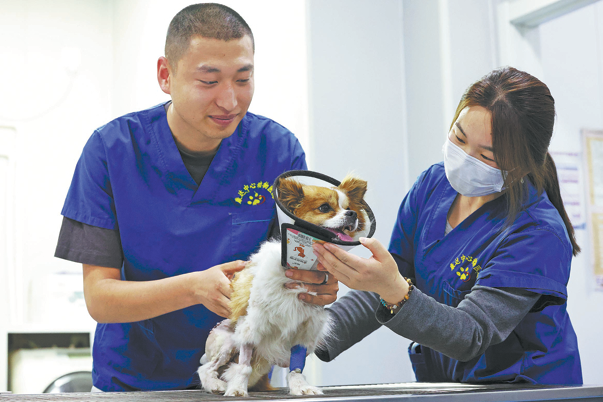
Driven by shifting generational attitudes that position pets as beloved family members rather than simple companions, China’s pet sector is undergoing rapid expansion, with cities in northern Shanxi province emerging as a key example of the industry’s evolution beyond basic retail into a diversified, professionalized ecosystem.
Across Taiyuan, the provincial capital of Shanxi, this growing demand for high-quality pet care has spawned a wave of new specialized services, ranging from standardized in-home pet sitting and high-speed rail pet transport to advanced veterinary care for aging animals. One of the professionals at the heart of this booming market is Chen Hong, a 40-year-old full-time in-home pet sitter who turned her years of personal pet ownership experience into a full-time career last winter.
During a recent service call, Chen followed strict industry hygiene protocols: putting on disposable shoe covers and gloves, and spraying disinfectant throughout the entryway before entering the client’s home, where two friendly cats immediately greeted her with affectionate attention. As she played gently with the animals, Chen explained the core driver of rising demand for her work. “More and more people consider their pets as family members and emotional anchors, ” she said. “As a result, pet owners are increasingly demanding higher quality services that put their pets’ comfort first.”
Chen’s work focuses on supporting pet owners who travel for work or leisure, providing in-home services that include feeding, litter box cleaning, and dedicated playtime. On an average day, she travels between Taiyuan’s residential communities to complete five to six appointments, with peak demand during national holiday seasons pushing her daily schedule to more than a dozen bookings.
Chen’s career transition mirrors a much larger national trend, as skyrocketing pet ownership across China creates thousands of new professional roles and opens up major new economic opportunities. Data from the 2026 China Pet Industry White Paper underscores the scale of this growth: urban China is now home to nearly 126 million pet dogs and cats, pushing the national pet industry market size to 312.6 billion yuan, equivalent to roughly $45.5 billion. Industry forecasts project that total consumer spending on pet-related products and services will climb to 405 billion yuan by 2028.
Unlike traditional pet boarding facilities that require owners to leave their animals at an off-site location, in-home pet sitting aligns far better with pets’ natural routines and reduces the stress animals often experience when separated from their owners in unfamiliar environments. That benefit has made the service increasingly popular among younger pet owners like Zhang Zining, a 28-year-old Taiyuan resident who owns an Abyssinian cat. Zhang says she always books in-home sitting services whenever she plans to travel for more than two days, citing the peace of mind it gives her knowing her pet is comfortable in its own home.
Local authorities in Shanxi have also moved to standardize this fast-growing sector, introducing formal guidelines to ensure service quality and consumer protection, laying the groundwork for the pet economy’s sustained long-term growth across the region.