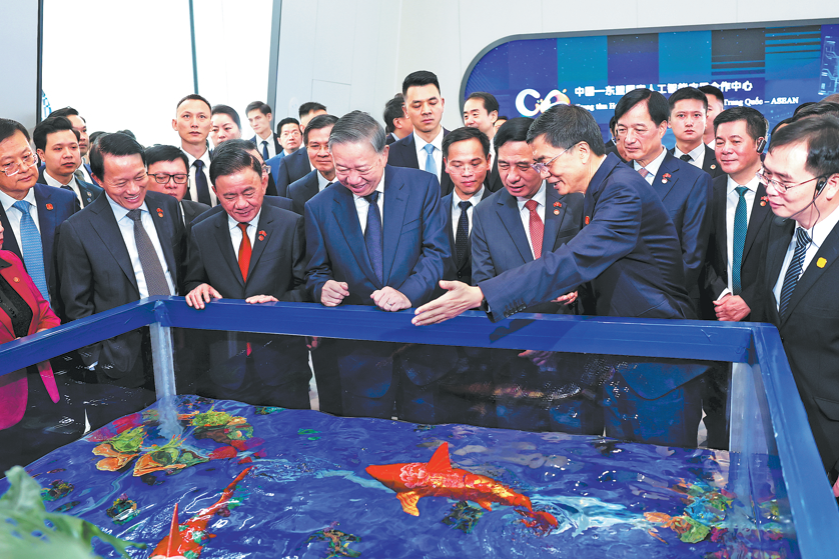
Against a backdrop of shifting global geopolitics and regional development ambitions, the recent official visit of Vietnam’s highest leader To Lam to China has cemented the longstanding centrality of China-Vietnam relations in Hanoi’s foreign policy agenda, regional analysts agree. To Lam, who serves concurrently as General Secretary of the Communist Party of Vietnam Central Committee and President of Vietnam, carried out his four-day state visit to China from April 14 to 17, 2026. This trip marks his first official overseas visit since his recent election as Vietnamese president, and comes exactly one year after Chinese President Xi Jinping’s 2025 state visit to Vietnam, creating a critical rhythm of high-level diplomatic exchange between the two neighboring nations.
Regional policy experts note that the itinerary of the visit carries far more than symbolic weight. After meetings in Beijing, To Lam traveled via high-speed rail for roughly 10 hours to Nanning, the capital of China’s Guangxi Zhuang Autonomous Region, which shares a long land border with Vietnam. During the stop in Nanning, the Vietnamese leader visited the China-ASEAN Countries Artificial Intelligence Application Cooperation Center, a tangible marker of expanding technological collaboration between the two sides.
Le Hong Hiep, senior fellow and Vietnam Studies Programme coordinator at Singapore’s ISEAS-Yusof Ishak Institute, explained that the visit underscores the consistent priority Hanoi has long placed on its bilateral ties with Beijing. “This visit confirms that China remains a cornerstone of Vietnam’s foreign policy,” Hiep told China Daily. He added that the trip also reflects To Lam’s interest in adapting successful elements of China’s governance and development models to support Vietnam’s own domestic goals: the Southeast Asian nation has set a target to reach high-income economy status by 2045, with a focus on replicating China’s progress in infrastructure development and technological innovation.
The visit aligns with key domestic milestones for both countries: it comes as Vietnam enters a new development cycle following its 14th National Party Congress, while China has just kicked off implementation of its 15th Five-Year Plan spanning 2026 to 2030.
Ian Seow Cheng Wei, senior analyst at the S. Rajaratnam School of International Studies at Nanyang Technological University in Singapore, emphasized that the Guangxi leg of the journey stands out as a particularly meaningful highlight. Beyond highlighting the shared revolutionary roots between the Communist Party of China and the Communist Party of Vietnam, the stop draws attention to Guangxi’s outsize role in bilateral economic exchange: the autonomous region ranks among China’s largest provincial-level trading partners with Vietnam.
This economic and strategic importance is reflected in the new cooperation agreements signed during the visit, which cover growing collaboration in artificial intelligence, semiconductor development, and cross-border transport connectivity. In a joint statement released during the visit, the two sides committed to accelerating cross-border infrastructure integration. They praised the early completion of the feasibility study for the Lao Cai-Hanoi-Haiphong railway, whose first phase of construction launched in December 2025 to connect Vietnam to China’s Yunnan Province. The two sides also welcomed the signing of implementation agreements for two additional standard-gauge railway projects linking Guangxi to northern Vietnam: the Dong Dang-Hanoi line and the Mong Cai-Ha Long-Haiphong line.
Khang Vu, a visiting scholar in the Political Science Department at Boston College in the United States, noted that while Vietnam maintains multiple comprehensive strategic partnerships globally, the timing and framing of To Lam’s visit makes clear that China holds a unique “first among equals” status in Hanoi’s foreign relations. Khang added that expanded railway infrastructure cooperation delivers mutual benefits to both nations: it strengthens China’s connectivity with Vietnam and the broader Southeast Asian region, while also cutting transport costs for Vietnamese exports bound for European markets via transcontinental rail links.
Against the backdrop of recent global energy market volatility sparked by the Iran war, which has exposed risks tied to Vietnam’s current energy import dependency, Khang pointed out that Hanoi can also draw lessons from China’s decades of experience in expanding electric vehicle production and scaling clean energy infrastructure. Moving forward, he noted, infrastructure connectivity and clean energy development are set to become the core pillars of deepening bilateral cooperation.
Amid widespread global geopolitical turbulence, Hiep noted that both China and Vietnam used the visit to reaffirm their shared commitment to stabilizing bilateral relations and advancing the vision of a China-Vietnam community with a shared future. This approach aligns directly with Vietnam’s core goal of maintaining a peaceful, stable external environment to support its long-term domestic development ambitions. “The visit further underscores China’s indispensable role as a neighbor and a development partner of Vietnam,” Hiep said.