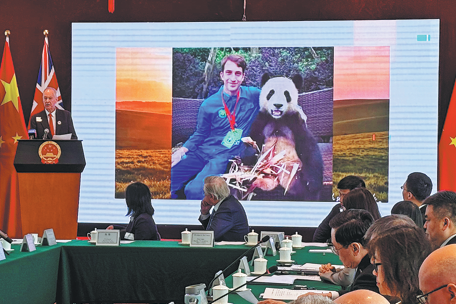
Eight years after their son Philip Hancock passed away in southwest China, his Australian family gathered in Sydney for a memorial symposium to celebrate the young man’s extraordinary act of humanitarian kindness that continues to connect communities across two nations.
In May 2018, 27-year-old Hancock, an English teacher at Chongqing’s Southwest University who had built deep personal ties with China, died after failed medical intervention. In line with explicit wishes he had shared with his family years earlier, his parents made the decision to donate his liver, two kidneys, and pair of corneas. The selfless choice granted five Chinese recipients a second chance at life — restoring sight to two and saving the lives of three others. This act made Hancock the first Australian and seventh foreign national to complete an organ donation in China.
Addressing attendees at the Sydney memorial, Peter Hancock, Philip’s father, reflected on the gravity of the choice his family made. “This was a very difficult decision for our family to make,” he said, noting that Philip’s clear long-stated intent softened the pain of their loss. “He said he would like his organs to be donated so that other people could benefit from them. He believed that this was a humanitarian thing to do and that everyone should have the same attitude toward organ donations.”
Co-hosted by the Red Cross Society of China and the Chinese Consulate-General in Sydney, the symposium brought together diplomatic and community leaders from both China and Australia to honor Hancock’s legacy. Chinese Consul General in Sydney Wang Yu highlighted the profound meaning of the young teacher’s choice, noting that his story vividly embodies boundless humanitarian love, strengthens the deep-rooted friendship between the Chinese and Australian peoples, and illustrates the core value of a shared human future.
He Wei, president of the Red Cross Society of China, emphasized that Hancock’s act of generosity transcends borders, race, and ideological difference, forging a living bridge of connection and friendship between the two nations. “The Australian’s name, his kindness and his invaluable spirit will always remain in the hearts of the Chinese people, standing as a most touching, precious and heartfelt testament to China-Australia friendship,” He said.
Gary Cowan, CEO of the National Foundation for Australia-China Relations, echoed that sentiment, pointing to the dual impact of Hancock’s legacy. “It really reminds us of the very profound lifesaving ripple effect that organ donation has. And it also reminds us in a very tangible way of the very real value of people-to-people relationships between Australia and China and the long-term positive impact,” Cowan explained.
For the five recipients who owe their renewed health and sight to Hancock, his legacy has become a deeply personal mission to carry forward his passion and kindness. After learning the young Australian was an avid music lover, the group came together to form “One-Man’s Band,” a musical ensemble named in his honor. The group performs at public events to raise awareness of organ donation, and donates 100% of proceeds from commercial shows to the Chongqing Red Cross Society to support public education campaigns.
Over the eight years since Philip’s passing, the Red Cross Society of China has maintained consistent contact with the Hancock family in Australia, providing regular updates on the maintenance of Philip’s memorial site and the ongoing health of the five recipients. This steady connection has brought significant comfort to the grieving family, turning an act of tragic loss into a lasting bond between two nations.