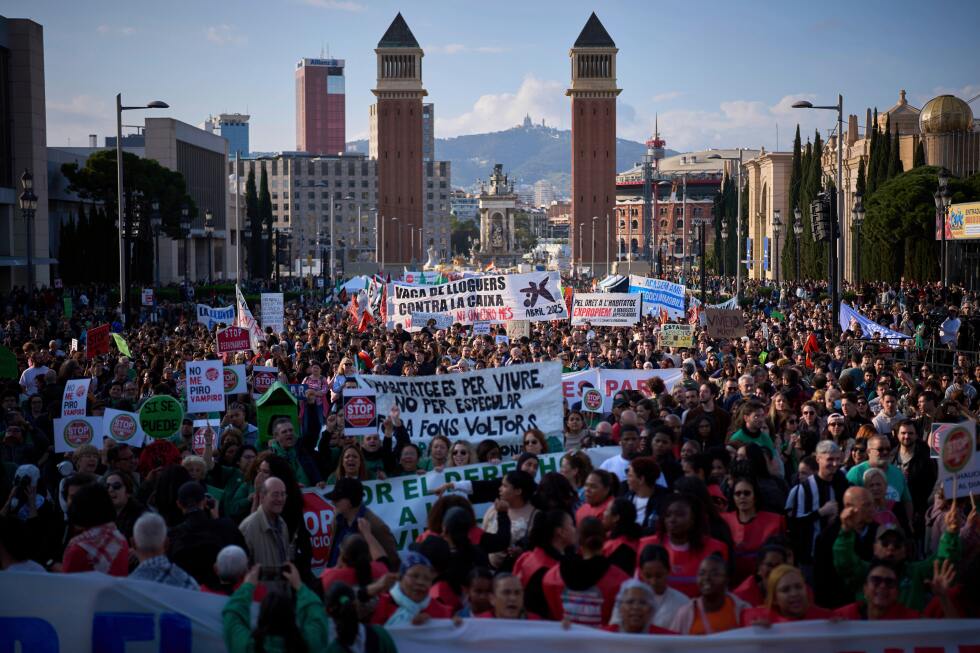
MADRID (AP) — Facing growing public anger over skyrocketing housing costs that have become one of Prime Minister Pedro Sánchez’s biggest political liabilities ahead of next year’s national elections, Spain’s central government greenlit a far-reaching €7 billion ($8.23 billion) strategy on Tuesday to address the country’s deepening housing insecurity.
Even as Spain has posted strong macroeconomic growth in recent years, swelling rental and purchase prices have pushed access to stable, affordable housing out of reach for millions of ordinary Spaniards, whose wages have failed to keep pace with the rate of housing inflation. Industry analysts point to two key structural factors worsening the supply crunch: the persistent demand for short-term vacation rentals driven by Spain’s massive tourism sector, and rapid urban population growth fueled by immigration that has stretched available housing stock in major cities far too thin.
The newly approved plan marks a major increase in public investment, tripling the government’s total spending on public housing development over the next four years. A core guardrail included in the policy blocks the common past practice of reclassifying subsidized public housing units for private ownership after just a few years, locking these affordable units into the public stock permanently. The plan also allocates targeted financial support for young renters and first-time home buyers struggling to enter the market.
Raluca Budian, associate director of the Observatory for Decent Housing at Madrid-based Esade business school, called the plan an important milestone for the country. “It is a significant step forward. For the first time in decades, there is a serious budgetary commitment,” Budian noted.
According to government breakdowns of the budget, 40% of the total €7 billion will go toward expanding the country’s extremely limited public housing supply, which currently lags far behind the European average. Thirty percent of the funds are earmarked for residential property renovations: this includes grants to upgrade existing homes to improve energy efficiency, and incentives for new housing construction in the parts of Spain that have faced decades of rural depopulation. The remaining 30% of the budget is dedicated to direct rental and down-payment subsidies, with a specific focus on supporting young people, who are disproportionately impacted by the housing crisis.
Housing consistently ranks as the top concern for Spanish voters in public opinion polling from state survey firm CIS, and Housing Minister Isabel Rodríguez framed the reform as a direct response to public demand. “The public is demanding an agreement to address the main problem currently affecting them,” Rodríguez said Tuesday.
Official data from the European Union’s statistics agency Eurostat shows housing costs in Spain rose nearly 13% year-on-year at the end of 2024, outpacing most other EU member states. When it comes to public rental housing, Spain ranks among the lowest of all Organization for Economic Co-operation and Development (OECD) countries, with public rental housing making up less than 2% of the country’s total housing supply. The OECD average across all member states sits at 7%, with far higher shares in peer Western European nations: 14% in France, 16% in the United Kingdom, and 34% in the Netherlands.
The legacy of past policy failures has contributed heavily to Spain’s current shortage. For decades, public funds were used to build housing that was later sold off to private owners, permanently removing those units from the national affordable housing stock. The new policy’s rule blocking future reclassification directly addresses this longstanding loophole.
Associated Press journalist Joseph Wilson contributed reporting from Barcelona.