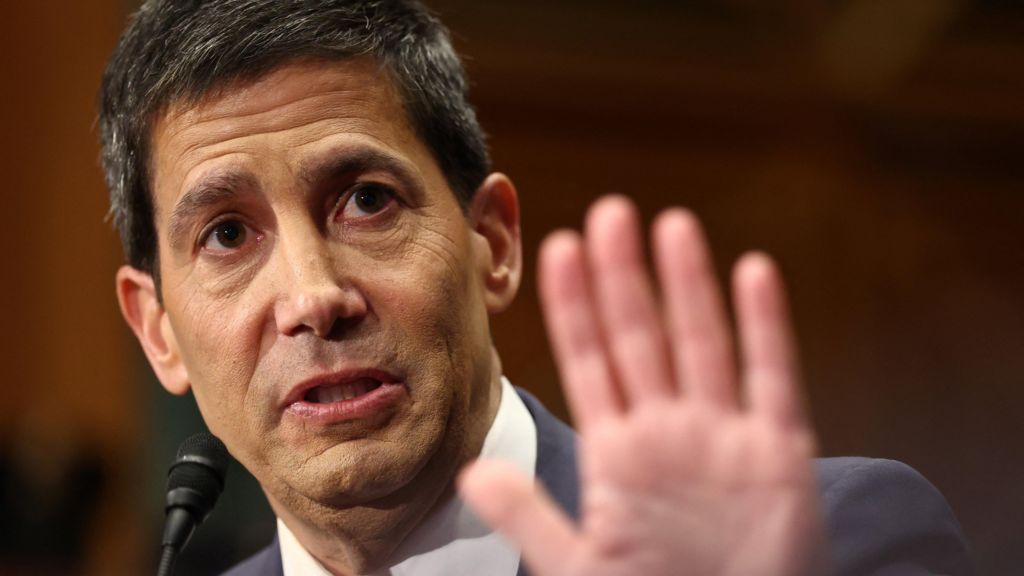
A contentious Capitol Hill confirmation hearing for Kevin Warsh, former Federal Reserve governor and U.S. President Donald Trump’s nominee to lead the Federal Reserve, devolved into sharp clashes between Warsh and Democratic lawmakers on Tuesday, with explosive allegations ranging from undue presidential influence to unanswered questions about ties to disgraced financier Jeffrey Epstein. The high-stakes showdown has put the future of the central bank’s long-held independence and U.S. monetary policy trajectory in the national spotlight.
Leading the opposition against Warsh was Senator Elizabeth Warren of Massachusetts, the top Democrat on the Senate Banking Committee that oversees the confirmation process. Warren opened with a searing accusation that Warsh would serve as nothing more than Trump’s “sock puppet” at the central bank, a claim that set the tone for the entire hearing. Trump has publicly pushed for deep interest rate cuts, arguing that looser monetary policy is required to stimulate continued growth in the U.S. economy, and has openly signaled he expects Warsh to align with his policy agenda if confirmed. Warren warned that placing a pliant leader in charge of the Fed would give Trump unprecedented access to the central bank’s policy tools, which he could exploit to enrich himself, his family, and his close allies in the Wall Street financial sector. When pressed directly on whether he would act as a loyalist to the president, Warsh pushed back firmly, telling the committee “Absolutely not.” He reaffirmed that the Federal Reserve’s institutional independence is non-negotiable and essential to its function, vowing to protect the central bank’s self-governance if he is confirmed to the post.
Beyond the question of political influence, Warren also pressed Warsh on his extensive undisclosed financial holdings and potential connections to Epstein, the convicted paedophile financier who died in prison while awaiting trial on sex trafficking charges. Warsh has publicly disclosed that his personal assets are worth hundreds of millions of dollars, including a stake in an investment fund valued at no less than $100 million. However, he has refused to detail the underlying assets held by that fund. In her questioning, Warren asked whether the fund holds stakes in companies linked to Trump or his family, entities that have been tied to money laundering, Chinese-controlled firms, or financing vehicles created by Epstein. Warsh declined to give a direct answer to the question, only stating that he plans to fully divest all of his conflicting financial holdings if and when he is officially confirmed to the chairmanship. Warsh’s name appears multiple times in Department of Justice court records connected to the Epstein case, though court officials have emphasized that a mention in the files does not inherently indicate any wrongdoing on Warsh’s part. Warsh also used the hearing to deny widespread reports that he had struck a quid pro quo deal with Trump: cutting interest rates in exchange for the Fed chair nomination. “The president never once asked me to commit to any particular interest rate decision, period, and nor would I ever agree to do so if he had, but he never did,” he stated. This denial was directly contradicted by Senator Ruben Gallego, an Arizona Democrat, who cited a 2025 Wall Street Journal report that claimed Trump had pressured Warsh to commit to lower borrowing costs during a private meeting. The hearing took place just hours after Trump told CNBC in an interview that he would be “disappointed” if Warsh did not move to cut interest rates immediately after taking office. Interest rate decisions made by the Federal Reserve ripple through every corner of the U.S. economy, impacting everything from residential mortgage rates and consumer auto loans to corporate borrowing costs for small and large businesses alike.
While support and opposition to Warsh’s nomination largely broke along partisan lines, the process hit an unexpected snag from within the Republican caucus: Senator Thom Tillis of North Carolina became the lone GOP member to withhold his support for the nominee. Notably, Tillis is not running for re-election in the upcoming cycle, and he clarified that he does not oppose Warsh personally, praising what he called Warsh’s “extraordinary credentials” for the role. However, Tillis has placed a hold on Warsh’s confirmation, demanding that a congressional inquiry into outgoing Fed Chair Jerome Powell over cost overruns on a Federal Reserve building renovation project be dropped before he will allow a vote on the nominee. Trump has had repeated public and private clashes with Powell over the Fed’s monetary policy over the course of his presidency. Tillis argued that the cost overruns, while “unfortunate”, were “legitimate”, citing unforeseen structural issues with the century-old existing building and global increases in construction material costs that drove up the final budget. If Warsh is not confirmed by May 15, the end date of Powell’s current term, Powell has stated he will remain in the post until a successor is confirmed. Tillis’s blockade makes it increasingly likely that Powell will stay on in the role beyond his scheduled term end.
Beyond the political clashes, Warsh used the hearing to outline his policy agenda for the central bank if confirmed, revealing plans to overhaul core Fed practices around inflation measurement and public communication of monetary policy. In his opening remarks, Warsh criticized the Fed’s longstanding practice of “forward guidance”, the system of public communications that signals the likely future path of interest rates to markets and the public. He argued that this policy has become “unhelpful” to market stability, saying he prefers “messier” Fed policy meetings that do not rely on “rehearsed scripts” for public announcements. Warsh also pledged to implement a “new inflation framework”, signaling that he plans to abandon the Personal Consumption Expenditures (PCE) price index that the Fed has relied on for decades to set its inflation targets. It remains unclear exactly what metrics Warsh would adopt to replace PCE, or how his new framework would change the Fed’s approach to monetary policy going forward. When pressed by Democratic Senator Lisa Blunt Rochester of Delaware on his previous calls for “regime change” at the Fed – with Rochester asking whether he planned to fire regional Fed presidents who participate in monetary policy voting – Warsh clarified that he was calling for change to policy frameworks, not a purge of sitting Fed officials.