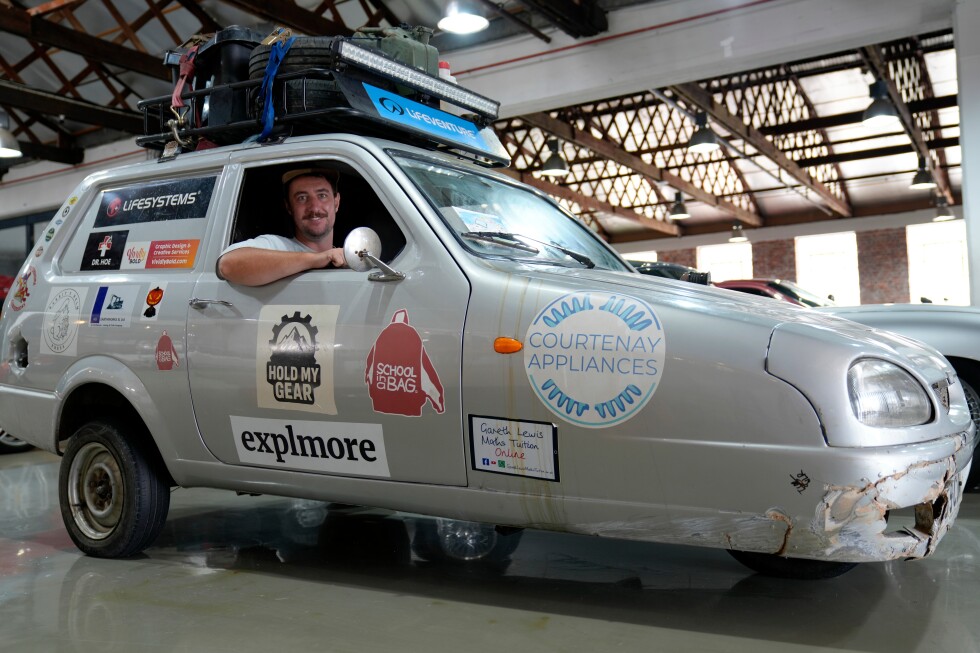
For most adventure seekers, a cross-continental road trip requires a sturdy, four-wheeled vehicle built to handle punishing terrain and extreme conditions. But for British car enthusiast Ollie Jenks and his Canadian friend Seth Scott, the appeal of their latest challenge lay in its sheer absurdity. What started as a wild proposal from Scott quickly became a once-in-a-lifetime expedition that would push the pair, and their vintage three-wheeled car, to the absolute limit.
The pair’s bold plan? Drive a half-century-old British-built Reliant Robin — a tiny three-wheeled vehicle originally designed for 1970s local grocery runs — from London all the way to Cape Town, South Africa. The 14,000-mile route would cut through 22 countries, traversing tropical jungles, rugged mountain ranges and scorching deserts along the way, all in pursuit of a new world record for the longest journey ever completed in a three-wheeled vehicle. For Jenks, the ridiculousness of the idea was exactly what made it impossible to turn down. “It was so ridiculous I couldn’t say no,” Jenks recalled of Scott’s initial pitch.
The Reliant Robin holds a unique cult status in British culture. Though production of the model ended in the early 2000s, it remains a beloved icon, largely thanks to its famous role as the Trotter brothers’ beat-up yellow van in the hit UK sitcom *Only Fools and Horses*. Even so, the small, underpowered vehicle is widely considered one of the least suitable cars for a multi-thousand-mile transcontinental expedition — and that was exactly the point for Jenks and Scott.
Dubbed “Sheila,” the silver Reliant they selected for the trip was one of the last models ever produced, acquired specifically for the adventure. When the pair set off in October, they brought little more than a spare can of fuel, a handful of essential supplies strapped to Sheila’s tiny roof, and a healthy dose of blind optimism that they would somehow reach South Africa. In a blunt assessment of the vehicle’s capabilities, Jenks noted: “No power steering, no air con, and it doesn’t do well up hills or down them. It is the most unsuitable car for probably any journey. We made friends with the designer of this car, and he’s scared to take it any more than 20 miles.”
Undeterred by warnings from even the car’s own designer, Jenks and Scott pressed ahead with the four-and-a-half month expedition, which cost an estimated $40,000 to $50,000, funded through a mix of sponsor support and crowdfunding. The pair documented every step of the journey on their Instagram page, fittingly titled “14,000 miles, 3 wheels, 0 common sense,” which quickly attracted a following of nearly 100,000 people tracking their progress.
The journey was far from smooth. The pair arrived in Benin in the middle of an attempted coup d’état, passed through northern Nigeria just as the U.S. launched airstrikes against Islamic State targets in the region, and required a 300-mile military escort through a separatist conflict zone in Cameroon. “Imagine this car in a military convoy,” Jenks joked.
Beyond political and security hazards, the pair faced constant danger on the road, including a heart-stopping moment when an overtaking bus nearly crushed Sheila against a Congolese cliff face. True to the Reliant’s reputation for unreliability, the vehicle suffered countless breakdowns across the continent’s rough, unpaved roads. Wheel springs needed replacing within the first two weeks of the trip. The gearbox failed in Ghana, leaving the pair stuck with only fourth gear for hundreds of miles. Clutch and distributor issues plagued the vehicle in Cameroon, before the expedition nearly ended entirely when Sheila’s engine blew out.
Against all odds, the kindness of local strangers and global Reliant Robin enthusiasts kept the dream alive. A local contact arranged for a new gearbox to be shipped to Ghana, while UK-based Reliant fans sourced and sent a replacement engine to Cameroon. On multiple occasions, locals helped tow the broken-down car to garages, often on improvised vehicles like cattle trucks. Mechanics across Africa spent hours welding, hammering and repairing Sheila to keep her running, many shaking their heads at the sheer madness of the pair’s mission.
For all the hardship and setbacks, the journey also delivered the breathtaking moments the pair had dreamed of. Sheila crawled across towering mountain passes and vast arid deserts, traversing terrain no Reliant Robin had ever reached. The three-wheeler even joined a safari, rolling alongside galloping giraffes, passing endangered rhinos, and posing for photos beside a massive African elephant.
More than 120 days after setting off, Sheila rattled into Cape Town last month, her engine having overheated in the Namibian Desert and running on borrowed power for the final 1,000 miles of the trip. For onlooker Graeme Hurst, a South African car enthusiast who followed the expedition on Instagram and traveled to see the pair arrive, the journey is a modern underdog story. “I see the farcical kind of comical nature of it … but also the sheer admiration. I mean, they have utter tenacity,” Hurst said.
In Cape Town, Sheila was given a temporary spot in a luxury car showroom, where she drew more attention than the gleaming Porsches and Mercedes parked around her, her broken side window, petrol-stained windshield, bent rims and countless dents and scratches a testament to her incredible journey. For now, Sheila will rest in South Africa for a full, well-deserved servicing before her final voyage: she will be driven to Kenya, shipped to Turkey, and eventually transported back to the UK, where she will take up permanent residence at the London Transport Museum.
After arriving in Cape Town, Jenks said he felt a deep sense of triumph, mixed with overwhelming relief to finally escape the car’s tiny two-seat cabin. “It was like driving a motorized coffin,” he joked.