A sudden diplomatic reversal following recent US-Iran talks in Islamabad has laid bare the dramatic new power dynamic reshaping Iran in the wake of six weeks of coordinated US-Israeli military strikes. On April 17, Iranian foreign minister and lead nuclear negotiator Abbas Araghchi took to the social platform X to announce that the strategically critical Strait of Hormuz was “completely open,” a signal that Tehran was prepared to show flexibility on two sticking points in negotiations: uranium enrichment limits and Iranian support for regional proxy armed groups.
Within days, however, that public outreach was completely reversed following backlash from Iran’s most powerful institution. Mohammad Bagher Zolghadr, a former Islamic Revolutionary Guards Corps (IRGC) commander newly appointed as secretary of Iran’s Supreme National Security Council, filed a formal complaint criticizing Araghchi for deviating from the negotiating mandate set by the IRGC leadership. The entire Iranian negotiating delegation was recalled to Tehran, state-run media launched scathing attacks on Araghchi, warning that his public statement had handed then-US President Donald Trump a political opening to falsely declare victory in the conflict, and the Iranian government issued a new declaration that the Strait of Hormuz was closed.
This high-profile public clash is not an isolated misstep, argues King’s College London defense studies associate professor Andreas Krieg in analysis shared via The Conversation. It is the clearest visible indicator of a permanent power shift that has transformed Iran’s political order: the IRGC now holds total control over all state decision-making, while civilian and traditional religious institutions have been reduced to little more than a ceremonial facade.
The decapitation strikes that opened the US-Israeli military campaign eliminated decades of entrenched Iranian leadership. Supreme Leader Ali Khamenei was killed in the opening day attack, alongside dozens of his most senior colleagues. Where Iran was once described as a sovereign state with an exceptionally powerful militia, Krieg argues the new reality is the opposite: Iran is now a powerful militia with a state, structured entirely around the IRGC as its core governing authority.
Traditional centers of Iranian power, including the elected civilian government and the senior Shia clergy, have been pushed to the margins as mere front organizations. Even the newly appointed supreme leader, Mojtaba Khamenei, son of the late Ali Khamenei, functions only as a symbolic legitimizing figure. Multiple reports confirm Mojtaba Khamenei sustained severe injuries in the strike that killed his father, and he plays no active role in governing the country.
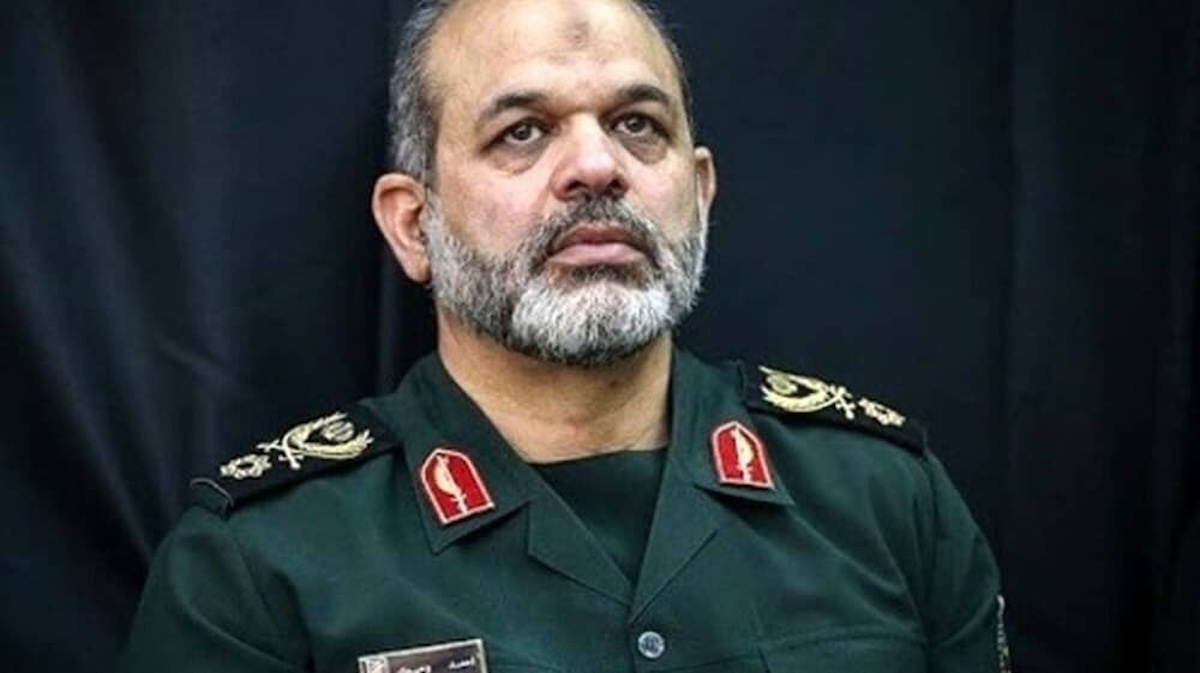
The undisputed holder of power in contemporary Iran is IRGC leader Ahmad Vahidi, a founding member of the corps with decades of experience in Iranian security and politics. The IRGC was founded immediately after the 1979 Islamic Revolution, when Ayatollah Ruhollah Khomeini and his allies distrusted the existing conventional military and state bureaucracy to protect the new revolutionary order. Over the subsequent 47 years, the IRGC expanded far beyond its original mandate as guardians of the revolution, evolving into an all-encompassing network that spans every sector of Iranian life: it operates a conventional military force, a domestic intelligence apparatus, a multi-billion dollar transnational economic conglomerate, and a regional expeditionary network that projects Iranian power across the Middle East.
Its domestic arm, the Basij militia, enables mass social control across Iran’s population, while the elite Quds Force manages the IRGC’s network of proxy armed groups across Lebanon, Iraq, Syria, Yemen and other regional states. Far from dismantling this network, decades of international sanctions against Iran actually strengthened it: sanctions pushed the IRGC to build a sprawling web of front companies for illicit trade and patronage networks that enriched IRGC-aligned elites, creating a parallel state that gradually outgrew the formal civilian government in both power and influence.
The IRGC’s organizational structure is built around a “mosaic defense doctrine,” a decentralized network design with a centralized core that sets strategic direction, surrounded by semi-autonomous cells that can continue operating even after decapitation strikes that eliminate top leadership. This structure was explicitly designed to allow the IRGC to keep functioning even when facing large-scale military attacks targeting its command structure, a design that has been vindicated by recent events.
After IRGC chief Mohammad Pakpour was killed on the opening day of the conflict, Vahidi— a former Iranian interior minister and founding IRGC figure— stepped into the top role in an emergency appointment. He has since consolidated full control over Iranian governance as civilian institutions have been hollowed out by war losses. With the new supreme leader incapacitated and the clergy sidelined, Vahidi and his coalition of hardline IRGC commanders and security council allies, including Ali Akbar Ahmadian and Zolghadr, now set all negotiating mandates and red lines for ongoing ceasefire and nuclear talks with the United States.
The IRGC’s non-negotiable red lines are well-defined: it will not abandon its uranium enrichment program entirely, it will preserve its ballistic missile program and its regional network of proxy groups (known as the “axis of resistance”), it demands full lifting of international sanctions and the unfreezing of billions of dollars in Iranian overseas assets. Only narrow technical details, such as enrichment level limits, sanctions lifting timelines, and the formal language of any final agreement, are open to negotiation.
The decimation of pragmatic Iranian political figures in Israeli strikes has cleared the last remaining obstacles to IRGC control. Former Supreme National Security Council secretary Ali Larijani, a leading pragmatic voice, was killed by an Israeli strike on March 16, leaving no prominent opposition to the IRGC’s hardline agenda. While the war accelerated the IRGC’s consolidation of power, Krieg notes this shift was decades in the making: the IRGC spent generations entrenching its influence across Iranian institutions, capturing economic assets, and building up its coercive capacity. The war only provided the final opportunity to eliminate competing power centers, most notably the senior clergy, and solidify total control.
This new power structure has profound implications for ongoing US-Iran negotiations. US negotiators are not bargaining with independent civilian diplomats; every Iranian negotiator operates on a short leash held directly by the IRGC leadership. Any progress in talks cannot be measured by public statements from Iranian diplomats, but only by what the IRGC is actually willing to implement in practice.
The US-Israeli decapitation strategy failed to break the IRGC’s structure, and the hardline network now finds itself emboldened, as it recognizes the White House is desperate to secure a diplomatic exit from the conflict. Krieg argues that assumptions the IRGC will quickly capitulate to US demands are unfounded wishful thinking.
Recent events have confirmed that the IRGC now governs Iran as a militia with a state, using the formal civilian and religious institutions of the Islamic Republic as a public outer layer. While there remains space for negotiation to reach a mutually acceptable agreement, the US administration must approach talks with a clear-eyed understanding of the IRGC’s non-negotiable red lines, and the resilience of a hardened network that has repeatedly demonstrated it can absorb severe punishment and maintain control.