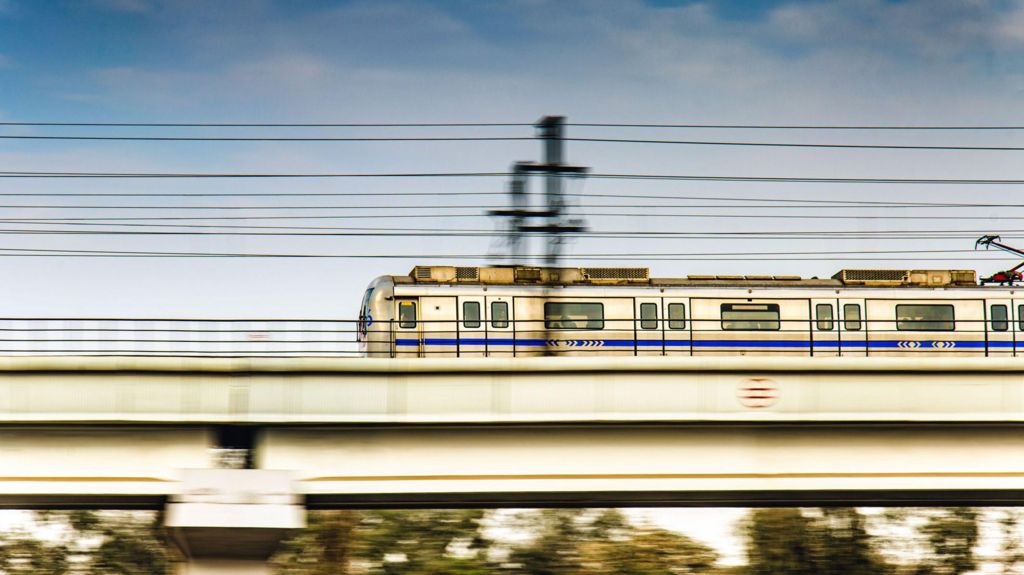
Over the past decade, India has embarked on one of the world’s most ambitious urban transit expansion programs, pouring more than $26 billion into building metro networks across 22 major and mid-sized cities under the national government led by Prime Minister Narendra Modi. From 2014 to 2025, the total length of operational metro lines across the country surged fourfold, climbing from less than 300 kilometers to over 1,000 kilometers, with average daily ridership also jumping from 3 million to more than 11 million. But these impressive national aggregate figures hide a persistent, troubling trend: the vast majority of new metro corridors are failing to come even close to hitting the ridership projections that were used to justify their construction, according to multiple independent studies and transport experts.
Take Mumbai’s new fully underground Aqua Line, for example. Opened in 2024, the 33.5-kilometer line connects the historic Cuffe Parade business district to the commercial hub of Bandra-Kurla Complex and the northern suburb’s airport terminals. Planners projected the corridor would ease chronic road congestion in India’s financial capital and carry roughly 1.5 million passengers every single day. But current estimates put actual daily ridership at just 10% of that target. On a recent weekday evening, the train nearly emptied out before its final stop, leaving the terminal looking more like a deserted, outdated Soviet-era infrastructure site than a bustling transit hub in one of the world’s most densely populated cities. “Not a lot of people are using the line. It’s too expensive,” a ticketing agent at the Cuffe Parade terminal told the BBC, summing up a common complaint across the country.
A 2023 study from the Indian Institute of Technology (IIT) Delhi found that across all new Indian metro corridors, actual ridership hits only 25% to 35% of the original projected numbers. One of the study’s lead authors confirmed that these figures have not improved meaningfully in 2024 and 2025. Independent research from other organizations backs up these findings. The Observer Research Foundation (ORF), a New Delhi-based think tank, reports that ridership in the tier-3 city of Kanpur is just 2% of the original projection, while Chennai’s first phase of metro hit only 37% of its target. Data shared with the BBC by the Institute for Transportation and Development Policy (ITDP) shows actual ridership falls between 20% and 50 of projections in western Indian cities Pune and Nagpur. Only Delhi, home to India’s largest and oldest metro network, has reported ridership that slightly exceeds initial projections—but experts note this is a statistical quirk: Delhi now counts interchanges between lines as separate trips, inflating the official total.
Transport analysts have identified a web of interconnected factors driving the persistent underperformance, starting with flawed demand forecasting. Ashish Verma, a transport expert at the Indian Institute of Science’s Sustainable Transportation Lab in Bengaluru, explains that projecting transit demand is a complex task, and consultants often inflate projected ridership numbers to make new projects appear economically viable to secure approval. Many forecasts also rely on assumptions about service capacity—such as train frequency and total number of coaches—that are never delivered in practice. For example, on Bengaluru’s busiest metro line, peak-hour trains run only every five minutes or more, while a newer line sees trains just once every 25 minutes. By comparison, the world’s busiest metro systems typically run nine-car trains every 90 seconds during peak periods.
Affordability is a second major barrier to higher ridership, particularly for low-income workers who make up a large share of potential urban commuters. On Mumbai’s Aqua Line, a single trip costs between 10 and 70 rupees ($0.10 to $0.70), while a three-month unlimited pass on the city’s established, overcrowded suburban railway costs just 590 rupees total—far less than the equivalent metro pass. Aditya Rane, senior transport specialist at ITDP, notes that for the lowest-income Indian commuters, the total cost of an integrated metro journey can consume up to 20% of their monthly income, well above the global affordability benchmark of 10% to 15%. In recent years, many Indian metro systems have cut government subsidies to cover construction costs, a move that has hit ridership hard: when Bengaluru raised metro fares in 2024, daily ridership dropped 13% in the following months, according to data collated by Greenpeace. “Even the London Tube, one of the world’s most expensive urban transit systems, still receives heavy government subsidies, because the core goal is to provide sustainable mobility and decongest cities,” Verma points out.
Poor network planning and a lack of usable last-mile connectivity also keep ridership low. Nandan Dawda, an urban studies fellow at ORF, explains that commuters will only switch from private vehicles or informal transit to metro if waiting and access times are kept to a minimum. A major missing piece across most Indian cities is affordable, reliable feeder bus service that connects residential and employment hubs to metro stations. Transfer times between different metro lines within the same network are also often unacceptably long: at Delhi’s busy Hauz Khas interchange, transferring between two lines can take 15 to 20 minutes. Compounding this is what Dawda calls “institutional disaggregation”: even within a single city, metro lines and local bus networks are often run by separate, siloed agencies that do not coordinate on scheduling, ticketing, or route planning to create a seamless experience for commuters.
Additional barriers include poorly maintained pedestrian walkways leading to stations and widespread safety concerns, particularly for women commuting after dark. For many residents, the end of a metro journey is only the start of a difficult, unsafe trip home. “If I am coming home after sunset, I cannot rely on the metro,” said Chetna Yadav, a 40-year-old resident of north Delhi. “The station is 15 kilometers from my house, and when I get off at night, it’s almost impossible to get a cab. I’ve been stuck there multiple times.” Even casual tourists struggle: “If I’m a tourist even in Delhi, I can’t drag my suitcase half a kilometer from the station to my hotel because the walkways are in such bad shape,” Verma says.
Despite these systemic challenges, most transport experts expect Indian metro ridership to continue climbing incrementally in coming years. Chronic traffic gridlock, worsening air pollution, and soaring parking costs have already reached a breaking point in most major Indian cities, and pressure is growing to introduce congestion pricing for private vehicles, which would push more commuters to consider public transit. But experts agree that a dramatic, rapid increase in adoption is unlikely without major systemic reforms. “Metro systems will only see strong ridership growth if cities get three things right: integrated bus connectivity, safe, accessible station access, and unified, affordable ticketing,” Rane says. “Without those changes, India will keep building gleaming new metro lines that look impressive on paper, but continue to fall far short of their original goals.”