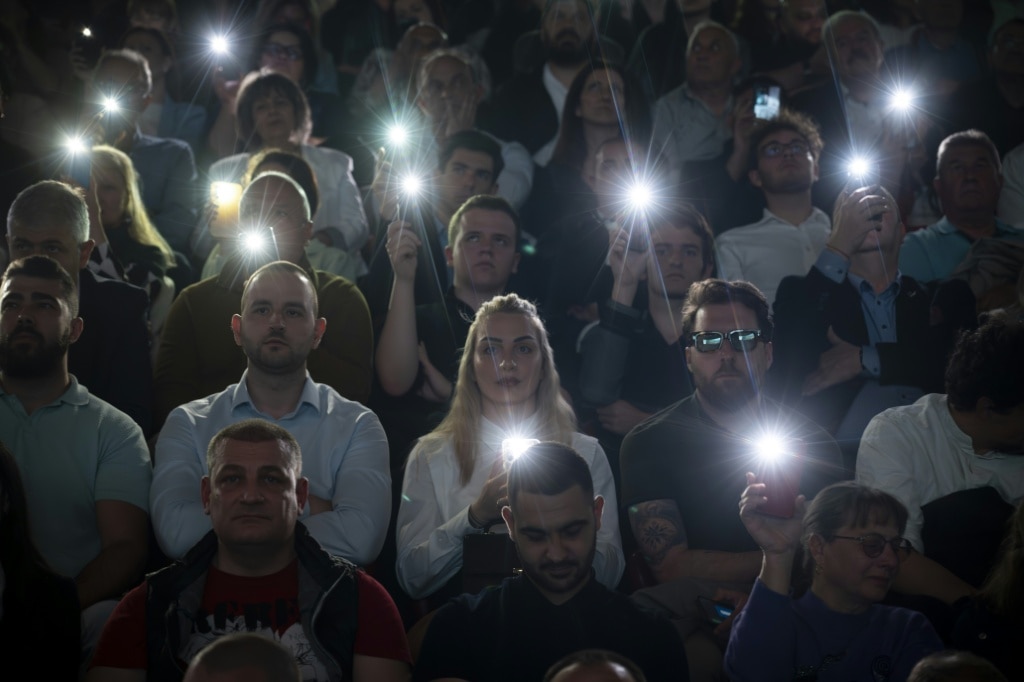
On Sunday, Bulgaria went to the polls for its eighth national election in five years, a historic stretch of political gridlock triggered by years of mass anti-corruption mobilization that has toppled one government after another across the Balkan nation. As the European Union’s poorest member state, Bulgaria has entered this prolonged period of instability after 2021, when widespread public protests against graft ended the 10-year near-continuous rule of veteran conservative leader Boyko Borissov, and no administration has managed to hold a stable majority since.
Leading the race going into election day is the newly formed centre-left bloc Progressive Bulgaria, headed by former nine-year president Rumen Radev. A former air force general who stepped down from the presidency in January to lead his electoral alliance, Radev has campaigned on a hardline platform of rooting out systemic corruption and dismantling what he calls Bulgaria’s long-standing “oligarchic governance model”. His anti-corruption rhetoric has resonated with a public deeply frustrated by persistent graft: it was the latest wave of anti-corruption protests in late 2024 that brought down the previous conservative-backed government, clearing the way for this snap vote. Pre-election opinion polls put Radev’s bloc on track to win roughly 35% of the popular vote, positioning it as the clear front-runner to form the next government.
Radev’s foreign policy positions have become a central point of controversy in the campaign. Unlike most major Bulgarian pro-European parties, Radev has openly called for restoring closer bilateral ties with Moscow, has repeatedly voiced opposition to Bulgarian military aid for Ukraine following Russia’s 2022 full-scale invasion, and recently publicly condemned a 10-year defense cooperation agreement between Sofia and Kyiv signed last month. He drew widespread outrage from political opponents during his final campaign rally when he displayed photos of his past meetings with Russian President Vladimir Putin to a crowd of 10,000 cheering supporters. Radev has also publicly rejected the European Union’s current green energy framework, calling it naive in what he frames as an unpredictable “world without rules”, though he has clarified he would not use Bulgaria’s veto power to block collective EU policy decisions.
Coming in second in pre-election polling is Borissov’s long-standing pro-European conservative party GERB, which is projected to win roughly 20% of the vote, outpacing the centrist liberal coalition PP-DB. Borissov, who led Bulgaria from 2009 to 2021, has pushed back against Radev’s narrative of radical change, arguing that his party delivered on the core ambitions of 1990s post-communist transition, most notably securing Bulgaria’s accession to the eurozone in 2025. Speaking at his final campaign events, Borissov dismissed Radev as offering no meaningful new agenda for the country.
Voters interviewed by AFP on election day expressed a wide range of frustrations and hopes. Many voters aligned with Radev’s anti-corruption message: 57-year-old Sofia resident Decho Kostadinov told reporters after casting his ballot that he voted for change, arguing that corrupt politicians “should leave — they should take whatever they’ve stolen and get out of Bulgaria”. Dozens of voters lined up outside polling stations in Sofia even before voting began at 7 a.m. local time. Other voters, like 60-year-old Sofia accountant Elena, who backed Borissov’s party, said she voted to “preserve what we have”, noting “we are a democratic country, we live well”.
Still, many Bulgarian voters remain deeply disillusioned with the entire political class. 55-year-old taxi driver Miglena Boyadjieva, who showed up to vote, summed up a common sentiment: “The problem is that there is no one to vote for. You vote for one person and get others. The system has to change.” Public distrust in political institutions has dragged down voter turnout in recent cycles, hitting a low of just 39% in 2024’s last election. However, polling analyst Boryana Dimitrova of the Alpha Research institute noted that Radev’s high-energy campaign has mobilized frustrated voters, leading analysts to predict a higher turnout on Sunday.
Authorities have stepped up efforts to combat systemic vote buying, a long-standing issue in Bulgarian elections. In coordinated raids over recent weeks, police seized more than 1 million euros in illicit campaign funds and detained hundreds of people, including sitting local councillors and municipal mayors. Political parties across the ideological spectrum have urged voters to turn out to the polls, in part to dilute the impact of vote buying on the final result.
Polling stations closed at 17:00 GMT on Sunday, with exit polls expected immediately after voting concludes. Official final results are not expected to be released until at least Monday. Radev has announced he is aiming to secure an absolute majority in the 240-seat National Assembly, a result that would allow his bloc to form a government alone without entering coalition negotiations with rival parties.