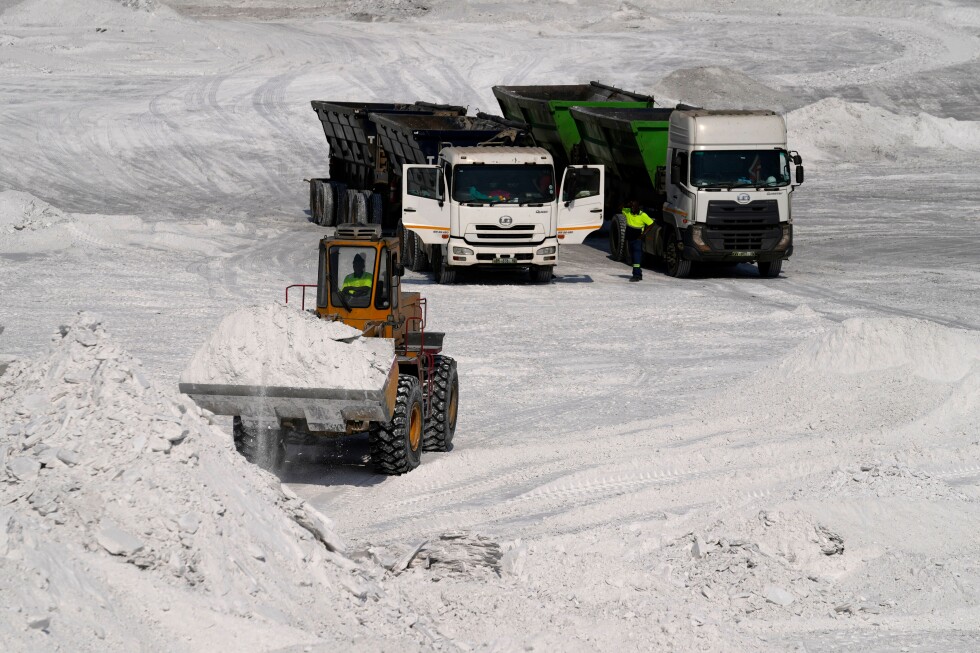
In the small South African town of Phalaborwa, two massive, sand-like dunes of industrial waste have become the focal point of a high-stakes U.S.-supported initiative to unlock a new supply of rare earth elements — minerals critical to modern high-tech manufacturing that the U.S. currently relies heavily on its top economic rival, China, to provide.
The Phalaborwa Rare Earths Project, led by UK-founded firm Rainbow Rare Earths, secured a $50 million equity investment from the U.S. International Development Finance Corporation (DFC), a U.S. government agency established during the first Trump administration. The commitment was formalized in 2023 under the Biden administration, but the current second Trump administration has opted to advance the work despite a sharp recent diplomatic rift between the U.S. and South Africa. Shortly after Trump returned to office in February this year, he issued an executive order freezing all U.S. financial aid to South Africa, but strategic economic priorities have overridden that diplomatic friction for the project. The DFC has framed its involvement in Phalaborwa as part of a broader goal to unlock Africa’s untapped mineral wealth while advancing core U.S. strategic interests.
Rare earth elements, a group of 17 chemically similar metals, are a key subset of the dozens of critical minerals that major global economies have identified as irreplaceable for manufacturing everything from smartphones and robotics to defense systems, electric vehicle motors and wind turbine generators. Expanding domestic and allied access to these critical minerals has been a signature policy priority for Trump across both of his presidential terms, with the current administration announcing this year it will allocate nearly $12 billion to establish a U.S. strategic reserve of these materials.
Unlike most rare earth projects that develop new ore deposits, Phalaborwa plans to extract its target minerals from 35 million tons of phosphogypsum, a waste byproduct left behind from decades of phosphate rock processing for fertilizer and industrial acid production at the site. Extraction is targeted to launch in 2028, with construction of the on-site processing facility scheduled to begin in early 2027 — and the $50 million DFC investment will only be disbursed once construction gets underway. The project is projected to operate for 16 years, producing high-demand rare earths including neodymium, praseodymium, dysprosium and terbium, all core components of high-performance magnets for clean energy and defense technologies.
Rainbow Rare Earths chief executive George Bennett told the Associated Press the project’s output will be primarily destined for the U.S. market, noting that American interest in the initiative is heavily tied to national defense supply chains. Project director Alberto Bruttomesso explained that the pre-processing of the waste material by former owners of the site eliminates one of the most costly steps in rare earth extraction, meaning the project can operate as a low-cost producer on par with Chinese mining operations. The firm also says up to 90% of the energy used for extraction will come from renewable sources, bringing the project’s environmental footprint far below that of traditional rare earth mining.
While rare earth elements are geologically relatively common around the world, they typically appear in very low concentrations and require complex, expensive separation and processing, which has left the global market dominated by China for decades. Industry analysts note that the Phalaborwa project is unique in its experimental approach of extracting minerals from existing above-ground waste, but its long-term potential remains unproven.
Neha Mukherjee, research manager at industry analyst firm Benchmark Mineral Intelligence, noted that the project’s low operational and capital costs are a major advantage, adding that it fills a pressing gap in global supply. “We do not have enough projects to meet the entire demand outside of China,” Mukherjee explained.
The Phalaborwa initiative is just one part of a broader, sustained push by the U.S. to expand its access to rare earth and critical mineral supplies, both at home and abroad. Beyond domestic mining investments, the Trump administration has pursued critical mineral deals in Ukraine, and has repeatedly signaled interest in acquiring Greenland largely due to the Arctic island’s large untapped rare earth reserves. In Africa, where China has long held the position of the dominant foreign investor in mining, the U.S. is actively working to catch up, according to mining specialist Patience Mususa of the Nordic Africa Institute in Sweden.
Other recent U.S.-backed rare earth projects on the continent include a $1.8 million feasibility study grant from the U.S. Trade and Development Agency for the Monte Muambe rare earth project in Mozambique, signed in February. The Trump administration is also continuing to fund the Lobito Corridor, a Biden-era infrastructure initiative to build a 1,290-kilometer railway connecting the mineral-rich interior of the Democratic Republic of Congo and Zambia to the Atlantic coast, designed to open up new export routes for African critical minerals to Western markets.