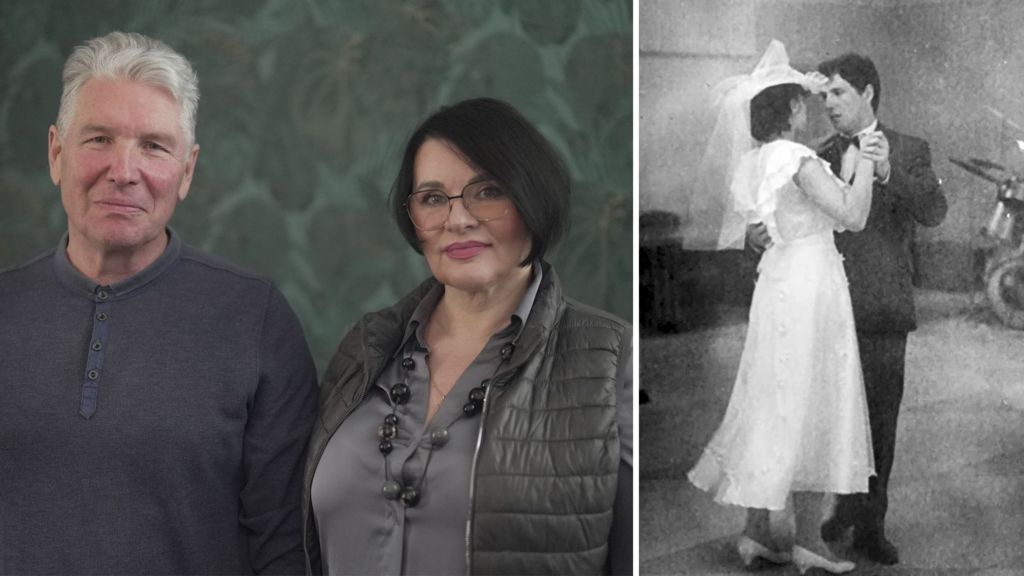
On the cusp of their wedding day in April 1986, 19-year-old trainee teacher Iryna Stetsenko and 25-year-old nuclear power plant engineer Serhiy Lobanov had every reason to look forward to their future. The young couple were building their life in Pripyat, a purpose-built, newly constructed Soviet city constructed to house workers of the nearby Chernobyl Nuclear Power Plant. What they could not know that night was that 4 kilometers from their apartment, the world’s worst nuclear disaster was already unfolding.
It was just after midnight when Iryna, who had just finished polishing her nails for the ceremony, stepped out onto her balcony and heard an unfamiliar, deep rumble. “It was as if a hundred planes were roaring overhead, everything hummed, and every window pane shook,” she recalled. Serhiy, sleeping on a kitchen mattress in a relative’s apartment full of wedding guests, felt a low, rolling wave that he mistook for a minor earthquake before drifting back to sleep.
When dawn broke on April 26, Serhiy woke full of excitement for his sunny wedding day. As he ran pre-ceremony errands, he noticed signs that something was very wrong: soldiers in gas masks patrolled the streets, workers hosed down roads with foamy decontamination solution, and colleagues from the plant told him they had been called in urgently for an emergency they could not explain. Glancing across the city, he could see dark smoke billowing from the damaged Reactor Number Four. What would later become clear is that firefighters and plant workers had spent the entire night fighting a massive toxic blaze, absorbing potentially lethal doses of radiation to contain the disaster.
Though anxiety prickled at him, Serhiy continued with his plans. He found the city market nearly deserted on what was usually a busy Saturday morning, and picked five simple tulips for his bride. Back at Iryna’s apartment, her mother had spent the night fielding frantic calls from neighbors warning of an unspecified catastrophe, but Soviet information controls kept any details of the accident from being released. When Iryna’s mother called local authorities for answers, officials insisted all scheduled city events proceed as planned. Schools stayed open, and the wedding went forward.
The wedding party processed in a line of cars to Pripyat’s Palace of Culture, the city’s central venue for both state ceremonies and popular local discos. The couple exchanged their vows standing on a cloth embroidered with their names, then moved to a nearby café for their wedding banquet. But the joy of the day was swallowed by uncertainty. “Everyone knew something terrible had happened, but nobody knew what it was,” Serhiy said. The couple had practiced a traditional waltz for their first dance, but as the weight of the unfolding tragedy settled over them, they lost the rhythm almost immediately. “We just hugged each other and stayed that way, moving together in the hug,” Iryna remembered.
By the early hours of Sunday, just hours after they were married, the couple were warned to evacuate immediately: a mandatory evacuation train was set to depart Pripyat at 5 a.m. Iryna only had a thin celebration dress with her, so she slipped her voluminous wedding dress back on to run back to her mother’s apartment to pack. Her new shoes had already given her blisters, so she ran barefoot through rain puddles, wedding dress trailing behind her. As their train pulled out of the station in the pre-dawn dark, they could see the glowing, collapsed reactor against the sky. Serhiy described it as “looking straight into the eye of an active volcano.” Authorities told evacuees the displacement would only last three days. The couple never returned.
The 1986 Chernobyl explosion, which occurred in what is now northern Ukraine, was caused by a catastrophic failed safety test. The International Atomic Energy Agency and World Health Organization estimate the blast released 400 times more radioactive material than the atomic bomb dropped on Hiroshima. The Soviet Union faced widespread international condemnation for its slow, opaque response: it only confirmed the accident two days later, after Swedish nuclear monitors detected abnormal radiation drifting across Western Europe, and Soviet leader Mikhail Gorbachev did not address the disaster publicly for more than two weeks.
Nikolai Solovyov, a lead turbine engineer on shift at the plant when the explosion hit, described the moment: “It felt like an earthquake under our feet. We saw the roof collapsing, a blast of hot air rushed toward us carrying thick black dust, and then the sirens started.” He and his colleagues rushed to the site assuming a generator had exploded, never imagining the reactor itself had blown. One worker’s dosimeter registered radiation levels far beyond its measuring capacity. They found a colleague alive but vomiting, a clear sign of acute radiation sickness—he was among the first to die from the disaster.
The official death toll in the immediate aftermath of the accident stands at 31: two killed directly by the blast, 28 who died from acute radiation sickness in the weeks that followed, and one fatality from cardiac arrest. The long-term death toll remains fiercely contested: a 2005 UN agency study estimated up to 4,000 people may eventually die from radiation-related causes, while other independent estimates put the number as high as tens of thousands.
To contain the spreading radiation, Soviet authorities launched a massive clean-up operation, mobilizing hundreds of thousands of “liquidators” from across the union to stabilize the site and clear radioactive debris. Extreme radiation levels fried electronic equipment, forcing many workers to clear toxic debris by hand in short shifts designed to limit lethal exposure. Jaan Krinal, one of dozens of liquidators deployed from Soviet-era Estonia, recalled wearing 20+ kilograms of lead plating for protection, plus a construction helmet, goggles, and a dosimeter tucked in his pocket. He and fellow Estonian liquidator Rein Klaar worked in 60-second bursts on the roof of Reactor Three, with no time to process the danger they faced. “Nobody could tell us what was what,” Rein said. “There was no time to think.”
In the months after the evacuation, Iryna and Serhiy were staying with Iryna’s grandmother 300 kilometers away in the Poltava region, east of Kyiv, when doctors made an unexpected discovery: Iryna was three months pregnant. Evacuated women were broadly warned that radiation exposure could harm fetuses, and many were advised to terminate pregnancies. “I was scared to have the baby, and scared to have an abortion,” Iryna remembered. But one supportive female doctor encouraged her to carry the pregnancy to term, and later that year, Iryna gave birth to a healthy daughter, Katya. Today, Katya is a mother herself, and the couple have a 15-year-old granddaughter.
Four decades on, the legacy of the Chernobyl disaster stretches across generations, and new upheaval has again upended the lives of those who survived it. The site of the explosion has become an active war zone following Russia’s 2022 full-scale invasion of Ukraine. In 2022, Russian tanks seized the Chernobyl plant complex, holding staff hostage for five weeks, laying mines, and digging defensive trenches across contaminated land. In 2025, a drone strike punched a hole in the 1.6 billion USD safety shield installed over Reactor Four in 2016, replacing an unstable original concrete sarcophagus. While radiation levels did not spike after the strike, the International Atomic Energy Agency has confirmed the shield can no longer perform its primary safety function. The plant requires constant monitoring and maintenance to prevent further radiation leaks.
Much of the 1,000-square-mile Chernobyl Exclusion Zone is now safe for short-term visitor tours, but permanent settlement remains banned, and hotspots of deadly contamination remain in areas like the Red Forest, a stand of pine trees killed by radiation that remains heavily toxic. Pripyat, once celebrated as a beacon of Soviet technological progress and youthful optimism, is now a crumbling ghost city. The Palace of Culture where Iryna and Serhiy married stands abandoned and derelict, succumbing to decades of neglect.
For Iryna and Serhiy, displacement became a second reality in 2022, after a Russian missile struck their daughter’s Kyiv apartment. The couple fled Ukraine for a new life in Berlin, forced to uproot their lives for the second time—once for a nuclear disaster, once for war. Though they suspect radiation exposure has contributed to long-term health issues Iryna has endured, including two total knee replacements, and a 2016 heart attack Serhiy suffered, their four-decade marriage has become their anchor through every crisis.
“I think we really had to go through so many difficulties in life to understand that we really can’t be one without the other,” Iryna said. “After 40 years, I can say with certainty that we are like a thread and a needle. We do everything together.”
This story accompanies new BBC programming marking the 40th anniversary of the Chernobyl disaster. UK viewers can watch *What Happened at Chernobyl* on BBC One at 8:30 p.m. on April 20, with streaming available on BBC iPlayer from 6 a.m. the same day. *The Last Dance Floor in Chernobyl*, a podcast telling the full story of Iryna and Serhiy’s wedding against the backdrop of disaster, will also be released.